Tag

Ends

Browsing


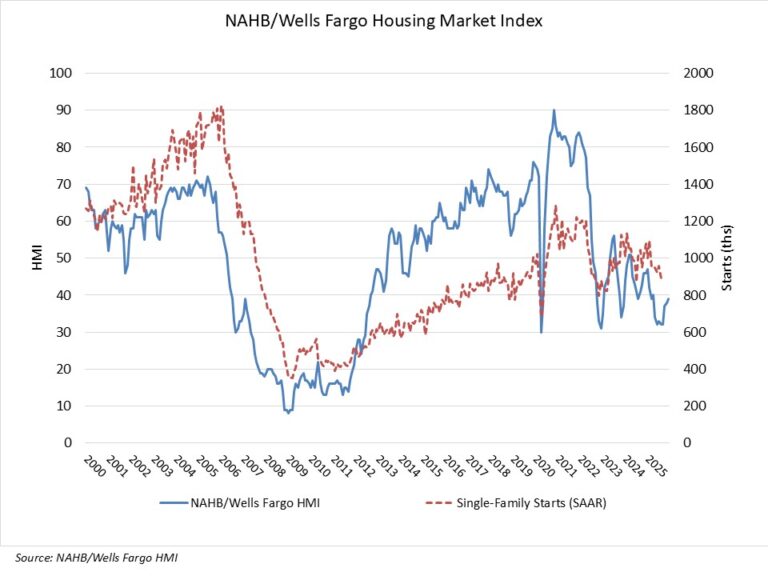
Builder confidence inched higher to end the year but still remains well into negative territory as builders continue to grapple with rising construction costs, tariff and economic uncertainty, and many potential buyers remaining on the sidelines due to affordability concerns.

Builder confidence in the market for newly built single-family homes rose one point to 39 in December, according to the National Association of Home Builders (NAHB)/Wells Fargo Housing Market Index (HMI). Sentiment levels were below the breakeven point of 50 every month in 2025 and ranged in the high 30s in the final quarter of the year.

Market conditions remain challenging with two-thirds of builders reporting they are offering incentives to move buyers off the fence.

In positive signs for the market, builders report that future sales expectations have been above the key breakeven level of 50 for the past three months and the recent easing of monetary policy should help builder loan conditions at the start of 2026. However, builders continue to face supply-side headwinds, as regulatory costs and material prices remain stubbornly high. Rising inventory also has increased competition for newly built homes.

In a further sign of ongoing challenges for the housing market, the latest HMI survey also revealed that 40% of builders reported cutting prices in December, marking the second consecutive month the share has been at 40% or higher since May 2020. It was 41% in November. Meanwhile, the average price reduction was 5% in December, down from the 6% rate in November. The use of sales incentives was 67% in December, the highest percentage in the post-Covid period.

Derived from a monthly survey that NAHB has been conducting for more than 40 years, the NAHB/Wells Fargo HMI gauges builder perceptions of current single-family home sales and sales expectations for the next six months as “good,” “fair” or “poor.” The survey also asks builders to rate traffic of prospective buyers as “high to very high,” “average” or “low to very low.” Scores for each component are then used to calculate a seasonally adjusted index where any number over 50 indicates that more builders view conditions as good than poor.

The HMI index gauging current sales conditions increased one point to 42, the index measuring future sales rose one point to 52 and the gauge charting traffic of prospective buyers held steady at 26.

Looking at the three-month moving averages for regional HMI scores, the Northeast fell one point to 47, the Midwest rose two points to 43, the South increased two points to 36 and the West gained four points to 34.

The HMI tables can be found at nahb.org/hmi.

Editor’s Note: With the official 2026 release schedule for the Survey of Construction still unavailable from the U.S. Census Bureau, NAHB confirms the HMI for January 2026 will be released on January 16.  A schedule for the rest of the year will be available as soon as possible.


This article was originally published by a eyeonhousing.org . Read the Original article here. .

The continued shortage of existing homes for sale has helped to keep new single-family construction growing across all regions, according to the latest National Association of Home Builders release of the Home Building Geography Index (HBGI). Despite persistent factors that continue to affect housing affordability, including a limited supply of buildable lots, rising construction costs, and a shortage of skilled labor, single-family construction grew over all four quarters of 2024. Multifamily construction remained lackluster but did feature some growth in lower density areas.

Single-Family

All HBGI-tracked geographies posted another quarter of growth in the fourth quarter after peaking in the second quarter. The HBGI is constructed using permit data, which has continued to post higher volumes than last year despite residential construction dealing with persistent structural issues.

Among the HBGI geographies, the highest growth in the fourth quarter of 2024 was registered in small metro core counties, which increased 10.3% year-over-year on a four-quarter moving average basis (4QMA). The market with the lowest level of growth was non metro/micro counties which were up 4.8% year-over-year (4QMA).

In terms of market share, single-family construction took place primarily in small metro core county areas, representing 29.1% of single-family construction. The smallest single-family construction market remained non metro/micro county areas, with a 4.2% market share.

Multifamily

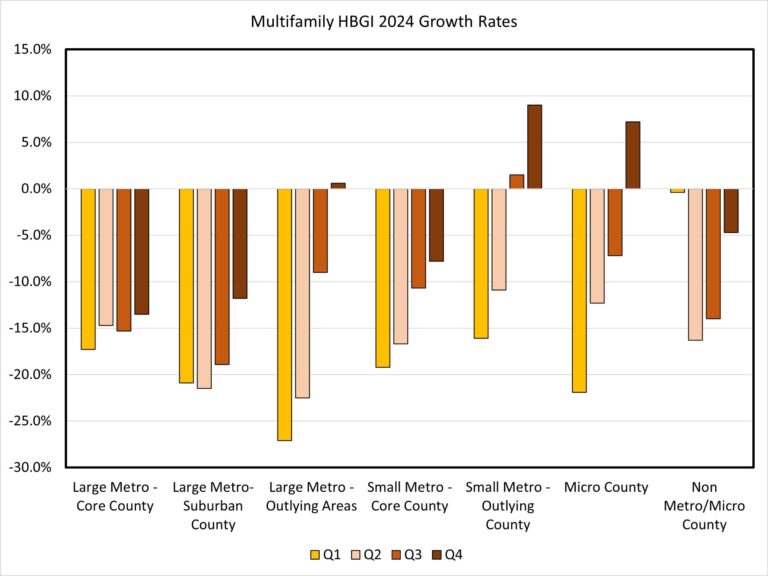
Multifamily construction continued to register negative growth rates across the largest markets, with large metro core county areas posting a decline of 13.5% quartering in the fourth quarter (4QMA). While permit levels remain lower for new multifamily construction, there were some positive signs in less densely populated areas. Small metro outlying county areas had the largest growth rate in the fourth quarter at 9.0%, the second consecutive quarter of growth. These areas make up around 5.0% of the total multifamily construction market.

The fourth quarter of 2024 HBGI data along with an interactive HBGI map can be found at http://nahb.org/hbgi.

Discover more from Eye On Housing

Subscribe to get the latest posts sent to your email.


This article was originally published by a eyeonhousing.org . Read the Original article here. .

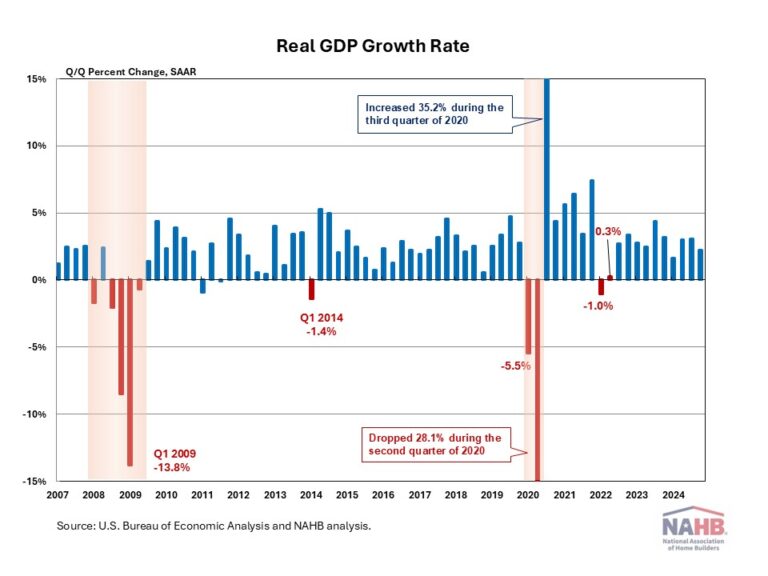
Real GDP growth slowed in the fourth quarter of 2024, but the economy finished the year at a solid rate. While consumer spending continued to drive growth, gross private domestic investment detracted over a full percentage point mainly due to a decline in private inventories.

According to the “advance” estimate released by the Bureau of Economic Analysis (BEA), real gross domestic product (GDP) expanded at an annual rate of 2.3% in the fourth quarter of 2024, following a 3.1% gain in the third quarter of 2024. This quarter’s growth was higher than NAHB’s forecast of a 1.8% increase.

Furthermore, the data from the GDP report suggests that inflationary pressure persisted at the end of 2024. The GDP price index rose 2.2% for the fourth quarter, up from a 1.9% increase in the third quarter of 2024. The Personal Consumption Expenditures Price (PCE) Index, which measures inflation (or deflation) across various consumer expenses and reflects changes in consumer behavior, rose 2.3% in the fourth quarter. This is up from a 1.5% increase in the third quarter of 2024.

For the full year, real GDP grew at a healthy rate of 2.8% in 2024. It was slightly slower than the 2023 level of a 2.9% increase and matched NAHB’s forecast.

This quarter’s increase in real GDP primarily reflected increases in consumer spending, and government spending.

Consumer spending, the backbone of the U.S. economy, rose at an annual rate of 4.2% in the fourth quarter. This marks the highest annual growth rate since the first quarter of 2023. The increase in consumer spending reflected increases in both goods and services. While goods spending increased at a 6.6% annual rate, expenditures for services increased at a 3.1% annual rate.

In the fourth quarter, government spending increased at a 2.5% rate.

Nonresidential fixed investment decreased 2.2% in the fourth quarter. The decrease in nonresidential fixed investment reflected decreases in equipment (-7.8%) and structures (-1.1%). Meanwhile, residential fixed investment increased 5.3% in the fourth quarter after two consecutive quarters of declines. Within residential fixed investment, single-family structures rose 3.1% at an annual rate, improvements increased 2.7%, while multifamily structures declined 7.2%.

Compared to the third quarter, the deceleration in real GDP in the fourth quarter primarily reflected

downturns in gross private domestic investment and exports. Inventories fell and dragged down the contribution to real GDP by 0.93 percentage points. Imports decreased.

For the common BEA terms and definitions, please access bea.gov/Help/Glossary.

Discover more from Eye On Housing

Subscribe to get the latest posts sent to your email.


This article was originally published by a eyeonhousing.org . Read the Original article here. .
Pin It