Tag

employment/labor

Browsing


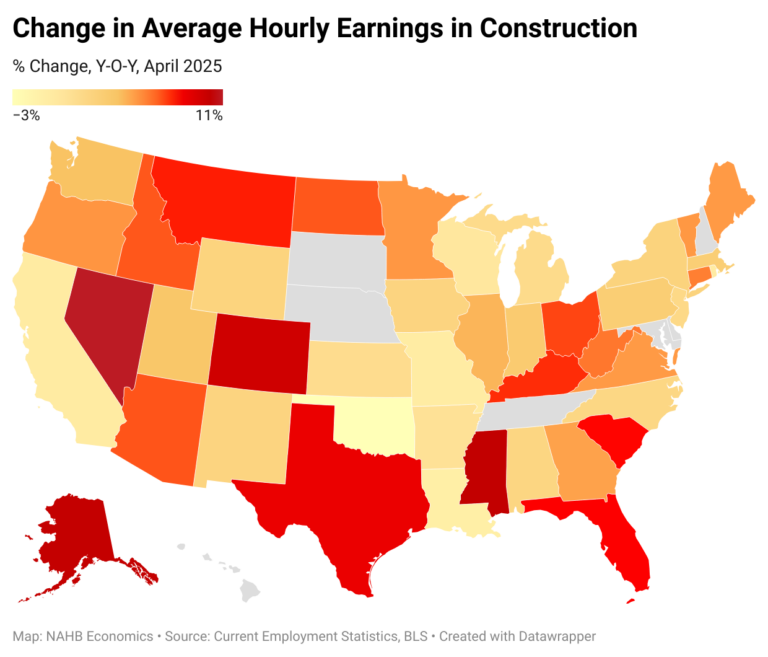
Wage growth in construction continued to decelerate in April on a national basis, but the differences across regional markets remain stark. Nationally, average hourly earnings (AHE) in construction increased 3.6% year-over-year and crossed the $39.3 mark when averaged across all payroll employees (non-seasonally adjusted, NSA). Meanwhile, average earnings in construction in Alaska and Massachusetts exceeded $50 per hour (NSA). Across states, the annual growth rate in AHE ranged from 10.6% in Nevada to a decline of 3% in Oklahoma. This is according to the latest Current Employment Statistics (CES) report from the Bureau of Labor Statistics (BLS).   

Average hourly earnings (AHE) in construction vary greatly across 43 states that report these data. Alaska, states along the Pacific coast, Illinois, Minnesota, and the majority of states in Northeast record the highest AHE. As of April 2025, fourteen states report average earnings (NSA) exceeding $40 per hour.

At the other end of the spectrum, nine states report NSA average hourly earnings in construction under $34. The states with the lowest AHE are mostly in the South, with Arkansas reporting the lowest rate of $29.3 per hour.

While differences in regional hourly rates reflect variation in the cost of living across states among other things, the faster growing wages are more likely to indicate specific labor markets that are particularly tight. Year-over-year, Nevada, Mississippi, Alaska, Colorado, Texas, Florida, South Carolina, and Montana reported fastest growing hourly wages in construction, more than doubling the national average growth of 3.6%. Nevada reported the largest annual increase of 10.6%, while the growth rate in Mississippi and Alaska was just under 10%.

In sharp contrast, Oklahoma registered a decline in hourly wages of 3%. Five other states reported modestly declining hourly rates in construction, compared to a year ago – Louisiana, Missouri, Rhode Island, California, and Wisconsin.

Discover more from Eye On Housing

Subscribe to get the latest posts sent to your email.


This article was originally published by a eyeonhousing.org . Read the Original article here. .


The count of open, unfilled positions in the construction industry held steady amid a slowdown for housing, per the April Bureau of Labor Statistics Job Openings and Labor Turnover Survey (JOLTS).

The number of open jobs for the overall economy increased slightly from 7.20 million in March to 7.39 million in April. This is notably smaller than the 7.62 million estimate reported a year ago and reflects a softened aggregate labor market. Previous NAHB analysis indicated that this number had to fall below 8 million on a sustained basis for the Federal Reserve to move forward on interest rate reductions. With estimates remaining below 8 million for national job openings, the Fed, in theory, should be able to cut further despite a recent pause. However, tariff proposals may keep the Fed on pause in the coming quarters.

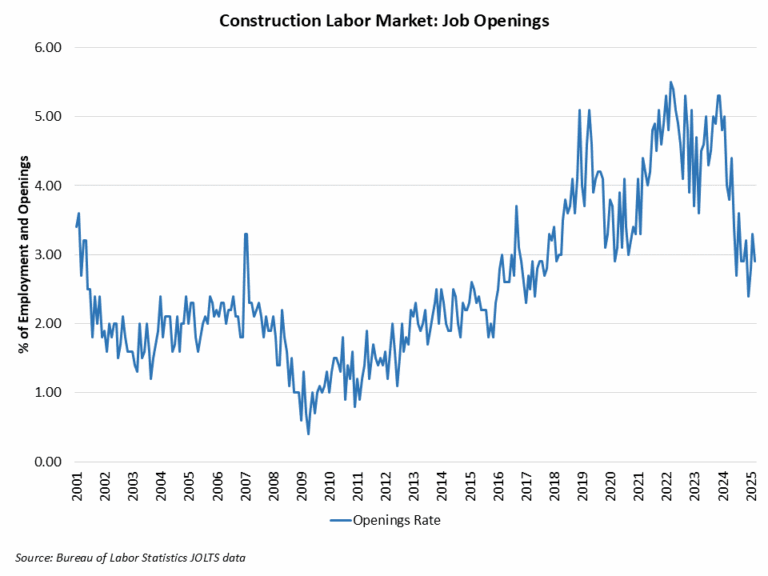
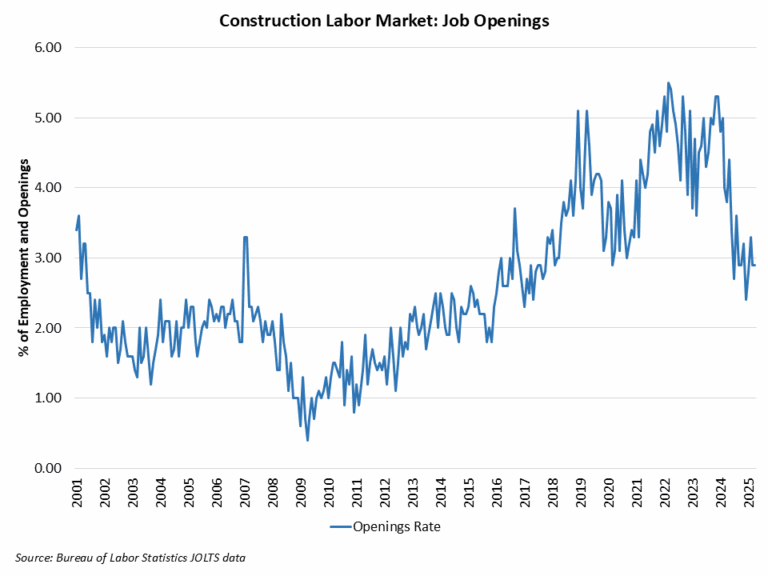
The number of open construction sector jobs was effectively unchanged from a revised 251,000 in March to 248,000 in April. This nonetheless marks a significant reduction of open, unfilled construction jobs than that registered a year ago (326,000) due to a slowing of construction activity. The chart below notes the recent decline for the construction job openings rate, which is now back to the lows of 2019.

The construction job openings rate was unchanged at 2.9% in April, although significantly lower year-over-year from 3.8%.

The layoff rate in construction ticked higher to 1.9% in April. The quits rate dipped to 1.8% for the month.

Discover more from Eye On Housing

Subscribe to get the latest posts sent to your email.


This article was originally published by a eyeonhousing.org . Read the Original article here. .


Nonfarm payroll employment increased in 40 states in April compared to the previous month, while it decreased in 10 states and the District of Columbia. According to the Bureau of Labor Statistics, nationwide total nonfarm payroll employment increased by 177,000 in April following a gain of 185,000 jobs in March.

On a month-over-month basis, employment data was most favorable in Texas, which added 37,700 jobs. Ohio came in second (+22,200), followed by Florida (+21,300). Meanwhile, a total of 21,100 jobs were lost across 10 states, with Missouri reporting the steepest job losses at 6,600. In percentage terms, employment increased the highest in Arizona at 0.4%, while Missouri saw the biggest decline at 0.2% between March and April.

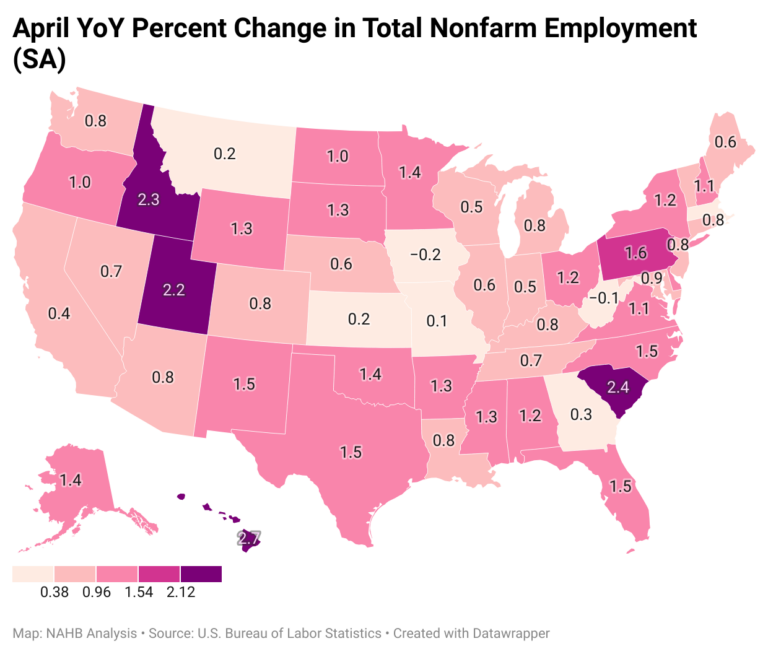
Year-over-year ending in April, 1.9 million jobs have been added to the labor market, which is a 1.2% increase compared to the April 2024 level. The range of job gains spanned from 800 jobs in Montana to 215,500 jobs in Texas. Two states and the District of Columbia lost a total of 4,500 jobs in the past 12 months, with Iowa reporting the steepest job losses at 3,100. In percentage terms, the range of job growth spanned 2.7% in Hawaii to 0.1% in Missouri. The District of Columbia, West Virginia, and Iowa declined by 0.1%, 0.1%, and 0.2% respectively.

Construction Employment

Across the nation, construction sector jobs data —which includes both residential and non-residential construction—showed that 24 states reported an increase in April compared to March, while 24 states and the District of Columbia lost construction sector jobs. The two remaining states, Indiana and New York reported no change on a month-over-month basis. California, with the highest increase, added 6,300 construction jobs, while Washington, on the other end of the spectrum, lost 3,300 jobs. Overall, the construction industry added a net 11,000 jobs in April compared to the previous month. In percentage terms, Virginia reported the highest increase at 1.9% and Alaska reported the largest decline at 3.1%.

Year-over-year, construction sector jobs in the U.S. increased by 143,000, which is a 1.7% increase compared to the April 2024 level. Texas added 32,000 jobs, which was the largest gain of any state, while Washington lost 15,000 construction sector jobs. In percentage terms, New Mexico had the highest annual growth rate in the construction sector at 14.6%. Over this period, Washington reported the largest decline of 6.6%.

Discover more from Eye On Housing

Subscribe to get the latest posts sent to your email.


This article was originally published by a eyeonhousing.org . Read the Original article here. .


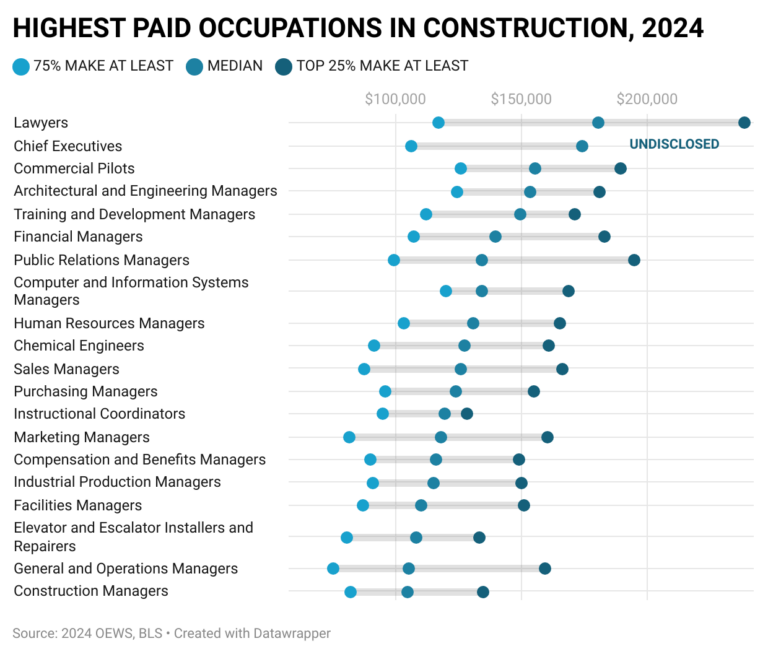
Half of payroll workers in construction earn more than $60,320 and the top 25% make at least $81,510, according to the latest May 2024 Bureau of Labor Statistics Occupational Employment and Wage Statistics (OEWS) and analysis by the National Association of Home Builders (NAHB). In comparison, the U.S. median annual pay is $49,500, while the top quartile (the highest paid 25%) makes at least $78,810.

The OEWS publishes wages for almost 400 occupations in construction. Out of these, only 46 are construction trades. The other construction industry workers are in finance, sales, administration and other off-site activities.

In 2024, the highest paid occupation in construction is lawyers with wages of $180,520 per year, and the top 25 percent making over $238,720. Traditionally, Chief Executive Officer (CEO) occupy the top paid position in the industry, but in 2024, they are second on the list, with half of CEOs making over $174,030, while the wages of the top quartile remain undisclosed.

Out of the top twenty highest paid occupations in construction, fourteen are various managers. The highest paid managers in construction are architectural and engineering managers, with half of them making over $153,510 and the top 25 percent on the pay scale earning over $181,150 annually.

The architectural and engineering managers also stand out for having a smaller salary range spread, measured as a percentage difference between the bottom and top 25 percent pay levels. Only computer and information systems (CIS) managers have a narrower pay range among managers in construction. The annual pay of the highest paid 25 percent CIS managers in construction is at least $168,850, which is 40% higher than the top earnings of the lowest paid quartile ($119,990). In contrast, higher-level positions, such as lawyers and CEOs, have a noticeably wider pay scale spread. The top 25 percent highest paid lawyers make more than double of the bottom quartile pay, potentially reflecting a greater range of responsibilities and opportunities for career advancement for lawyers in construction.

Among construction trades, elevator installers and repairers top the median wages list with half of them earning over $108,130 a year, and the top 25% making at least $133,370. This is also the only construction trade that made the industry overall top 20 highest paid occupations list. 

First-line supervisors of construction trades are next on the trade list; their median wages are $78,900, with the top 25% highest paid supervisors earning more than $100,150.  

In general, construction trades that require more years of formal education tend to offer higher annual wages. Median wages of construction and building inspectors are $66,340 and the top quartile is $89,550. This is also the trade with a relatively wide pay scale spread, with the top 25 percent making at least 74% more than the bottom quartile, potentially reflecting a wider variance in educational attainment, professional responsibilities and expertise of building inspectors.

Carpenters are one of the most prevalent construction crafts in the industry. The trade requires less formal education. Nevertheless, the median wages of carpenters working in construction exceed the national median. Half of these craftsmen earn over $59,890 and the highest paid 25 percent bring in at least $76,290.

Plumbers and electricians, trades that typically require specialized training and licensing, earn higher annual wages. Half of plumbers in construction earn over $62,820, with the top quartile making over $81,740. Electricians’ wages are similarly high.

The construction trade with the greatest pay range spread is pile driver operators. The top 25 percent highest paid operators earn at least $105,100, over 100% more than the bottom quartile. This wide pay scale presumably reflects a greater variety of opportunities and geographic locations (some pile driver operators work on offshore rigs), as well as varying degree of technical expertise and training (some equipment comes with computerized controls and requires additional knowledge of electronics).

In contrast, solar photovoltaic installers, a relatively new construction trade, have a much narrower pay scale. The difference between the annual pay of the top 25 percent ($65,850) and the bottom quartile ($48,350) is 36%, likely reflecting less variation in expertise, training, and geographic prevalence.

Typically, construction trades that require less skill not only offer lower wages but also show less variation in pay. Apprentice workers (helpers of painters, plumbers, electricians, roofers, carpenters, and other construction trades) illustrate this point. These are the six lowest paid construction occupations that simultaneously show the narrowest variation in pay. For example, the highest paid quartile of carpenters’ helpers makes at least $46,720 a year, while the bottom quartile earns at most $35,870, only a 30% difference.

Discover more from Eye On Housing

Subscribe to get the latest posts sent to your email.


This article was originally published by a eyeonhousing.org . Read the Original article here. .


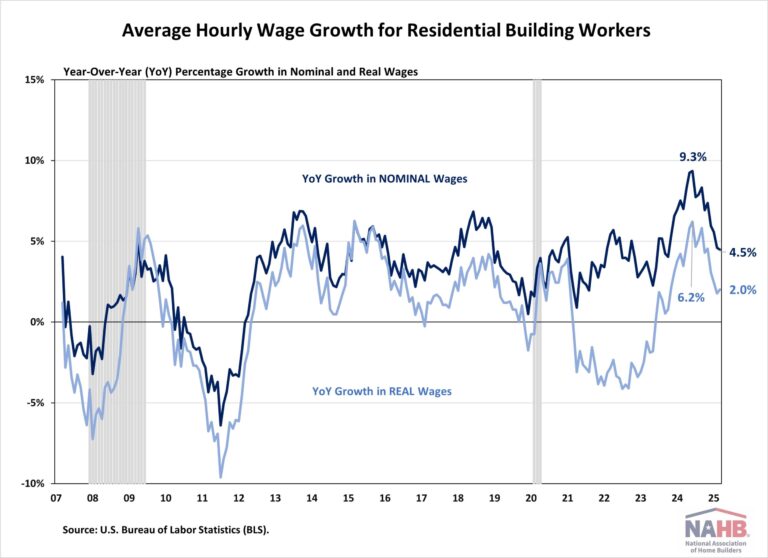
Wage growth for residential building workers continued to slow in March 2025, reflecting softening in the construction labor market, according to the latest report from the U.S. Bureau of Labor Statistics (BLS).

On a nominal basis, average hourly earnings (AHE) for residential building workers reached $38.76 in March 2025, up 4.5% from $37.10 a year ago. This marks a continued deceleration in the year-over-year wage growth, which peaked at 9.3% in June 2024. The recent slowdown reflects an easing of pandemic-related labor shortages and a softening labor demand in the construction sector. In March, the construction labor market saw a decline in job openings as employers slowed hiring plans amid ongoing economic uncertainty.

Despite the slowdown in wage growth, residential building workers’ wages remain competitive:

10.2% higher than the manufacturing sector ($35.17/hour)

24.0% higher than the transportation and warehousing sector ($31.25/hour)

3.7% lower than the mining and logging sector ($40.23/hour)

Note:

Data used in this post relate to all employees in the residential building industry. This group includes both new single-family housing construction (excluding for-sale builders) and residential remodelers but does not include specialty trade contractors.

Discover more from Eye On Housing

Subscribe to get the latest posts sent to your email.


This article was originally published by a eyeonhousing.org . Read the Original article here. .


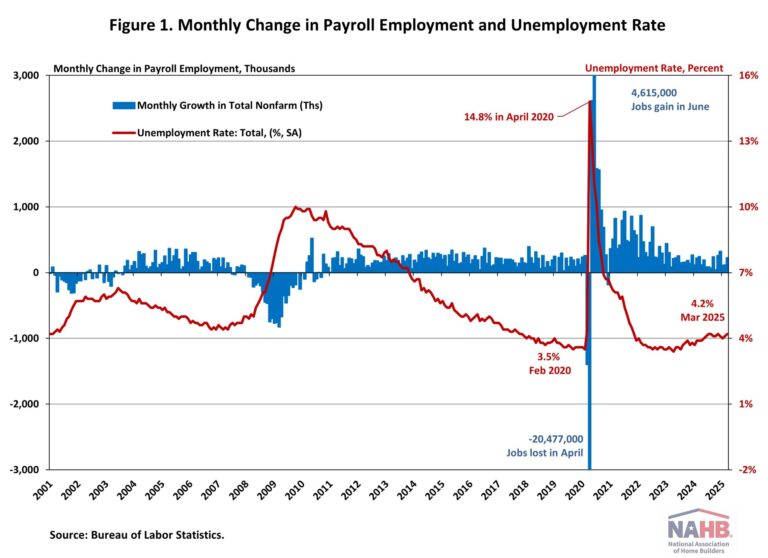
The U.S. job market slowed slightly in April, with notable downward revisions to February and March figures. The unemployment rate held steady at 4.2%. The labor market remains resilient despite growing economic uncertainty, though early signs of softening are beginning to emerge.

In April, wage growth remained unchanged. Year-over-year, wages grew at a 3.8% rate. Wage growth has been outpacing inflation for nearly two years, which typically occurs as productivity increases.

National Employment

According to the Employment Situation Summary reported by the Bureau of Labor Statistics (BLS), total nonfarm payroll employment rose by 177,000 in April, following a downwardly revised increase of 185,000 jobs in March. Since January 2021, the U.S. job market has added jobs for 52 consecutive months, making it the third-longest period of employment expansion on record. Monthly employment growth has averaged 144,000 per month in 2025, compared with the 168,000 monthly average gain for 2024.

The estimates for the previous two months were revised down. The monthly change in total nonfarm payroll employment for February was revised down by 15,000 from +117,000 to +102,000, while the change for March was revised down by 43,000 from +228,000 to +185,000. Combined, the revisions were 58,000 lower than previously reported.

The unemployment rate remained unchanged at 4.2% in April. While the number of employed persons increased by 436,000, the number of unemployed persons increased by 82,000.

Meanwhile, the labor force participation rate—the proportion of the population either looking for a job or already holding a job—rose one percentage point to 62.6%. Among individuals aged 25 to 54, the participation rate rose three percentage points to 83.6%, marking the highest rate since September 2024. Despite these gains, the overall labor force participation rate remains below its pre-pandemic levels of 63.3% at the beginning of 2020. Additionally, the rate for the prime working-age group (25 to 54) has been trending downward since peaking at 83.9% last summer.

In April, industries like health care (+51,000), transportation and warehousing (+29,000), and financial activities (+14,000) continued to see gains. Meanwhile, federal government employment lost 9,000 jobs in April and has shed 26,000 since January 2025, reflecting the effects of government cutbacks. The BLS notes that “employees on paid leave or receiving ongoing severance pay are counted as employed in the establishment survey.”

Construction Employment

Employment in the overall construction sector increased by 11,000 in April, following a downwardly revised gain of 7,000 in March. While residential construction gained 3,400 jobs, non-residential construction employment added 8,000 jobs for the month.

Residential construction employment now stands at 3.3 million in April, broken down as 956,000 builders and 2.4 million residential specialty trade contractors. The six-month moving average of job gains for residential construction was -1,583 a month, mainly reflecting the three months’ job loss over the past six months (October 2024, January 2025, and March 2025). Over the last 12 months, home builders and remodelers added 5,000 jobs on a net basis. Since the low point following the Great Recession, residential construction has gained 1,367,000 positions.

In April, the unemployment rate for construction workers rose to 5.2% on a seasonally adjusted basis. The unemployment rate for construction workers has remained at a relatively lower level, after reaching 15.3% in April 2020 due to the housing demand impact of the COVID-19 pandemic.

Discover more from Eye On Housing

Subscribe to get the latest posts sent to your email.


This article was originally published by a eyeonhousing.org . Read the Original article here. .


Consistent with soft sentiment data, the count of job openings for the overall economy and construction fell in March as employers slowed hiring plans amid a broader economic slowdown, per the March Bureau of Labor Statistics Job Openings and Labor Turnover Survey (JOLTS).

The number of open jobs for the overall economy declined from 7.48 million in February to 7.19 million in March. This is notably smaller than the 8.09 million estimate reported a year ago and reflects a softened aggregate labor market. Previous NAHB analysis indicated that this number had to fall below 8 million on a sustained basis for the Federal Reserve move on interest rate reductions. With estimates remaining below 8 million for national job openings, the Fed, in theory, should be able to cut further despite a recent pause. However, tariff proposals may keep the Fed on pause in the coming quarters.

The number of open construction sector jobs fell from a revised 286,000 in February to 248,000 in March. This nonetheless marks a significant reduction of open, unfilled construction jobs than that registered a year ago (338,000) due to a slowing of construction activity. The chart below notes the recent decline for the construction job openings rate, which is now back to 2019 levels.

The construction job openings rate moved lower to 2.9% in March, significantly down year-over-year from 4%.

The layoff rate in construction stayed low (1.7%) in March. The quits rate declined to 1.8% in March.

Discover more from Eye On Housing

Subscribe to get the latest posts sent to your email.


This article was originally published by a eyeonhousing.org . Read the Original article here. .


Over the past 125 years, women have played a crucial and multifaceted role in the labor force. Increasing women’s participation in the workforce is not only essential for individual and family well-being, but also contributes significantly to overall labor force participation rates and economic growth by adding more workers and enhancing overall productivity1.   

Historically, women’s labor force participation rate rose rapidly between 1948 and 2000, peaking around 60% in 1999. During the same period, men’s participation rates declined. However, since 2000, the growth in women’s labor force participation has flattened and then declined.

According to the March 2025 Employment Situation Summary reported by the Bureau of Labor Statistics (BLS), women’s labor force participation rate held steady at 57.5%, and women now represent nearly half (47%) of the total U.S. labor force.

Selected Categories

Prime-age women (ages 25-54) represent a significant and growing segment of the U.S. labor force. As of 2024, they accounted for nearly 30% of the civilian labor force, compared to 34% for prime-age men. According to the latest data from the Current Population Survey (CPS), prime-age women had a labor force participation rate of 78%, the highest among all female age groups. This rate has fully recovered from the COVID-19 pandemic, surpassing its previous peak recorded in February 2020.

As discussed in the previous blog, higher levels of educational attainment are strongly associated with higher labor force participation and lower unemployment. Women with a bachelor’s degree or higher have played a vital role in shaping the labor market. In 2024, about 70% of women with this level of educational attainment were active in the labor force, compared to only 34% of women who had not completed high school.

The CPS data also reveals notable differences in women’s labor force participation based on parental status.  Women with older children (ages 6 to 17) and no children under 6 years old had a higher labor force participation rate than those with younger children. Interestingly, women without children had a relatively lower labor force participation rate compared to those with children. Further research from the Brookings Institution and The Hamilton Project2 highlights a significant shift: women with young children (under 5 years), especially those who are highly educated, married, or foreign-born, are more likely to be in the labor force now than they were before the pandemic.

Women’s labor force participation also varies by race and ethnicity. Among women ages 16 and over, Black women had the highest participation rate at 61%, followed by Hispanic women (59%), Asian women (59%), and White women (57%).

The figure below reflects the diversity and complexity of women’s roles in the workforce.

Women in Industry

As more women enter the labor force, they are increasingly shaping a broad range of industries–from healthcare and education to leisure and hospitality, retail, technology, and construction.

In 1964, women were primarily employed in a narrower set of sectors. The top four industries employing the most women at that time were: manufacturing; trade, transportation, and utilities; local government; and education and health services3.

By 2024, however, women’s participation in the workforce has expanded significantly, both in scope and impact. According to the latest CPS data, women dominated the education and health services sector, where they hold approximately 27.6 million jobs. That means seven in every ten workers in this field are women. Moreover, women now make up more than half of the workforce in several other key industries, including other services, leisure and hospitality, and financial activities.

Despite their growing role in the workforce, they remain underrepresented in certain sectors, most notably, construction. Although women now make up a significant portion of the overall labor force, they account for just 11% of total employment in the construction industry. Of those, only 2.8% of women work in actual trade roles, while most women in the industry are employed in:

Office and administrative support

Management

Business

Financial operations

Gender Pay Gap by Occupation

While the gender pay gap in the U.S. has narrowed significantly over the past few decades, it remains a persistent issue in the labor market. According to a study4 by the Pew Research Center, women earned about 65 cents for every dollar earned by men in 1982. By 2023, that figure had risen to approximately 82 cents on the dollar—a clear sign of progress. However, the pace of change has slowed considerably in recent years.

In 2024, the CPS data shows that women working full time earned a median weekly wage of $1,043, compared to $1,261 for men. This means women earned 83 cents for every dollar earned by men—a 17% gender wage gap.

At the occupational level, women earn less than men across all major occupational groups, even ones dominated by women. The smallest gender pay gap was found in community and social services occupations. In contrast, occupations in legal, sales and related, protective services, and production display larger disparities in earnings between women and men.

The Future of Women in the Workforce

Looking ahead to 2033, the number of women in the labor force is expected to continue growing, driven primarily by the prime-age women (ages 25 to 54). BLS employment projections estimate that roughly 3.2 million prime-age women will join the workforce between 2023 and 2033. During this period, their participation rate is projected to increase slightly, reflecting continued momentum in women’s economic engagement.

Meanwhile, the U.S. labor market is experiencing a critical shortage of skilled workers, especially in fields like STEM (science, technology, engineering, and math) and skilled trades. As the NAHB Chief Economist stated, “The ultimate solution for the persistent, national labor shortage will be found…by recruiting, training and retaining skilled workers.” This applies equally to the women’s labor force.

Women’s participation is closely tied to their access to education and skills development. As more women pursue higher education and specialized training, their career opportunities expand, particularly in fields previously dominated by men. This progress can help narrow the gender pay gap over time.

However, women often shoulder disproportionate family and caregiving responsibilities, not only during their reproductive years, but throughout their lives. According to the American Time Use Survey (ATUS), on a typical weekday, prime-age working women spent about four hours on caregiving and household tasks, such as household activities, caring for and helping household members, and purchasing goods and services. This is nearly twice the time men spent on the same activities. Many women face a tough decision between career advancement and family caregiving responsibilities, often leading to reduced work hours or even complete withdrawal from the labor force.

To support and increase women’s labor force participation, it may be beneficial to consider a range of policies and workplace reforms. For example, promoting flexible work arrangements can help women better balance professional and personal responsibilities. Narrowing the gender pay gap would also play a critical role in ensuring fair compensation and financial security. Furthermore, expanding access to affordable and high-quality childcare could remove a major barrier for many working mothers. In addition, continued investment in education and training programs would enable women to advance in their careers and contribute to broader, long-term economic growth.

To conclude, empowering women to succeed in the workforce not only improves individual and family well-being, but also strengthens the entire economy.

Note:

Discover more from Eye On Housing

Subscribe to get the latest posts sent to your email.


This article was originally published by a eyeonhousing.org . Read the Original article here. .


Nonfarm payroll employment increased in 37 states and the District of Columbia in March compared to the previous month, while it decreased in 12 states. Wyoming reported no change during this time. According to the Bureau of Labor Statistics, nationwide total nonfarm payroll employment increased by 228,000 in March following a gain of 117,000 jobs in February.

On a month-over-month basis, employment data was most favorable in Texas, which added 26,500 jobs. Pennsylvania came in second (+20,900), followed by Florida (+18,100). Meanwhile, a total of 33,900 jobs were lost across 12 states, with California reporting the steepest job losses at 11,600. In percentage terms, employment increased the highest in Missouri at 0.5%, while Connecticut saw the biggest decline at 0.3% between February and March.

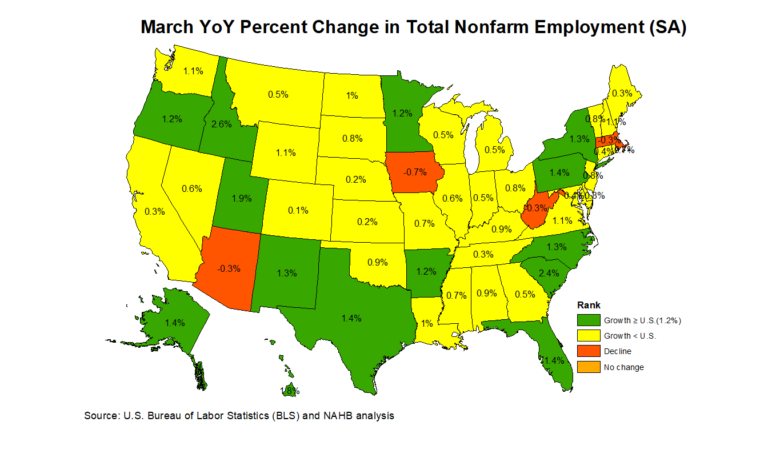
Year-over-year ending in March, 1.9 million jobs have been added to the labor market, which is a 1.2% increase compared to the March 2024 level. The range of job gains spanned from 300 jobs in the District of Columbia to 192,100 jobs in Texas. Four states lost a total of 34,700 jobs in the past 12 months, with Iowa reporting the steepest job losses at 11,800. In percentage terms, the range of job growth spanned 2.6% in Idaho to 0.1% in Colorado. The District of Columbia was unchanged while West Virginia, Massachusetts, Arizona, and Iowa declined by 0.3%, 0.3%, 0.3%, and 0.7% respectively.

Construction Employment

Across the nation, construction sector jobs data —which includes both residential and non-residential construction—showed that 30 states reported an increase in March compared to February, while 17 states and the District of Columbia lost construction sector jobs. The three remaining states reported no change on a month-over-month basis. Texas, with the highest increase, added 8,500 construction jobs, while California, on the other end of the spectrum, lost 3,700 jobs. Overall, the construction industry added a net 13,000 jobs in March compared to the previous month. In percentage terms, Kentucky reported the highest increase at 3.6% and Mississippi reported the largest decline at 3.4%.

Year-over-year, construction sector jobs in the U.S. increased by 143,000, which is a 1.8% increase compared to the March 2024 level. Texas added 28,700 jobs, which was the largest gain of any state, while California lost 23,400 construction sector jobs. In percentage terms, New Mexico had the highest annual growth rate in the construction sector at 12.0%. Over this period, Washington reported the largest decline of 5.3%.

Discover more from Eye On Housing

Subscribe to get the latest posts sent to your email.


This article was originally published by a eyeonhousing.org . Read the Original article here. .


The U.S. job market unexpectedly accelerated in March, while the figures for January and February were revised downward substantially. The unemployment rate ticked up slightly to 4.2% in March, from 4.1% the previous month. This month’s jobs report highlights the continued resilience of the labor market despite sticky inflation, a drop in consumer confidence, mass federal government layoffs, and growing economic uncertainty.

Noticeably, residential construction employment has shown signs of weakness in recent months. In March, the six-month moving average of job gains for residential construction turned negative for the first time since August 2020. It reflects three significant drops in employment: 8,400 jobs in October 2024, 6,700 jobs in January 2025, and 9,800 jobs in March 2025. Additionally, the construction job openings rate has returned to 2019 levels, driven by a slowdown in construction activity.

In March, wage growth slowed. Year-over-year, wages grew at a 3.8% rate, down 0.3 percentage points from a year ago. Wage growth has been outpacing inflation for nearly two years, which typically occurs as productivity increases.

National Employment

According to the Employment Situation Summary reported by the Bureau of Labor Statistics (BLS), total nonfarm payroll employment rose by 228,000 in March, following a downwardly revised increase of 117,000 jobs in February. Since January 2021, the U.S. job market has added jobs for 51 consecutive months, making it the third-longest period of employment expansion on record.

The estimates for the previous two months were revised down. The monthly change in total nonfarm payroll employment for January was revised down by 14,000 from +125,000 to +111,000, while the change for February was revised down by 34,000 from +151,000 to +117,000. Combined, the revisions were 48,000 lower than previously reported.

The unemployment rate rose to 4.2% in March. While the number of employed persons increased by 201,000, the number of unemployed persons increased by 31,000.

Meanwhile, the labor force participation rate—the proportion of the population either looking for a job or already holding a job—rose one percentage point to 62.5%. For people aged between 25 and 54, the participation rate decreased two percentage points to 83.3%. While the overall labor force participation rate remains below its pre-pandemic levels of 63.3% at the beginning of 2020, the rate for people aged between 25 and 54 has been trending down since it peaked at 83.9% last summer.

In March, employment rose in health care (+54,000), social assistance (+24,000), and transportation and warehousing (+23,000). Employment in retail trade also added 24,000 jobs in March, partially reflecting the return of workers from a strike. However, within the government sector, federal government employment saw a decline of 4,000, following a loss of 11,000 jobs in February. The BLS notes that “employees on paid leave or receiving ongoing severance pay are counted as employed in the establishment survey.”

Construction Employment

Employment in the overall construction sector increased by 13,000 in March, following a gain of 14,000 in February. While residential construction saw a decline of 9,800 jobs, non-residential construction employment added 22,300 jobs for the month.

Residential construction employment now stands at 3.4 million in March, broken down as 958,000 builders and 2.4 million residential specialty trade contractors. The six-month moving average of job gains for residential construction was -2,883 a month, mainly reflecting the three months’ job loss over the past six months (October 2024, January 2025 and March 2025). Over the last 12 months, home builders and remodelers added 14,000 jobs on a net basis. Since the low point following the Great Recession, residential construction has gained 1,367,600 positions.

In March, the unemployment rate for construction workers declined to 4.3% on a seasonally adjusted basis. The unemployment rate for construction workers has remained at a relatively lower level, after reaching 15.3% in April 2020 due to the housing demand impact of the COVID-19 pandemic.

Discover more from Eye On Housing

Subscribe to get the latest posts sent to your email.


This article was originally published by a eyeonhousing.org . Read the Original article here. .

Pin It