Tag

Edges

Browsing


The share of new homes with decks edged down from 17.6% in 2023 to a new all-time low of 17.4% in 2024, according to NAHB tabulation of data from the HUD/Census Bureau Survey of Construction (SOC).

Over the longer term, the share of new homes with decks has been declining steadily since reaching a peak of 27.0% in 2007 and 2008. Amidst that decline, the share of new homes with patios has been trending upward, from under 50% to over 60% (despite a minor reversal of the upward trend in 2024). From the re-design of the SOC in 2005 through 2024, the correlation between the percentages of new homes with patios and decks is -0.85, indicating that patios and decks are functioning as substitutes over time—i.e., as patios become more common, they are crowding out decks.

Decks and patios appear to be substitutes across the U.S. On the single-family homes started in 2024, decks tended to be more common where patios were comparatively rare. For example, only 14% of the homes in the New England Census Division included patios, while a high of 69% included decks. Conversely, 82% of new homes included patios in the West South Central, while only 3% included decks. Across all nine divisions, the correlation between the percentages of new homes with decks and patios was -0.77.

Even so, decks remain relatively popular on new homes in some parts of the country. In addition to New England, over 30% of new homes came with decks in the West North Central (46%), Middle Atlantic (34%) and East South Central (31%) divisions. Moreover, in the latest edition of  What Home Buyers Really Want, 79% of recent and prospective home buyers rated a deck as an essential or desirable feature.

Additional detail on the characteristics of new-home decks is available from the Annual Builder Practices Survey (BPS) conducted by Home Innovation Research Labs.

Nationally, the 2025 BPS report (based on homes built in 2024) shows that the average size of a deck on a new single-family home is 278 square feet. Across Census Divisions, the average ranges from a low of 163 square feet in the West South Central to a high of 422 square feet in the Mountain division.

Beyond size, there continue to be strong geographic differences in builders’ choice of deck materials. On a square foot basis, treated wood is the most popular choice in the New England, South Atlantic, East South Central, and Mountain divisions. In the Middle Atlantic, East North Central, and West North Central, composite material predominates. In the Pacific Division, builders use concrete more than any other material, while in the West South Central there is a roughly even split between treated wood and concrete.

Of course, decks can be—and often are—added after the home itself is built. In the fourth-quarter 2024 survey for the NAHB/Westlake Royal Remodeling Market Index, decks ranked seventh among 22 listed remodeling projects, cited as a common job by 23% of the professional remodelers who responded to the survey.


This article was originally published by a eyeonhousing.org . Read the Original article here. .


Builder confidence for future sales expectations received a slight boost in July with the extension of the 2017 tax cuts, but elevated interest rates and economic and policy uncertainty continue to act as headwinds for the housing sector.

Builder confidence in the market for newly built single-family homes was 33 in July, up one point from June, according to the National Association of Home Builders (NAHB)/Wells Fargo Housing Market Index (HMI). Builder sentiment has now been in negative territory for 15 consecutive months.

The July HMI survey revealed that 38% of builders reported cutting prices in July, the highest percentage since NAHB began tracking this figure on a monthly basis in 2022. This compares with 37% of builders who reported cutting prices in June, 34% in May and 29% in April. Meanwhile, the average price reduction was 5% in July, the same as it’s been every month since last November. The use of sales incentives was 62% in July, unchanged from June.

Consistent with ongoing weakness for the HMI, single-family housing starts will post a decline in 2025 due to ongoing housing affordability challenges per the latest NAHB forecast. Single-family permits are down 6% on a year-to-date basis and builder traffic in the HMI is at a more than two-year low.

Derived from a monthly survey that NAHB has been conducting for more than 40 years, the NAHB/Wells Fargo HMI gauges builder perceptions of current single-family home sales and sales expectations for the next six months as “good,” “fair” or “poor.” The survey also asks builders to rate traffic of prospective buyers as “high to very high,” “average” or “low to very low.” Scores for each component are then used to calculate a seasonally adjusted index where any number over 50 indicates that more builders view conditions as good than poor.

The HMI index gauging current sales conditions rose one point in July to a level of 36 while the component measuring sales expectations in the next six months increased three points to 43. The gauge charting traffic of prospective buyers posted a one-point decline to 20, the lowest reading since end of 2022.

Looking at the three-month moving averages for regional HMI scores, the Northeast increased two points to 45, the Midwest held steady at 41, the South dropped three points to 30 and the West declined three points to 25.

The HMI tables can be found at nahb.org/hmi.

Discover more from Eye On Housing

Subscribe to get the latest posts sent to your email.


This article was originally published by a eyeonhousing.org . Read the Original article here. .
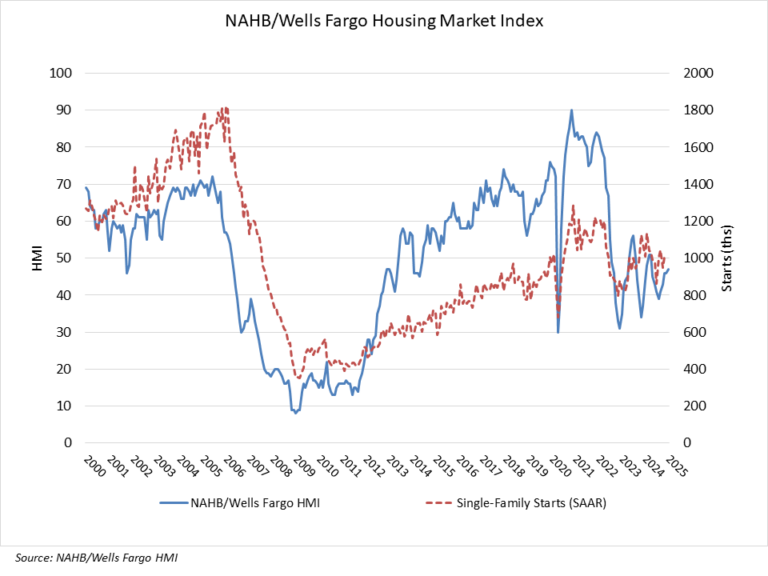

Builder sentiment edged higher to begin the year on hopes for an improved economic growth and regulatory environment. At the same time, builders expressed concerns over building material tariffs and costs and a larger government deficit that would put upward pressure on inflation and mortgage rates.

Builder confidence in the market for newly built single-family homes was 47 in January, up one point from December, according to the National Association of Home Builders (NAHB)/Wells Fargo Housing Market Index (HMI).

Builders are facing continued challenges for housing demand in the near-term, with mortgage rates up from near 6.1% in late September to above 6.9% today. Land is expensive and financing for private builders remains costly. However, there is hope that policymakers are taking the impact of regulatory hurdles seriously and will make improvements in 2025.

NAHB is forecasting a slight gain for single-family housing starts in 2025, as the market faces offsetting upside and downside risks from an improving regulatory outlook and ongoing elevated interest rates,. And while ongoing, but slower, easing from the Federal Reserve should help financing for private builders currently squeezed out of some local markets, builders report cancellations are climbing as a direct result of mortgage rates rising back up near 7%.

The latest HMI survey also revealed that 30% of builders cut home prices in January. This share has been stable between 30% and 33% since last July. Meanwhile, the average price reduction was 5% in January, the same rate as in December. The use of sales incentives was 61% in January. This share has remained between 60% and 64% since last June.

Derived from a monthly survey that NAHB has been conducting for more than 35 years, the NAHB/Wells Fargo HMI gauges builder perceptions of current single-family home sales and sales expectations for the next six months as “good,” “fair” or “poor.” The survey also asks builders to rate traffic of prospective buyers as “high to very high,” “average” or “low to very low.” Scores for each component are then used to calculate a seasonally adjusted index where any number over 50 indicates that more builders view conditions as good than poor.

The HMI index gauging current sales conditions rose three points to 51 and the gauge charting traffic of prospective buyers posted a two-point gain to 33. The component measuring sales expectations in the next six months fell six points to 60 because of the elevated interest rate environment. While this serves as a cautionary note, the future sales component is still the highest of the three sub-indices and well above the breakeven level of 50.

Looking at the three-month moving averages for regional HMI scores, the Northeast increased five points to 60, the Midwest moved one point higher to 47, the South posted a one-point gain to 46 and the West fell one point to 40. The HMI tables can be found at nahb.org/hmi.

Discover more from Eye On Housing

Subscribe to get the latest posts sent to your email.


This article was originally published by a eyeonhousing.org . Read the Original article here. .
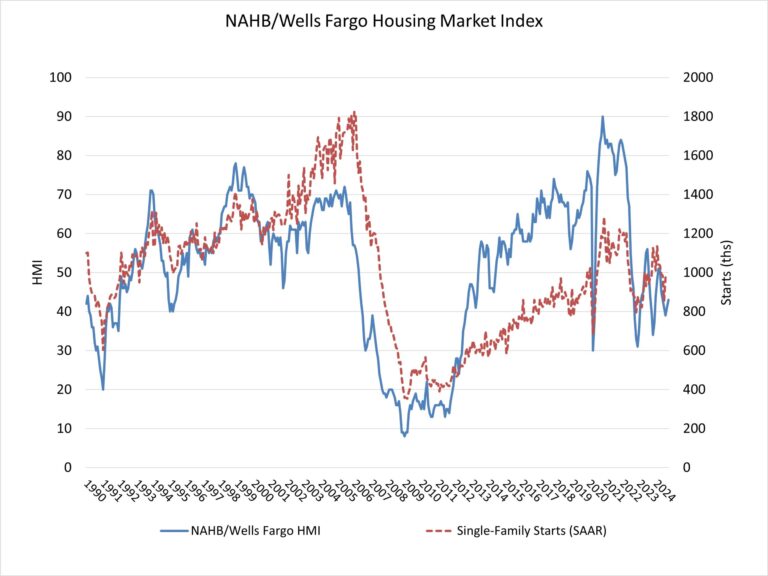

With inflation gradually easing and builders anticipating mortgage rates will moderate in coming months, builder sentiment moved higher for a second consecutive month despite challenging affordability conditions.

Builder confidence in the market for newly built single-family homes was 43 in October, up two points from a reading of 41 in September, according to the National Association of Home Builders (NAHB)/Wells Fargo Housing Market Index (HMI).

Despite the beginning of the Fed’s easing cycle, many prospective home buyers remain on the sideline waiting for lower interest rates. We are forecasting uneven declines for mortgage interest rates in the coming quarters, which will improve housing demand but place stress on building lot supplies due to tight lending conditions for development and construction loans. However, while housing affordability remains low, builders are feeling more optimistic about 2025 market conditions. A wildcard for the outlook remains the election.

The latest HMI survey also revealed that the share of builders cutting prices held steady at 32% in October, the same rate as last month. Meanwhile, the average price reduction returned to the long-term trend of 6% after dropping to 5% in September. The use of sales incentives was 62% in October, slightly up from 61% in September.

Derived from a monthly survey that NAHB has been conducting for more than 35 years, the NAHB/Wells Fargo HMI gauges builder perceptions of current single-family home sales and sales expectations for the next six months as “good,” “fair” or “poor.” The survey also asks builders to rate traffic of prospective buyers as “high to very high,” “average” or “low to very low.” Scores for each component are then used to calculate a seasonally adjusted index where any number over 50 indicates that more builders view conditions as good than poor.

All three HMI indices were up in October. The index charting current sales conditions rose two points to 47, the component measuring sales expectations in the next six months increased four points to 57 and the gauge charting traffic of prospective buyers posted a two-point gain to 29.

Looking at the three-month moving averages for regional HMI scores, the Northeast increased two points to 51, the Midwest moved two points higher to 41, the South held steady at 41 and the West increased three points to 41. The HMI tables can be found at nahb.org/hmi.

Discover more from Eye On Housing

Subscribe to get the latest posts sent to your email.


This article was originally published by a eyeonhousing.org . Read the Original article here. .
Pin It