Tag

Drives

Browsing


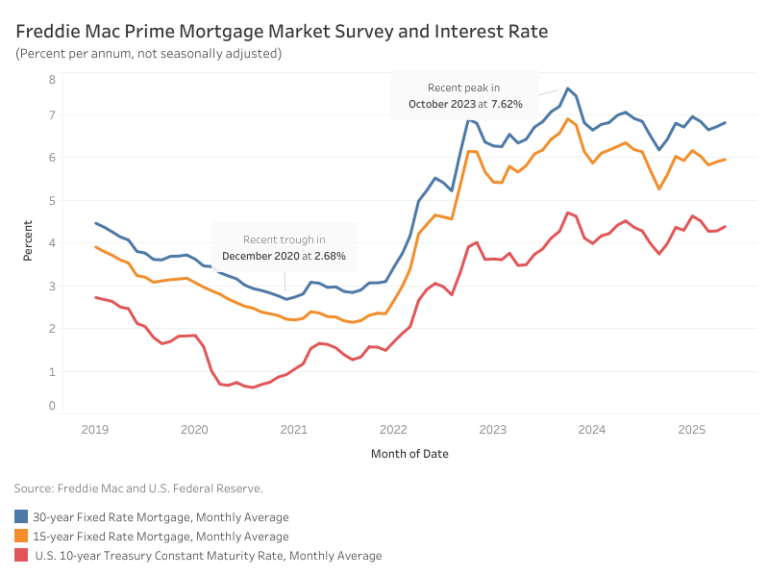
Mortgage rates continued their upward trend in May due to market volatility triggered by fiscal concerns and weaker U.S. Treasury demand. According to Freddie Mac, the average 30-year fixed-rate mortgage rose to 6.82% — a 9-basis-point (bps) increase from April. The 15-year fixed-rate mortgage increased by 5 bps to 5.95%.

The 10-year Treasury yield, a benchmark for mortgage rates, averaged 4.38% in May, with the most recent weekly yield surpassing 4.50%. Long-term treasury yields spiked following two events: first, a credit rating downgrade by Moody’s Ratings, and then, a tepid auction of the 20-year treasury. The weak demand for long-term government bonds necessitated a higher yield to attract investors.

At the core of the market unease is concern over the growing fiscal deficit that intensified as the new “One Big Beautiful Bill” threatens to further widen the federal deficit, which stood at $1.9 trillion as of January 2025. The combination of weakening fiscal credibility and poor auction performance suggests a possible upward repricing of long-term borrowing costs.

Discover more from Eye On Housing

Subscribe to get the latest posts sent to your email.


This article was originally published by a eyeonhousing.org . Read the Original article here. .
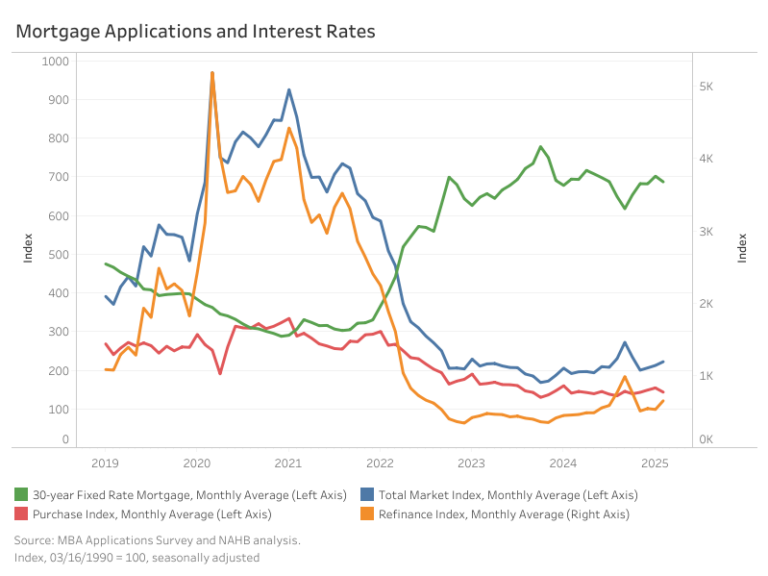

The Market Composite Index, a measure of mortgage loan application volume from the Mortgage Bankers Association’s (MBA) weekly survey, rose 4.7% month-over-month on a seasonally adjusted (SA) basis, primarily driven by refinancing activity. Compared to February last year, the index is 15.6% higher.

The Purchase Index declined 6.5% (SA) from the previous month, though it may rebound as mortgage rates continue to fall amid weakening consumer sentiment and growing economic concerns. Meanwhile, the Refinance Index surged 22.7% (SA). Compared to February last year, purchase applications are marginally higher by 2.1%, while refinance activity has jumped 43.7%.

The average 30-year fixed rate mortgage reported in the MBA survey for February fell 15 basis points (bps) to 6.9% (index level 687), 7 bps lower than a year ago.

Loan sizes also increased with the average total market loan size (purchases and refinances combined) rising by 4.4% on a non-seasonally adjusted (NSA) basis from January to $389,500. For purchase loans, the average size increased by 3.93% to $446,000, while refinance loans experienced a 6.1% increase, reaching an average of $305,800. Adjustable-rate mortgages (ARMs) saw a jump in average loan size of 5.9% from $1.07 million to $1.13 million.

Discover more from Eye On Housing

Subscribe to get the latest posts sent to your email.


This article was originally published by a eyeonhousing.org . Read the Original article here. .
Pin It