Tag

Dominate

Browsing


Adults ages 55 and older make up a large and growing share of the U.S. population and play an important role in the U.S. housing market. In 2024, around 103 million Americans were ages 55 or older, ranging from adults still in the labor force to retirees. Using data from the latest American Community Survey, this analysis shows the demographic and housing characteristics of the 55+ population.

Among the 55+ population, adults 55-64 accounted for the largest share, at 40.5%. Another 34.6% were ages 65-74, followed by ages 75-84 at 18.8%. Adults 85 and older stood at about 6.3 million, representing 6.2% of the 55+ population. Overall, 60.9% of adults ages 55 and older were not in the labor force, while 37.9% were employed and 1.2% were unemployed. This reflects the large share of older adults who have transitioned out of employment as they move into retirement.

Single-family detached homes are the most common living arrangements for the 55+ population, but the pattern changes with age. More than 72% of adults ages 55-64 and 65-74 lived in single-family detached homes, compared with about 70% of those ages 75-84, and 58% of adults 85 and older. At the same time, multifamily housing becomes more common at older ages, rising from about 15% among adults ages 55-74, to 22.2% among those 85 and older. The shares living in group quarters also increased sharply with age, from less than 2% among adults ages 55-74 to 9.7% among those 85 and older.

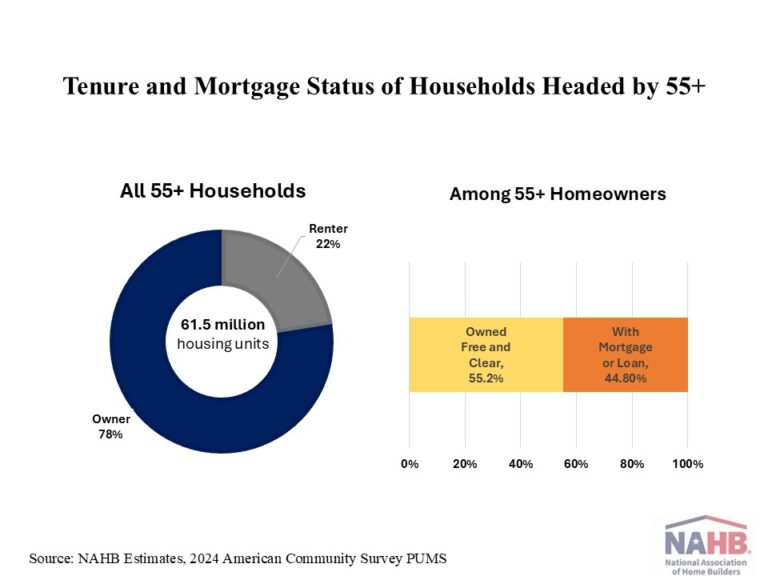
Looking more closely at the housing stock occupied by the 55+ population, the analysis next focuses on households headed by someone 55 or older. In 2024, these households occupied about 61.5 million housing units, accounting for 46.3% of all occupied housing units. Homeownership was widespread among these households, with 78% owner-occupied and 22% renter-occupied. Households headed by someone 55 or older accounted for about 55% of all owner-occupied homes, showing their substantial presence in the nation’s housing stock.

Among homeowners 55 and older, 55% owned their homes free and clear, while 44.8% had a mortgage or other housing loan. Moreover, mortgage-free homeownership also increases with age. About 41% of homeowners ages 55-64 owned their home free and clear, compared with 58% of those ages 65-74, 69% of those ages 75-84, and 82% of homeowners age 85 and older. On the other hand, the share of homeowners with a mortgage or loan fell from nearly 59% among ages 55-64 to about 18% among those age 85 and older.

Around half of homeowners 55 or older lived in homes built before 1980, including 24.5% in homes built between 1960 and 1979 and 25.4% in homes built before 1960. Homes built between 1980 and 1999 accounted for the largest share, at 27.4%, while only 22.6% of older households lived in homes built after 2000. This concentration of older homeowners in relatively aging housing stock signals a growing market for remodeling, maintenance and aging-in-place improvements.

Long residential duration was also common among homeowners 55 or older, showing the substantial share of aging in place among older Americans. Overall, around 29% of homeowners had lived in their current home for 30 years or more, while another 23% had lived in their home for 20 to 29 years. Length of residence increased with the age of the homeowner. Among homeowners ages 55-64, 14% had lived in their current home for at least 30 years. This share rose to 32% among homeowners ages 65-74, 43% among those ages 75-84, and 56% among homeowners ages 85 and older.

Older homeowners typically reported lower values for their homes The share reporting home values below $200,000 increased steadily with age, from 24.0% among homeowners ages 55–64 to 29.9% among those age 85 and older. By contrast, the share reporting values of $500,000 or more generally declined with age. Among homeowners ages 55–64, 33.2% reported home values of at least $500,000, compared with 26.6% of homeowners age 85 and older. Although reported home values tended to be lower at older ages, older homeowners were also much more likely to own their homes free and clear. As a result, many continued to hold substantial housing assets even at advanced ages.

Housing cost burdens[1] were generally manageable for homeowners 55 and over, but severe housing cost burdens increased at advanced ages. Overall, about 75% of the households headed by the 55+ population spent less than 30% of their household income on housing cost, while 12.8% spent between 30% and 49.9% and 12% spent 50% or more. The share of severely cost-burdened households, those spending at least half of their income on housing, increased steadily with age, from 9.6% among householders ages 55–64 to 12.3% among those ages 65–74, 14.3% among those ages 75–84, and 18.0% among householders age 85 and older. This pattern coincided with substantially lower household incomes at older ages, as labor force participation and employment rates tend to decline with age. Median household income for homeowners declined from about $105,700 for homeowners ages 55–64 to $45,800 for those age 85 or older.

Taken together, the data show that a large share of the 55+ population stayed in single-family detached homes, while multifamily housing and group quarters became more common among the oldest adults. At the same time, long residential tenure, high rates of mortgage-free home ownership, and the large share of older households in aging housing stock show the importance of remodeling and aging-in-place solutions as the 55+ population continues to grow.

[1] Housing cost burden calculation is for homeowners who report their household income.


This article was originally published by a eyeonhousing.org . Read the Original article here. .
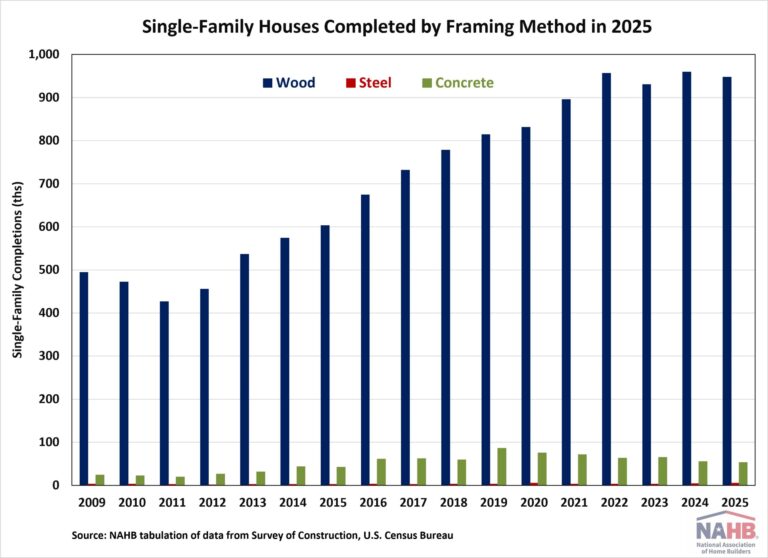

Wood framing continues to dominate the U.S. single-family home construction market, according to NAHB analysis of 2025 Census Bureau data. In 2025, wood framing accounted for 94% of all completed single-family homes, maintaining its position as the leading construction method. Concrete-framed homes represented 5% of completions, while steel-framed homes remained relatively rare, comprising half a percent of the market.

On a count basis, approximately 947,000 wood-framed homes were completed in 2025. This was a 1% decrease compared to the 2024 total. Despite the decline in the number of wood-framed homes, the wood-framed market share remained unchanged at 94% in 2025. Steel-framed homes, while still uncommon, continued to increase. About 5,000 steel-framed homes were completed in 2025, representing a 25% increase from the previous year.

Meanwhile, concrete-framed homes also experienced a decline. The concrete market share remained at 5% in 2025, while the number of concrete-framed homes completed fell to approximately 53,000, a 4% decrease compared to the prior year. Non-wood-based framing methods are primarily concentrated in the South due to residential resiliency requirements. In 2025, concrete-framed homes made up 9% of all single-family home completions in the South. Additionally, about 60% of all steel-framed homes completed in 2025 were built in the South, highlighting the region’s distinct building trends.


This article was originally published by a eyeonhousing.org . Read the Original article here. .


If you’ve been tracking home color trends, you’ve likely noticed a clear shift toward warmth — both inside and out. Blues and greens are still going strong, but the cool, icy tones of recent years have melted away. In their place are earthier blue and green shades touched with yellow or brown. Grays, once the go-to neutral, are giving way to taupes, khakis and even beiges.

That move toward warmth is echoed in the latest paint trend reports from major U.S. brands, including their 2026 Color of the Year picks. While the choices aren’t identical, a pattern emerges: cozy greens, creamy neutrals and a few moody darks for contrast. Let’s take a closer look.

1. Hidden Gem by Behr

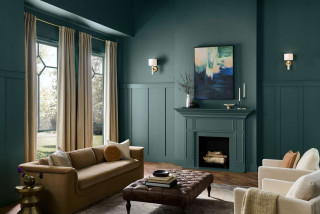
This richly saturated blue-green has a touch of smoke that tempers its boldness. Warm undertones keep it grounded and livable, giving it an elegant, slightly moody edge — a color that makes a statement without shouting.

Wrap bedroom, dining room or library walls in this hue for a cocooning feel, and balance the depth with light, textured neutrals.

Hidden Gem also shines on architectural details — interior doors, window trim, wainscoting, built-ins or a fireplace surround — for a refined, tailored look. On a kitchen island or mudroom lockers, it can anchor the space without overwhelming it.

Outside, try it on a front door for a jewel box welcome or as siding with light trim for a modern coastal vibe. It’s equally striking on shutters set against pale brick or natural stone.

Find an interior designer on Houzz

2. Warm Eucalyptus by Valspar

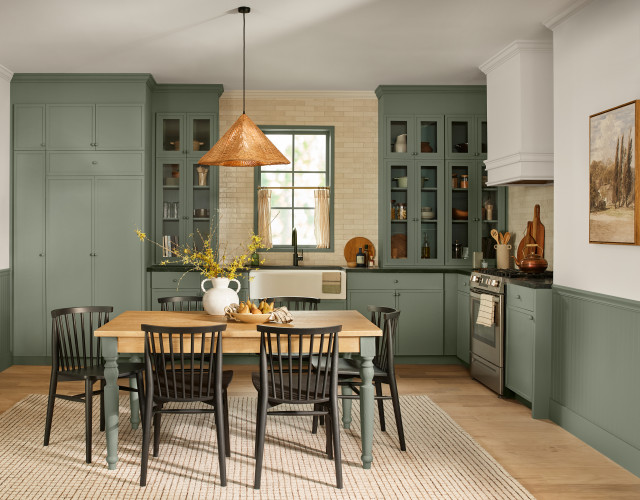
Warm Eucalyptus is a softly muted gray-green — think sun-dried leaves with an earthy undertone. Quieter than bolder statement greens, it feels soothing and grounded, with just enough presence to act as a modern neutral.

It’s a beautiful choice for kitchen cabinetry, pairing effortlessly with soapstone or marble counters and aged brass or matte black hardware. Try it on bookcases, bath vanities or a media console for calm, tailored color that adds depth without dominating.

See why you should hire a professional who uses Houzz Pro software

3. Midnight Garden by Dunn-Edwards

Midnight Garden is a slightly cooler, botanical green that feels fresher and brighter than the deeper, earthier olives. It brings an outdoorsy, organic vibe indoors and looks especially crisp and welcoming when paired with white.

This appetizing hue is right at home in kitchens, where it fits beautifully with warm wood tones. It also works well in living rooms or offices, creating a softly energizing mood. Balance it with textured neutrals and pale woods, or introduce contrast with inky navy, charcoal or terra-cotta accents.

Pros Share 10 Beautiful Green Paint Colors

4. Secret Safari by PPG

This vivid, electric green leans sunny and yellow, bringing a fresh, tropical energy to any space. It’s high-impact and instantly energizing.

A little goes a long way: Use it on a powder room wall, the inside of a bookcase, stair risers or interior doors. If you want to go all in, make sure the room has plenty of natural light or balance it with light neutrals to soften the effect.

8 Color Trends From the Maison & Objet Design Show

5. Universal Khaki by Sherwin-Williams

This soft tan from Sherwin-Williams was selected for its timeless simplicity. Light to medium in depth, it carries gentle yellow and brown undertones that create casual warmth.

South- or west-facing rooms will bring out its sunnier side, while north-facing spaces make it feel more subdued and cooler. As a wall color, it pairs wonderfully with crisp white trim and warm wood accents. Plus, it makes a neutral backdrop for bolder shades like rust, terra cotta, graphite or deep green.

6. Melodious Ivory by Dutch Boy

Melodious Ivory is a pale, creamy neutral with a soft peach undertone. Lighter and brighter than the previous tan, it shares the same timeless, easygoing appeal. It plays nicely with soft greens, oranges and browns, or it can serve as a calm backdrop for bolder pops of burgundy or watery blue.

How to Confidently Choose Colors for Your Home

7. Epernay by C2

Named for the town in France’s Champagne region, Epernay is a crisp, luminous warm white — the cleanest and brightest of these Color of the Year picks.

Its subtle warmth keeps it from feeling stark, making it a refined alternative to gallery white. It beautifully showcases art, luxurious textures and rich wood tones. As shown here, Epernay works especially well on kitchen cabinets when you want a light, soft white rather than a pure, icy shade.

8. Silhouette by Benjamin Moore

One of the few dark shades on the list, Silhouette is a deep, smoky espresso brown with a hint of gray. That subtle gray undertone gives it an earthy yet refined quality, making it versatile for a range of interiors. Whether your style leans modern and minimalist or layered and transitional, Silhouette adds elegant calm — a sophisticated neutral with depth. Pair it with light warm grays or creamy whites for contrast, or embrace its moody side with navy, rich burgundy or black.

New to home remodeling? Learn the basics

9. Warm Mahogany by Glidden

Warm Mahogany is a sumptuous red-orange softened by earthy brown undertones, perfect for wrapping a room in cozy color. It’s ideal for intimate spaces like bedrooms, as well as more public areas such as dining rooms or kitchens.

Pair it with creamy whites, bone or putty for a softer look, or add contrast with warm blackened bronze or deep olive. Natural materials and textures — walnut or oak, leather, boucle, velvet and linen — amplify its richness.

Your turn: Which of these 2026 Color of the Year picks is your favorite? Which would you pick? Share your thoughts in the Comments.

More on Houzz
Read more stories
Browse photos for ideas
Find a home professional


This article was originally published by a www.houzz.com . Read the Original article here. .

Pin It