Tag

Delinquencies

Browsing


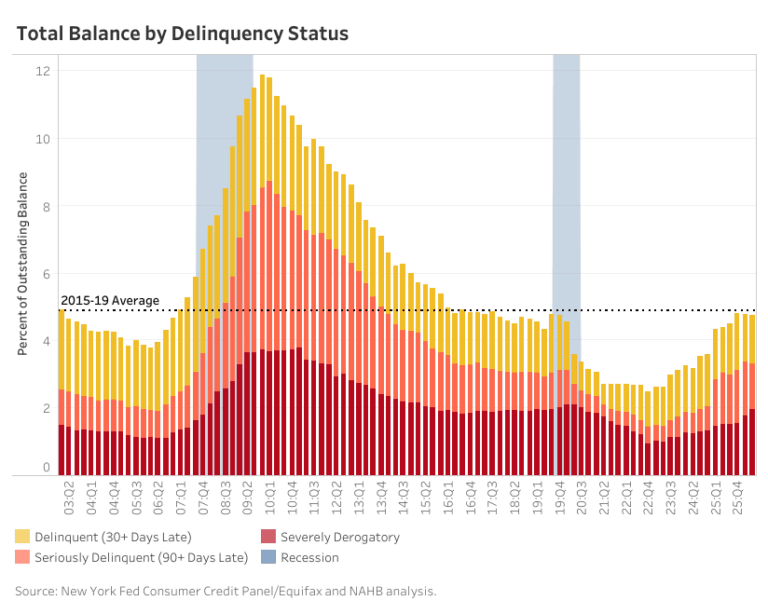
Household debt delinquency rates showed signs of stabilization in the second quarter of 2026 as overall share of delinquency balances edged lower and the transition to seriously delinquent debt declined for the second consecutive quarter.

According to the latest Quarterly Report on Household Debt and Credit from the Federal Reserve Bank of New York, about 4.7% of outstanding household debt balances were in some stage of delinquency, a decrease of 0.1 percentage points (pp) from the previous quarter. Moreover, 3.3% of total household debt balances were seriously delinquent (at least 90 days delinquent) in the second quarter, down slightly from 3.4% in the first quarter.

The improvement occurred across most consumer loan categories. Serious delinquency rate for auto loans decreased to 5.5% from 5.6%, while credit card balances at least 90 days delinquent declined 0.2 pp to 12.9% in the second quarter. Nonetheless, credit cards continued to have the highest serious delinquency rate among the major debt categories. Housing-related debt had mixed results. The share of mortgage balances that were seriously delinquent fell to 0.99% from 1.1%. In contrast, the serious delinquency rate for student loans and HELOC edged higher to 10.6% and 0.99%, respectively.

The flow of balances newly entering a serious delinquency stage was more encouraging. Overall, 2.6% transitioned into serious delinquency during the second quarter, down from 2.8% in the previous quarter. This marked the second consecutive quarterly decline following a transition of 3.3% in the fourth quarter of 2025. Much of the decline was driven by student loans and credit cards. The share of student loan balances newly becoming seriously delinquent fell sharply to 7.8%, from 10.9% in the first quarter. Credit card transitions also declined to 6.97%, from 7.10%.

Mortgage transitions, however, continued to move in the opposite direction. The share of mortgage balances newly entering serious delinquency increased to 1.52%, from 1.48% in the first quarter. This category has been gradually trending upward in recent years, indicating some continued deterioration in mortgage credit performance even as the stock of seriously delinquent mortgage balances declined during the quarter. Auto loan transitions also edged higher to 3.0%.


This article was originally published by a eyeonhousing.org . Read the Original article here. .
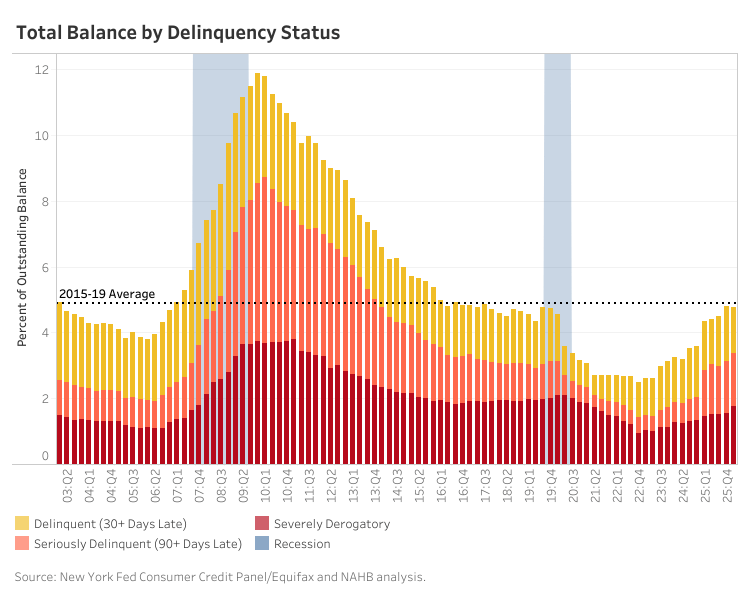

Consumer loan delinquency rates continued to normalize in the first quarter of 2026 as pandemic-related disruptions diminished and credit conditions moved closer to historical norms.  According to the latest Quarterly Report on Household Debt and Credit from the Federal Reserve Bank of New York, about 4.8% of outstanding household debt balances were in some stage of delinquency, unchanged from the previous quarter but above the unusually low levels observed during the pandemic period.

The composition of delinquent balances also points to increasing persistence of financial stress among borrowers. Loans categorized as severely derogatory—which are delinquent balances with reports of repossession, charge-off to bad debt, or foreclosure—increased of 0.3 percentage points in the first quarter of 2026 compared to the previous quarter to 1.8%. Likewise, balances that were 120 or more days delinquent have steadily trended upward since 2022 as more borrowers who fall behind are remaining delinquent for longer periods rather than catching up on missed payments.

Looking at seriously delinquent loans, defined as balances 90 or more days past due, conditions continue to diverge across loan types. Credit cards remain the top area of concern. Approximately 13.1% of credit card balances were seriously delinquent in the first quarter of 2026, increasing 0.4 percentage points from the previous quarter and quickly approaching levels last seen following the Great Recession. The sustained rise in seriously delinquent credit card balances since mid-2022 suggests many households increasingly relied on revolving debt to manage higher everyday living costs during the inflation surge and are now struggling to keep up with repayment.

Student loan balances that were seriously delinquent also continued rising following the resumption of collections and credit reporting after the payment pause. About 10.3% of student loan balances were 90+ days delinquent in the first quarter, up from 9.6% at the end of 2025. Furthermore, roughly 1 million federal student loan borrowers entered default in the last quarter of 2025, followed by another 2.6 million borrowers in the first quarter of 2026, as missed payments began progressing through the federal default timeline. The study also noted that the student loan borrowers entering default were likely to be delinquent on other forms of debt, and the financial strain could intensify as collection efforts resume.

Auto loan performance also continued deteriorating in the first quarter. The share of auto loan balances that were seriously delinquent rose to 5.6%, the highest level since 2003. Elevated vehicle prices and financing costs which rose during the pandemic and have remained sticky, continue to pressure many borrowers, particularly those with lower credit quality.

Mortgage debt, by contrast, remains comparatively healthy despite inching up in recent years. About 1.1% of mortgage balances were seriously delinquent, remaining low by historical standards. Strong homeowner equity positions and historically low fixed-rate mortgages continue supporting mortgage credit performance even as broader consumer credit conditions weaken.

Overall, household balance sheets show growing financial strain especially within non-housing consumer debt categories, with gradual and persistent deterioration in credit card, student loan, and auto loan performance.


This article was originally published by a eyeonhousing.org . Read the Original article here. .
Pin It