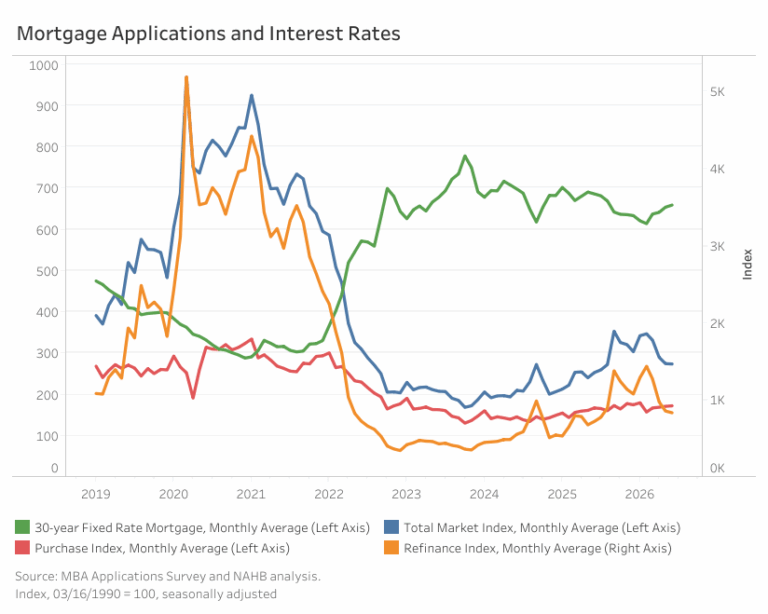
Mortgage applications stalled in June as higher mortgage rates dampened market activity. The Mortgage Bankers Association’s (MBA) Market Composite Index, a measure of total mortgage application volume, stayed relatively unchanged with a marginal decrease of 0.3% month-over-month on a seasonally adjusted basis. The decline was driven by a 2.5% decline in refinancing applications, which offset a modest 0.7% gain in purchase applications. Compared with a year earlier, however, total mortgage application activity remained 7.9% higher, with refinance applications up 15.6% and purchase applications rising 3.1%. Meanwhile, applications for adjustable-rate mortgages (ARM) decreased 9.4% over the month, bringing the ARM share of total applications to 8.2%.
The average contract rate for a 30-year fixed-rate mortgage increased 5 basis points (bps) to 6.59% in June, as markets priced in inflation risks and the possibility of the Federal Reserve increasing rates this year. Nonetheless, the rate remained 27 bps lower than its level a year ago.
By loan type, applications for ARMs decreased 9.4%, while fixed-rate mortgages (FRMs) increased about 0.4% from the previous month. On a year-over-year basis, applications for FRM and ARMs were up 6.9% and 22.4%, respectively. As of June 2026, the share of ARMs applications was down 0.8 percentage points from the prior month to 8.2% on a non-seasonally adjusted basis (NSA). Compared to a year ago, ARMs share were 0.6 percentage points higher. The average contract interest rate for 5/1 ARMs was 5.8% in June.
Loan sizes decreased across most categories in June, with ARM loans being the only exception. Consequently, the overall average loan size declined 3.4% to $393,800. The average purchase and refinance loan sizes decreased 1.8% to $456,500, and 5.8% to $302,500, respectively. The average ARM loan size edged up 0.8% to $944,800.
This article was originally published by a eyeonhousing.org . Read the Original article here. .