Tag

Declined

Browsing


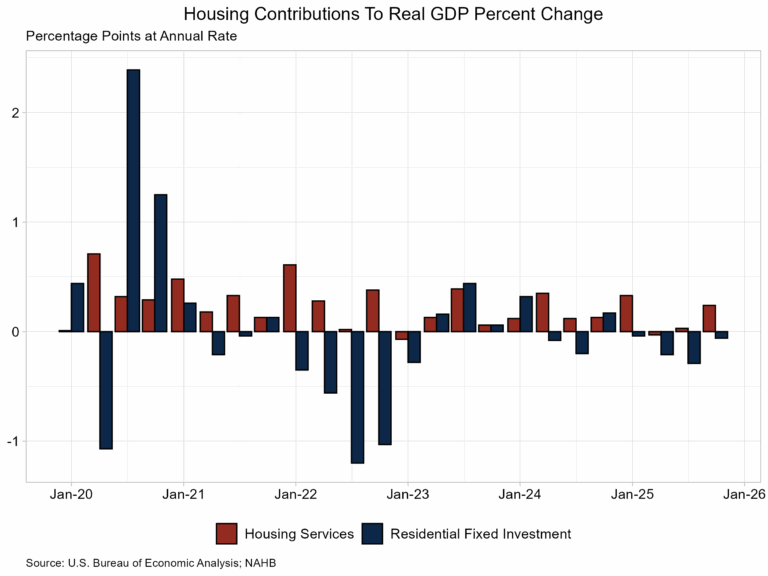
Housing’s share of the economy was 16.0% in the fourth quarter of 2025, according to the latest estimates of GDP produced by the Bureau of Economic Analysis. This share is down from 16.1% in the third quarter and is also lower than 16.3% as registered just one year ago. Residential construction, measured by residential fixed investment, subtracted from real GDP growth for each quarter in 2025, replicating a trend from 2022.

The more cyclical home building and remodeling component–residential fixed investment (RFI)–was 3.7% of GDP, down from 3.8% in the previous quarter. The second component, housing services, was 12.3% of GDP, constant from 12.3% in the previous quarter. The graph below plots the share for housing services and RFI along with housing’s total share of nominal GDP.

Housing service growth is much less volatile when compared to RFI due to the cyclical nature of RFI. Historically, RFI has averaged roughly 5% of GDP, while housing services have averaged between 12% and 13%, for a combined 17% to 18% of GDP. These shares tend to vary over the business cycle. However, the housing share of GDP lagged during the post-Great Recession period due to underbuilding, particularly in the single-family sector.

Residential Fixed Investment

In the fourth quarter, RFI subtracted 6 basis points from the headline GDP growth rate, marking the fourth consecutive quarter of negative contributions. RFI was 3.7% of the economy, recording a $1.2 trillion seasonally adjusted annual pace. Among the two segments of RFI, private investment in structures fell 1.6%, while residential equipment rose 2.1%.

Breaking down the components of residential structures, single-family RFI fell 5.2%, while multifamily RFI fell 3.6%. RFI for multifamily structures has contracted for nine consecutive quarters, recently due to declines in new supply and a shift in geography for multifamily construction to lower density markets. Permanent site structure RFI, which is made up of single-family and multifamily RFI, fell 4.9%. The “other structures” RFI category was the only one to rise, up 1.2% in the fourth quarter. This component consists primarily of manufactured homes, improvements, and dormitories. On a seasonally adjusted annual basis in the fourth quarter, private investment in permanent site structures was at $517.4 billion, while other structures totaled $640.6 billion.

Housing Services

The second impact of housing on GDP is the measure of housing services. Similar to the RFI, housing services consumption can be broken into two components. The first component, housing, includes gross rents paid by renters, owners’ imputed rent (an estimate of how much it would cost to rent owner-occupied units), rental value of farm dwellings, and group housing. The inclusion of owners’ imputed rent is necessary from a national income accounting approach, because without this measure, increases in homeownership would result in declines in GDP. The second component, household utilities, is composed of consumption expenditures on water supply, sanitation, electricity, and gas.

For the fourth quarter, housing services represented 12.3% of the economy or $3.9 trillion on a seasonally adjusted annual basis. Real housing services expenditures rose 2.0% at an annual rate in the fourth quarter. Real personal consumption expenditures for housing grew 1.2%, while real household utilities expenditures increased 7.9%.

Personal consumption expenditures (PCE) for housing services are the largest component of PCE, making up 18.0% in the fourth quarter. The second largest component of PCE is health care services, at 17.2%. Expenditures on services were $14.8 trillion on a seasonally adjusted annual basis in the fourth quarter, more than double the expenditures on goods ($6.6 trillion).


This article was originally published by a eyeonhousing.org . Read the Original article here. .
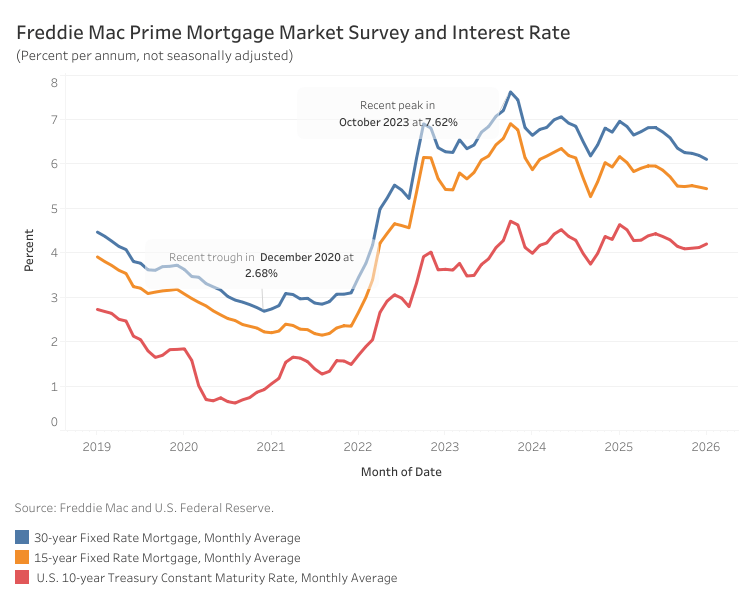

Long-term mortgage rates continued to decline in January. According to Freddie Mac, the 30-year fixed-rate mortgage averaged 6.10% last month, 9 basis points (bps) lower than December. Meanwhile, the 15-year rate declined 4 bps to 5.44%. Compared to a year ago, the 30-year rate is lower by 86 bps. The 15-year rate is also lower by 72 bps.

The 10-year Treasury yield, a key benchmark for long-term borrowing, averaged 4.20% in January – an increase of 8 bps from the previous month, but remained considerably lower than last year by 43 bps. While mortgage rates typically move in tandem with the treasury yields, the spread between the two narrowed during the month. Reports that the Trump administration encouraged Fannie Mae and Freddie Mac to expand purchases of mortgage-backed securities (MBS) boosted demand for MBS, pushing mortgage rates lower.

However, treasury yields rose sharply in the final week of January from global and fiscal pressures. The impact of the rift with Europe and the broader reduction of international purchases of U.S. Treasuries has left a measurable impact on U.S. interest rates. The 10-year Treasury rate at the beginning of 2026 was at 4.11%. That rate has now increased to 4.26%. This unfortunately means the beneficial impact of the $200 billion of additional acquisition of Fannie Mae and Freddie Mac MBS by those GSEs has been partially offset by international concerns.


This article was originally published by a eyeonhousing.org . Read the Original article here. .

From 2020 to 2024, sales of lower-priced new homes declined significantly as the market moved toward higher-priced segments. Rising construction costs—driven by inflation, supply chain disruptions, and labor shortages—as well as higher regulatory costs, made it increasingly difficult for builders to construct affordable homes. On the other hand, low levels of inventory pushed up the price of new single-family homes, deepening the housing affordability crisis for first-time and middle-income buyers.

National New Home Sales by Sales Price

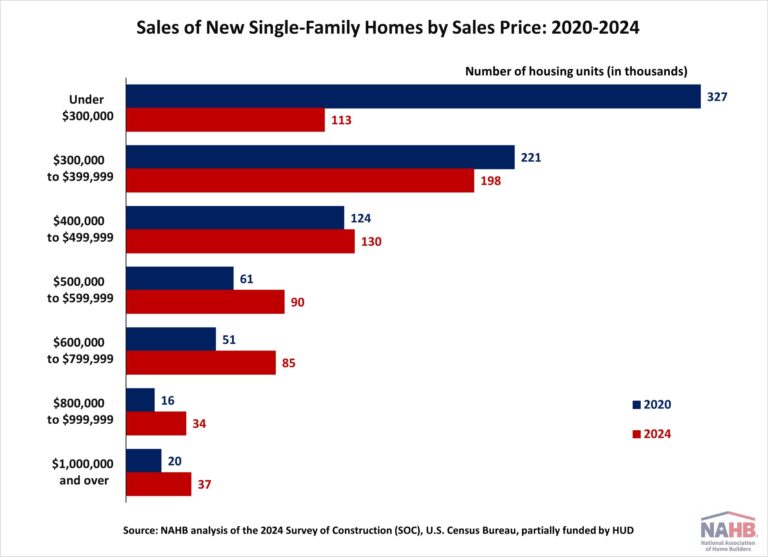
Data from the U.S. Census’s Survey of Construction (SOC) shows that total sales of new single-family homes declined by 17% during the 2020—2024 period. Meanwhile, the median sales price of new single-family homes increased significantly, rising from $330,900 in 2020 to $420,300 in 2024. This steep rise in sales price has placed additional pressure on prospective home buyers, particularly those seeking homes in the lower-priced segments.

Between 2020 and 2024, the market for new single-family homes experienced significant shifts in the distribution of sales by price range. Most notably, there was a sharp decline in sales of lower-priced homes. Homes priced under $300,000 experienced a 65% decline in sales, while sales of homes priced between $300,000 and $399,999 fell by 10%. In contrast, higher-end segments saw substantial growth, with sales of homes priced between $800,000 and $999,999 more than doubling and those priced at $1,000,000 or more increasing by 85%.

The market share of lower-priced homes declined dramatically. In 2020, homes priced under $300,000 accounted for 40% of the total new single-family home sales, making them a dominant category. By 2024, this category had dropped to the third largest, overtaken by homes in the $300,000—$399,999 and $400,000—$499,999 ranges. Meanwhile, the share of higher-priced homes expanded, reflecting a broader shift toward more expensive construction and away from affordability.

Regional New Home Sales by Sales Price

The regional picture mirrors these national trends, though the magnitude and affected price category vary by geography. Between 2020 and 2024, all four regions—the Northeast, Midwest, South, and West—saw declines in new home sales. The West experienced the steepest drop at 28%, followed by the Midwest at 14%, the South at 13%, and the Northeast at 8%. The declines mainly reflect significant declines in lower-priced home sales.

In the Midwest and South, the declines in new home sales were limited to homes priced under $300,000. In the Northeast and West, where the regions tend to have higher median home prices, sales declines occurred in multiple price categories. The Northeast saw a broader decline in new homes sold under $600,000, while new home sales in the West reported declines in three price categories under $500,000.

Furthermore, all four regions also experienced a decline in the market share of lower-priced homes. In 2020, more than half of the new homes sold in the Midwest and South were priced under $300,000. By 2024, that share had plummeted to just 16% in the Midwest and 23% in the South. The Northeast and West also saw notable shifts, with the share of homes priced between $300,000 and $499,999 dropping sharply over the same period.

Discover more from Eye On Housing

Subscribe to get the latest posts sent to your email.


This article was originally published by a eyeonhousing.org . Read the Original article here. .
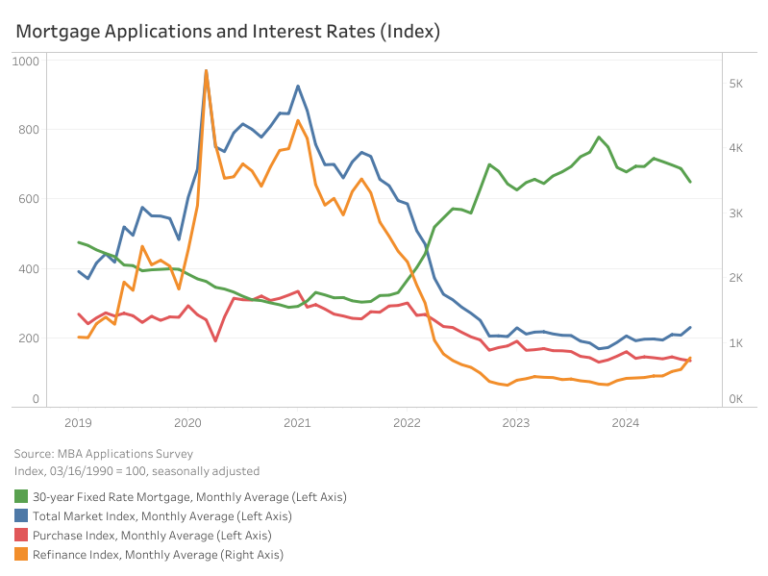

The Market Composite Index, a measure of mortgage loan application volume by the Mortgage Bankers Association’s (MBA) weekly survey, saw a month-over-month increase of 10.7% on a seasonally adjusted (SA) basis. Compared to last August, the index increased by 20.8%. While the Purchase Index declined by 2.9%, month-over-month, the Refinance Index jumped 30.8% as borrowers took advantage of the declining mortgage rates to refinance higher-rate loans. On a yearly basis, the Purchase Index is down by 8.6%, while the Refinance Index increased by 87.2%.

The average monthly 30-year fixed mortgage rate has fallen for four straight months with August seeing the largest decrease of 40 basis points (bps), bringing the rate to 6.49%. The current rate is 73 bps lower than last August.

The average loan size for the total market (including purchases and refinances) is up 3.6% from July to $380,800 on a non-seasonally adjusted (NSA) basis. Similarly, the month-over-month change for purchase loans increased 0.6% to an average size of $426,600, while refinance loans rose by 18.5% to an average of $325,800. The average loan size for an adjustable-rate mortgage (ARM) also saw a steep increase of 9.5% for the same period, from $1.01 million to $1.1 million.

Discover more from Eye On Housing

Subscribe to get the latest posts sent to your email.


This article was originally published by a eyeonhousing.org . Read the Original article here. .
Pin It