Tag

Decline

Browsing


Economic uncertainty coupled with rising building material costs and interest rates resulted in a sharp decline in builder sentiment in April as the housing market enters into the heart of the spring buying season.

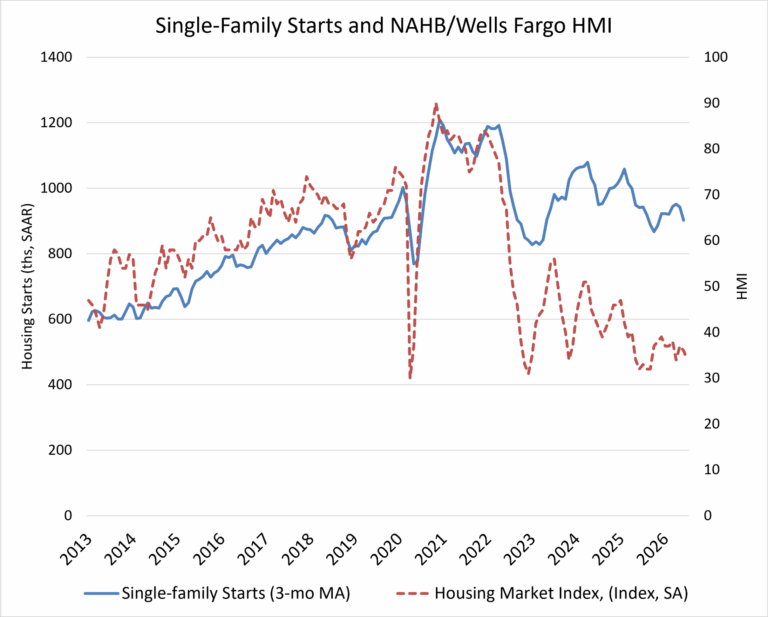
Builder confidence in the market for newly built single-family homes fell four points to 34 in April, according to the National Association of Home Builders (NAHB)/Wells Fargo Housing Market Index (HMI). This is the lowest level since September 2025.

Builder sentiment fell back in spring as buyers face ongoing elevated interest rates and growing economic uncertainty. The year started with hopes for housing momentum growth, but risks with respect to the Iran war, energy costs, and declines for consumer confidence have slowed the market.

With oil prices higher in the U.S., 62% of builders reported suppliers have increased building material costs due to higher fuel prices, including gas and diesel. Energy costs make up approximately 4% of residential construction material input and service costs.  With near-term economic risks elevated, 70% of builders reported challenges pricing homes given uncertainty about material costs.

The latest HMI survey also revealed that 36% of builders cut prices in April, down slightly from 37% in March. The average price reduction was 5%, down from the 6% figure in March. The use of sales incentives was 60% in April, down from 64% in March, and marking the 13th consecutive month this share reached 60% or higher.

Derived from a monthly survey that NAHB has been conducting for more than 40 years, the NAHB/Wells Fargo HMI gauges builder perceptions of current single-family home sales and sales expectations for the next six months as “good,” “fair” or “poor.” The survey also asks builders to rate traffic of prospective buyers as “high to very high,” “average” or “low to very low.” Scores for each component are then used to calculate a seasonally adjusted index where any number over 50 indicates that more builders view conditions as good than poor.

All three of the major HMI indices posted losses in April. The HMI index gauging current sales conditions fell four points to 37 from March to April, the index measuring future sales dropped seven points to 42 and the index charting traffic of prospective buyers posted a three-point decline to 22.

Looking at the three-month moving averages for regional HMI scores, the Northeast fell two points to 42, the Midwest dropped two points to 41, the South held constant at 35 and the West fell three points to 29.

The HMI tables can be found at nahb.org/hmi.


This article was originally published by a eyeonhousing.org . Read the Original article here. .


Residential construction activity began 2026 on a mixed note, with single-family permitting weakening significantly while multifamily activity remained relatively stable. Higher borrowing costs and affordability constraints continue to weigh on single-family construction, while multifamily permitting shows signs of resilience despite regional variation.

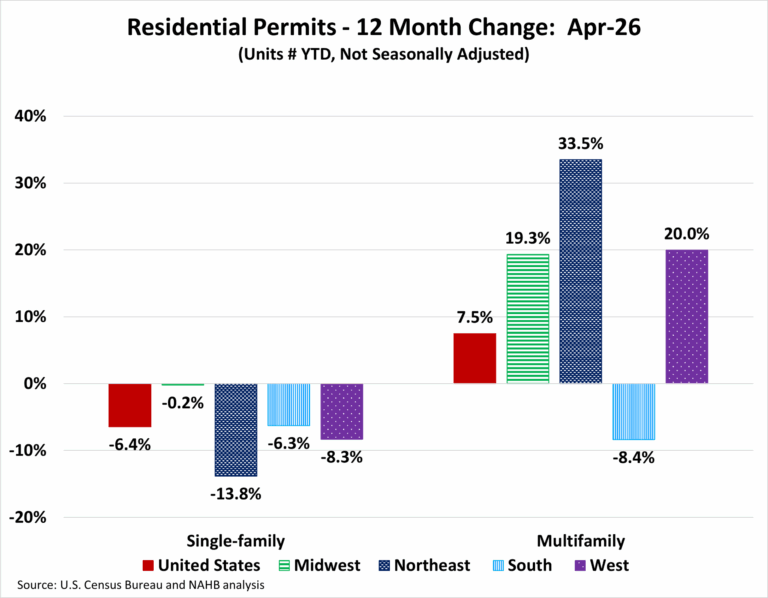
Over the first month of the year, the number of single-family permits issued nationwide reached 62,034. On a year-over-year basis, this represents a 15.2 percent decline compared with the January 2025 total of 73,115. Multifamily permitting activity was essentially flat, with 38,215 permits issued nationwide, marking a 0.5 percent decline from the same period last year.

Regionally, year-to-date single-family permitting declined in all four regions in January. The Midwest declined by 9.1 percent, the Northeast fell 10.6 percent, the South declined 14.7 percent, and the West dropped 20.1 percent. Multifamily permits increased in three of the four regions, led by gains in the Northeast (up 39.4 percent), followed by the West (up 35.5 percent), and the Midwest (up 10.9 percent). The South saw a decline of 24.2 percent, driven largely by a 42.0 percent decrease in Atlanta-Sandy Springs-Roswell, GA metropolitan areas and a 39.0 percent drop in the Houston-Pasadena-The Woodlands, TX metropolitan area.

At the state level, seven states recorded year-over-year increases in single-family permits in January, with gains ranging from 25.5 percent in Montana to 0.4 percent in Washington. Connecticut reported no change. The remaining 42 states and the District of Columbia reported declines, led by the District of Columbia, which posted the steepest drop at 52.0 percent.

The ten states issuing the highest number of single-family permits accounted for 63.8 percent of all single-family permits issued nationwide. Texas led the country, with 9,580 permits issued at the start of 2026, although this represented a 21.3 percent decline compared with January 2025. Florida, the second-highest state, saw permits fall by 14.9 percent, while North Carolina, ranked third, experienced a decline of 9.8 percent.

Between January 2026 and January 2025, 26 states recorded increases in multifamily building permits, while 24 states and the District of Columbia experienced declines. Delaware posted the largest percentage increase, with multifamily permits surging 1,293.8 percent, rising from 16 to 223 units. In contrast, Wyoming recorded the steepest decline, with permits falling 100.0 percent, from 13 to zero units.

The ten states issuing the highest number of multifamily permits accounted for 63.1 percent of all multifamily permits issued nationwide. Over the first month of 2026, California, which issued the most multifamily permits, recorded a substantial increase of 119.2 percent. Texas, the second-highest state, posted a decline of 24.4 percent, while New York, ranking third, saw multifamily permits rise by 66.7 percent.

At the local level, the following are the ten metropolitan areas with the highest number of single-family permits issued.

Below are the ten metropolitan areas with the highest levels of multifamily permitting activity.


This article was originally published by a eyeonhousing.org . Read the Original article here. .

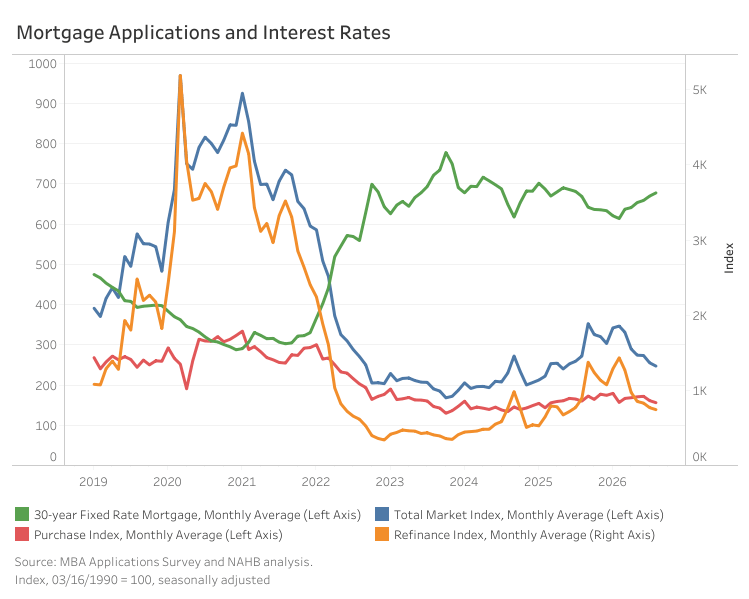
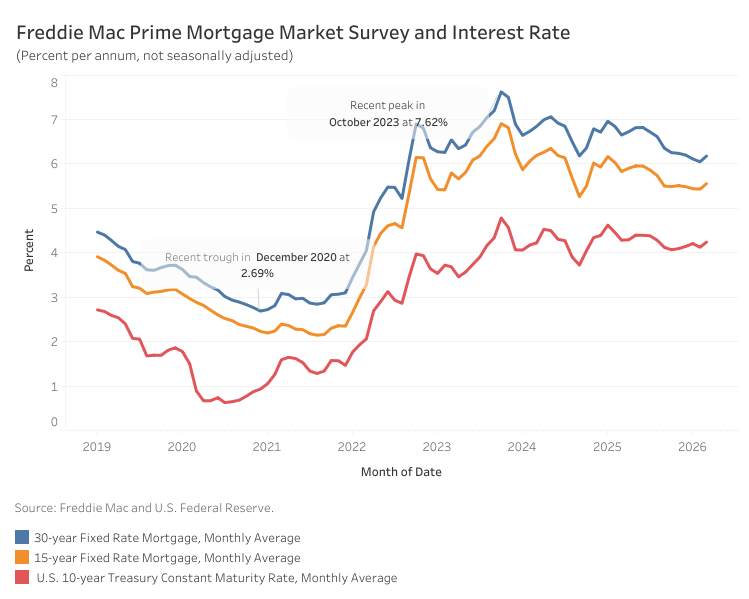
Mortgage rates, which dipped below 6% in February, climbed back up to end the month just under 6.4%. According to Freddie Mac, the 30-year fixed-rate mortgage averaged 6.18% in March, 13 points (bps) higher than February. The average 15-year rate also increased by the same amount to 5.56%. Despite the recent increase, both rates remain lower than a year ago by 47 bps and 27 bps, respectively.

The rebound in mortgage rates was driven primarily by movements in the 10-year Treasury yield, which jumped 11 bps to 4.24% as tensions in the Middle East escalated. The ongoing Iran conflict has disrupted oil markets, pushing oil prices higher and reigniting fears that inflation could pick up again.

Amid this uncertainty, the Federal Reserve held the federal funds rates unchanged at 3.5% to 3.75%. They revised their inflation expectations higher from 2.4% last December to 2.7% but maintained that one rate cut is still possible in 2026.


This article was originally published by a eyeonhousing.org . Read the Original article here. .


The number of open positions in construction in February was down year-over-year, per the Bureau of Labor Statistics Job Openings and Labor Turnover Survey (JOLTS). The current level of open jobs is down measurably from three years ago due to declines in construction activity, particularly in housing. However, recent gains for nonresidential construction have not fully offset soft conditions for housing with respect to the demand for construction labor.

The number of open jobs for the overall economy declined in February, falling from 7.24 million in January to 6.88 million in February. The February reading was down from a year ago (7.24 million) due to a cooling labor market.

Previous NAHB analysis indicated that this number had to fall below eight million on a sustained basis for the Federal Reserve to move forward on interest rate reductions. With estimates remaining below eight million for national job openings, the Fed, in theory, should be able to cut further.

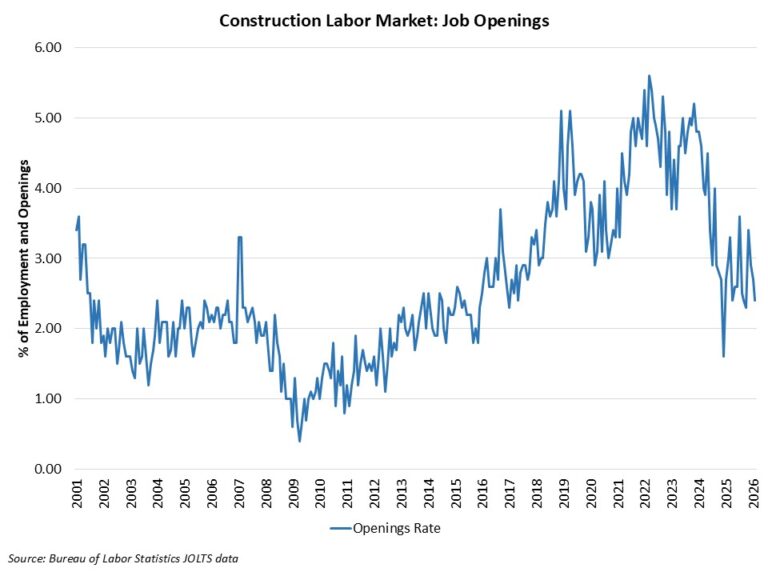
The number of open construction sector jobs fell, declining slightly from 230,000 in January to 202,000 in February. This total was down compared to a year ago (255,000). The chart below notes the declining trend that has been in place for unfilled construction jobs since the Fed raised the federal funds rate and home building weakened. While home building employment was declining during the second half of 2025, other subsectors of the construction industry have expanded (e.g. data centers). This has produced volatility within a reduced range in the series since 2024.

The construction job openings rate decreased to 2.4% in February, down from the 3% rate estimated a year ago.

The layoff rate in construction declined slightly to 1.8% in February. The quits rate decreased to 1.3% for the month.

The current data looks similar to the much discussed low-hire, low-fire labor market paradigm.


This article was originally published by a eyeonhousing.org . Read the Original article here. .

New home sales declined in January, reflecting typical monthly volatility as well as weather-related disruptions. On a three-month moving average basis, sales remain broadly in line with a year ago, suggesting underlying demand conditions have been relatively stable despite the month-to-month fluctuations. Meanwhile, builders continue to rely on incentives to attract buyers and sustain demand. The January NAHB/Wells Fargo Housing Market Index showed that 64% of builders used sales incentives, marking the 12th consecutive month this share exceeded 60%.

Sales of newly built single-family homes fell 17.6% in January to a seasonally adjusted annual rate of 587,000 from a downwardly revised December reading, according to newly released data from the U.S. Department of Housing and Urban Development and the U.S. Census Bureau. The pace of new home sales is down 11.3% from a year earlier. On a three-month moving average basis, sales were 688,000, remaining broadly in line with the 685,000 pace seen a year ago.

A new home sale occurs when a sales contract is signed, or a deposit is accepted. The home can be in any stage of construction: not yet started, under construction or completed. In addition to adjusting for seasonal effects, the January reading of 587,000 units is the number of homes that would sell if this pace continued for the next 12 months.

New single-family home inventory rose to 476,000 units in January. This is 0.4% higher than the previous month, but 4.0% lower than a year earlier. At the current sales pace, months’ supply for new homes stood at 9.7, compared to 9.0 a year ago. The increase in inventory along with weaker sales partly reflects a temporary slowdown in the new home market, as weather disruptions limited transactions during the month, particularly in regions such as the Northeast, where sales declined sharply by 44.7%.

A year ago, there were 116,000 completed, ready-to-occupy homes available for sale (not seasonally adjusted). By the end of January 2026, that number increased 10.3% to 128,000. However, completed, ready-to-occupy inventory accounted for just 27% of total inventory, while homes under construction made up 51%. The remaining 22% of new homes for sale in January were homes that had not started construction when the sales contract was signed.

The median new home sale price declined 4.5% to $400,500, representing a 6.8% decrease from a year ago. In January, 19% of new homes were priced below $300,000, while 34% were priced above $500,000. The share of new homes priced below $300,000 has trended lower since October 2025, after reaching a recent peak of 23% in September 2025.

Regionally, on a year-to-date basis, new home sales are up 1.4% in the Midwest and 4.1% in the South. New home sales are down 8.3% in the Northeast and 3.5% in the West.


This article was originally published by a eyeonhousing.org . Read the Original article here. .


Housing affordability remains a critical challenge nationwide, and mortgage rates continue to play a central role in shaping homebuying power. Although rates have declined from the recent peak of about 7.6% in 2023 to around 6.01% as of February 19,2026, they remain elevated relative to typical levels in the 2010s. During that decade, mortgage rates generally ranged between 4% and 5%. They also remain well above the historic lows reached during the pandemic. Even modest declines in mortgage rates can have a significant impact on housing affordability, pricing more households back into the market. New NAHB Priced-Out Estimates illustrate how changes in interest rates affect the number of households that can afford a median-priced new home.

At the beginning of 2026, with the average 30-year fixed mortgage rate at 6.25%, around 31.5 million households could afford a median-priced new home at $413,595. This requires a household income of $124,336 by the front-end underwriting standards. A modest 25 basis-point rate reduction from 6.25% to 6% would lower the qualifying income threshold sufficiently to allow 1.42 million additional households to afford a median-priced new home in 2026.

This sizable affordability response reflects the underlying distribution of U.S. household incomes. Household incomes are heavily concentrated in the middle of the distribution, with many households near key affordability thresholds. Approximately 79.8 million households earn less than $105,880, and an additional 14 million households earn between $105,881 and $132,350. When mortgage rates decline, the qualifying minimum income shifts downward into these densely populated income ranges, bringing a substantial number of households into the market.

In contrast, an equivalent 25 basis-point cut at higher interest rate levels has a smaller impact on affordability. For example, a decline from 7.75% to 7.5% would only price around 1 million households into the market. At higher rate levels, fewer households remain near the margin of qualification.

Overall, the estimates demonstrate that modest mortgage rate relief at current levels can translate into significant gains in housing affordability, highlighting the importance of mortgage interest rates for prospective homebuyers and the housing market.


This article was originally published by a eyeonhousing.org . Read the Original article here. .


Nationally, house prices continued to rise at a modest pace in the third quarter of 2025, as mentioned in our previous quarterly house prices post. However, this national trend masks significant variation across local markets. While many metro areas continued to see house price appreciation, others experienced notable declines following several years of rapid growth.

Since the onset of the COVID-19 pandemic, house prices have surged nationwide. Between the first quarter of 2020 and the third quarter of 2025, national house prices climbed 54.9%. Local markets saw broad gains as well, with cumulative appreciation ranging from 18.3% to 88.4%, and 159 metro areas reached their highest recorded house prices in the third quarter of 2025.

Yet despite these increases, more than half of metro areas have now experienced at least some decline from their recent price peak. These declines range from a slight 0.1% dip to a more substantial 12.7% decline, with most of the downward trends beginning in last 2024 or early 2025.

House price declines have been most widespread in the West and South, regions that saw some of the fastest appreciation during the pandemic boom.  Several markets stand out for their significant corrections:

Punta Gorda, FL has experienced the sharpest decline, with prices falling 12.7% since its peak in the fourth quarter of 2022.

Austin–Round Rock–San Marcos, TX, one of the nation’s hottest markets during the pandemic, has seen prices drop 11.3% since reaching a peak in the second quarter of 2022.

Victoria, TX reached its peak more recently in the fourth quarter of 2024 and has since seen prices decline 11.0% over the past three quarters.

In contrast, many metro areas in the Midwest and Northeast have avoided significant price declines. These regions continue to see slower but steady price growth, supported by persistent inventory shortages and solid demand. Their more moderate appreciation during the pandemic has also helped limit the risk of sharp price corrections. Here are some examples (listed in no particular order):

York–Hanover, PA recorded a 6.0% year-over-year increase in house prices in the third quarter of 2025, reflecting stable demand and limited housing supply.

Worcester, MA continues to experience price growth, slowing from the rapid 18.0% growth in the third quarter of 2021 to a still-solid 4.4% year-over-year gain in the third quarter of 2025.

Wausau, WI experienced a robust 9.5% year-over-year increase in home prices, standing out as one of the strongest and most resilient housing markets in the region.

Milwaukee-Waukesha, WI continue to see rising house prices, with growth easing from a peak of 16.7% growth in the second quarter of 2022 to a more sustainable 5.6% year-over-year increase in the third quarter of 2025.


This article was originally published by a eyeonhousing.org . Read the Original article here. .

In 2024, 73% of new single-family homes started were built on slab foundations, according to NAHB analysis of the U.S. Census Bureau’s Survey of Construction (SOC). Although this was a modest year-over-year increase of 0.6 percentage points, it continues the upward trend in slab adoption, widening the gap between slabs and other foundation types. In comparison, basements (full or partial) accounted for 17% of new homes, while crawl spaces made up just 9.2%.

Foundation type continues to follow regional climate patterns. In colder northern divisions, where foundations to extend below the frost line, basements are more common. In 2024, the majority of homes in New England (67.2%), West North Central (62.3%), East North Central (50.3%), and the Middle Atlantic (48.8%) were built with full or partial basements. Among these, East North Central (1,119 sq. ft.) and the Middle Atlantic (1,113 sq. ft.) had the largest average finished basement areas, both exceeding the national average of 1,112 sq. ft. West North Central followed with 940 sq. ft., and New England averaged 810 sq. ft.

In contrast, warmer regions favor slab foundations for their affordability and efficiency. Nearly all new single-family homes in West South Central (97.9%), Pacific (89.9%), and South Atlantic (85.7%) divisions were built on slabs in 2024. The cost advantages of slabs have also led to increased adoption in some northern divisions – especially post-pandemic, as rising material costs and supply chain disruptions pushed builders to prioritize cost-effective construction methods.

Crawl space foundations have seen a long-term decline. While East South Central and Pacific divisions have historically led in crawl space usage, both have experienced noticeable decreases, particularly the Pacific, which saw a sharp drop in the past decade. Interestingly, the Mountain division has seen a gradual rebound in crawl space use, now ranking second in crawl space share. Meanwhile, divisions such as East North Central, New England, and West South Central have consistently maintained shares of new homes started below 10%, reflecting persistent regional preferences. Notably, the West North Central division surpassed the 10% threshold in 2024 after several years of incremental growth, although it remains unclear whether this marks a lasting shift or a one-time fluctuation.

Discover more from Eye On Housing

Subscribe to get the latest posts sent to your email.


This article was originally published by a eyeonhousing.org . Read the Original article here. .

Average mortgage rates dipped in July, according to Freddie Mac. The average 30-year fixed-rate mortgage was 6.72%, 10 basis points (bps) lower than June. Meanwhile, the 15-year rate declined 9 bps to average at 5.86%. Compared to a year ago, the 30-year rate is down 13 basis points (bps), and the 15-year rate is 28 bps lower.

The 10-year Treasury yield, a key benchmark for long-term borrowing, averaged 4.37% in July – a 6 bps decline from the previous month. Yields began the month lower but reversed course and rose steadily as investor expectations solidified that the Federal Reserve would maintain its current policy stance. These expectations were driven by economic data showing an uptick in inflation while the economy and labor market remained solid.

On July 30, the Federal Open Market Committee (FOMC) solidified market expectations by voting to keep the federal funds rate unchanged at 4.25% to 4.50%. However, just days later, the July employment report released by the Bureau of Labor Statistics on Friday, August 1, showed downward revisions to job gains in May and June. In response, yields fell to around 4.2% as investors perceived an increased likelihood of a rate cut at the Fed’s next meeting in September.

Discover more from Eye On Housing

Subscribe to get the latest posts sent to your email.


This article was originally published by a eyeonhousing.org . Read the Original article here. .


Constrained housing affordability conditions due to elevated interest rates, rising construction costs and labor shortages led to a reduction in housing production in March.

Overall housing starts decreased 11.4% in March to a seasonally adjusted annual rate of 1.32 million units, according to a report from the U.S. Department of Housing and Urban Development and the U.S. Census Bureau.

The March reading of 1.32 million starts is the number of housing units builders would begin if development kept this pace for the next 12 months. Within this overall number, single-family starts decreased 14.2% to a 940,000 seasonally adjusted annual rate over the month and are down 9.7% compared to March 2024. On a year-to-date basis, single-family starts are down 5.6%. The three-month moving average (a useful gauge given recent volatility) is down to 1.01 million units, as charted below.

The multifamily sector, which includes apartment buildings and condos, decreased 3.5% to an annualized 384,000 pace. The three-month moving average for multifamily construction has trended upward to a 381,000-unit annual rate. On a year-over-year basis, multifamily construction is up 48.8%.

On a regional and year-to-date basis, combined single-family and multifamily starts were 10.6% higher in the West, 8.6% higher in the Northeast, 3.3% higher in the Midwest, and 8.5% lower in the South.

The total number of single-family homes and apartments under construction was 1.4 million in March. This is the lowest total since July 2021. Total housing units now under construction are 15.2% lower than a year ago. Single-family units under construction fell to a count of 632,000—down 8.7% compared to a year ago. The number of multifamily units under construction has fallen to 759,000 units. This is down 20.0% compared to a year ago.

On a 3-month moving average basis, there are currently 1.5 apartments completing construction for every one that is beginning construction. While apartment construction starts are down, the number of completed units entering the market is rising due to prior elevated construction levels. Year-to-date, the pace of completions for apartments in buildings with five or more units is down 3.5% in 2025 compared to 2024. An elevated pace of completions in 2025 for multifamily construction will place some downward pressure on rent growth.

Overall permits increased 1.6% to a 1.48-million-unit annualized rate in March. Single-family permits decreased 2.0% to a 978,000-unit rate. Multifamily permits increased 9.3% to a 504,000 pace.

Looking at regional permit data on a year-to-date basis, permits were 4.7% higher in the Midwest, 0.4% higher in the South, 8.8% lower in the West and 24.7% lower in the Northeast.

Discover more from Eye On Housing

Subscribe to get the latest posts sent to your email.


This article was originally published by a eyeonhousing.org . Read the Original article here. .
Pin It