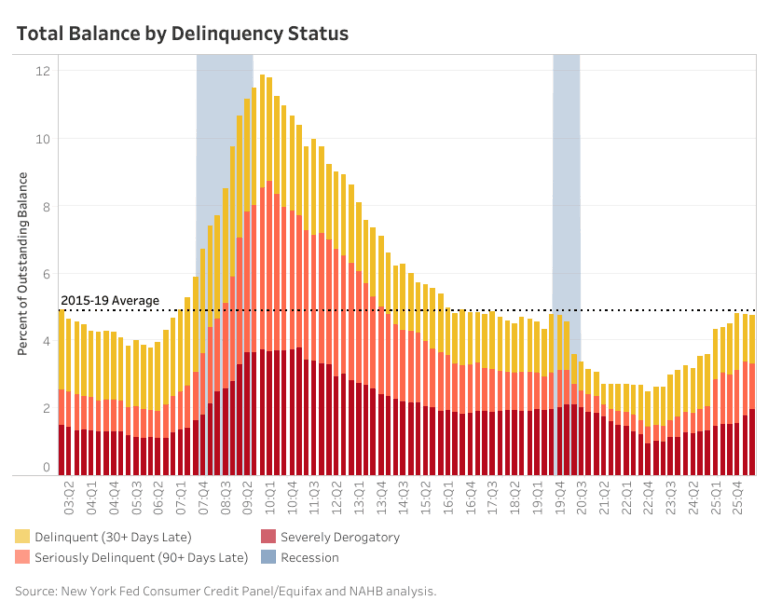
Household debt delinquency rates increased in the third quarter of 2026 as the share of delinquent balances and the transition to seriously delinquent debt increased. According to the latest Quarterly Report on Household Debt and Credit from the Federal Reserve Bank of New York, about 5.0% of outstanding household debt balances were in some stage of delinquency, an increase of 0.3 percentage points (pp) from the previous quarter. Total household debt balances that were seriously delinquent (at least 90 days delinquent) also edged up slightly from 3.3% in the second quarter to 3.4%.
The deterioration occurred across several consumer loan categories. The serious delinquency rate for auto loans increased 0.2 pp to 5.7%, while mortgage delinquency rate increased 0.1 pp to 1.1%. In contrast, the serious delinquency rate for credit cards edged lower to 12.9%, although credit cards continued to have the highest rate among the major debt categories.
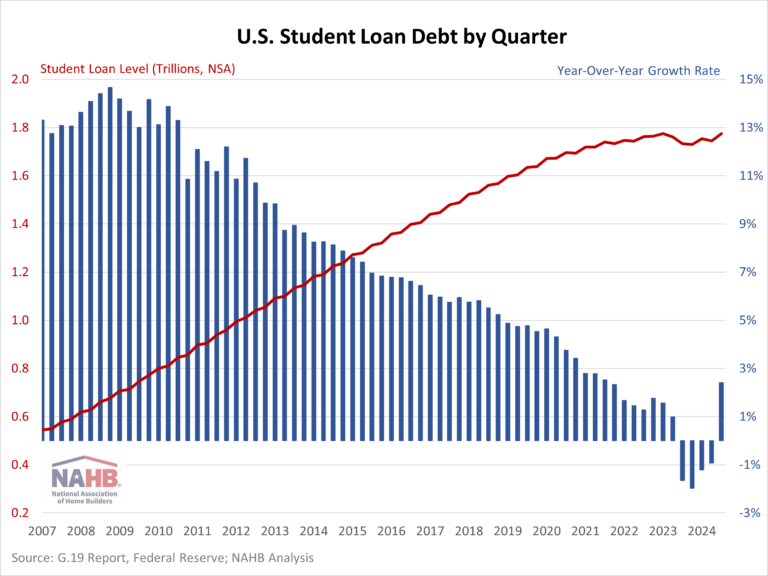
Student loans displayed continued deterioration. The share of student loan balances that were seriously delinquent increased to 10.9%, from 10.6% in the second quarter. This marked a further increase in the proportion of student loan debt classified as seriously delinquent following the resumption of delinquency reporting.
The flow of balances newly entering a serious delinquency stage showed a more mixed picture. Overall, 2.6% transitioned into serious delinquency during the third quarter, unchanged from the previous quarter. The share of student loan balances transitioning into serious delinquency declined to 7.7%, from 7.8% in the previous quarter. This followed a much sharper decline in the second quarter, when the transition rate dropped from 10.9% to 7.8%.
Credit card transitions also improved slightly. The share of credit card balances newly entering serious delinquency decreased to 6.9%, from 7.0% in the second quarter, marking the third consecutive quarterly decline.
Mortgage transitions, however, continued to move in the opposite direction. The share of mortgage balances newly entering serious delinquency increased to 1.6%, from 1.5% in the previous quarter. This category has been gradually trending upward in recent years, indicating continued deterioration in mortgage credit performance. Auto loan transitions remained relatively steady at 3.0%.
This article was originally published by a eyeonhousing.org . Read the Original article here. .