Tag

data

Browsing


Persistently low homeowner and rental vacancy rates indicate that the U.S. housing market remains structurally undersupplied.

Comparing 2024 abnormally low vacancy rates with long-run equilibrium levels across U.S. metropolitan markets, NAHB estimates that approximately 1.2 million additional housing units are required to close the gap and restore vacancy rates to historical norms. This figure represents NAHB’s updated estimate of the structural housing deficit, defined as the cumulative amount of above-equilibrium construction needed to rebalance the market. NAHB’s baseline forecast suggests this adjustment could occur between 2026 and 2030, contingent on sustained home building activity.

Homeowner and rental vacancy rates are key indicators of housing market tightness and future price dynamics. In 2022, U.S. rental vacancy rates fell to 5.1%, the lowest level in decades, underscoring the severity of the post-pandemic housing shortage. By comparison, rental vacancy rates have averaged 6.6% since 2005, when the American Community Survey (ACS) began reporting these data. A surge in multifamily construction in 2024 led to improved rental availability across many metropolitan areas, with the national vacancy rate rising to 5.7% but remaining below the historic norm.

In contrast, single-family construction remains significantly constrained by structural barriers, including restrictive zoning regulations, limited land availability, and persistent labor shortages. As a result, owner vacancy rates continued to decline through 2023, reaching a record low of 0.8%, the lowest level observed in the ACS series. While showing a modest improvement in 2024, owner vacancy rates remain below 1%, compared with the post-2005 average of 1.8%, indicating that for-sale housing shortages persist nationally.

ACS data provide a granular view of vacancy rates across metropolitan areas and allow geographic identification of structural imbalances. The “long run” average vacancy rates can serve as a proxy for normal, or natural, vacancy rates. There are numerous reasons why normal vacancy rates may differ across metropolitan areas. For example, areas with mobile labor markets and higher population turnover will consistently experience higher vacancy rates. Vacation destination housing markets also naturally have higher vacancy rates, reflecting more volatile seasonal housing demand.

For example, according to NAHB’s estimates, the rental vacancy rates in Panama City, FL, and Sebastian-Vero Beach, FL, have hovered around 20% since 2005. The averages were even higher in Myrtle Beach, SC, fluctuating around 28%. In sharp contrast, many areas in California, including Santa Maria-Santa Barbara, Santa Cruz-Watsonville, San Jose-Sunnyvale-Santa Clara, Oxnard-Thousand Oaks-Ventura, and Los Angeles-Long Beach-Anaheim, registered long-term rental vacancy rates below 4%.

In the case of homeowner properties, natural vacancy rates are usually lower, reflecting slower housing turnover, with owners moving in and out less often compared to renters. It is important to remember that owned seasonal (occasional use) properties do not affect the homeowner vacancy rate. In this context, the vacancy rate is the proportion of vacant units for sale within the combined stock of homeowner-occupied, sold but not yet occupied, and for-sale units. Therefore, vacation or other seasonal properties are excluded from this analysis.

Nevertheless, long-term homeowner vacancy rates tend to be higher in resort areas. Consistent with this pattern, several metro areas along the coast of Florida report some of the highest long-term owner vacancy rates. In Sebastian-Vero Beach, FL, and Naples-Immokalee-Marco Island, FL, owner vacancy rates have fluctuated around 4% since 2005. By contrast, San Jose-Sunnyvale-Santa Clara, CA, experienced owner vacancy rates below 1% most of the time.

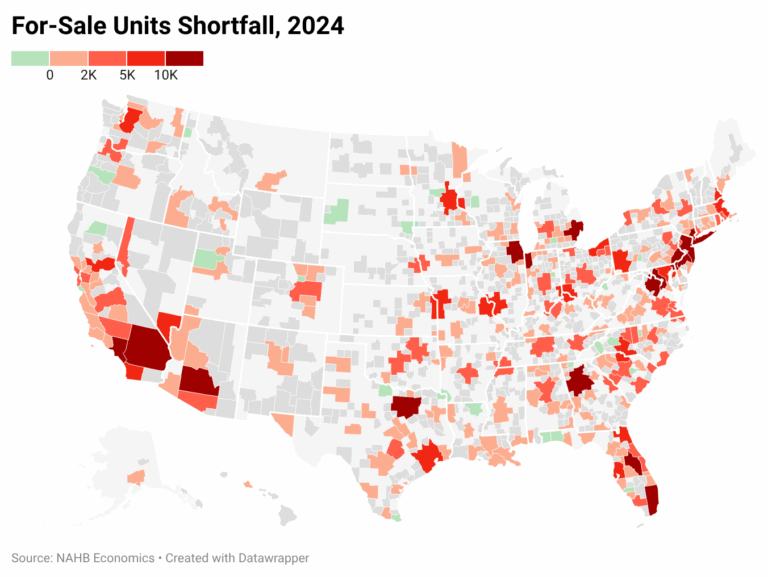
The gap between the “natural” or long-run average vacancy rate and the current vacancy rate helps estimate the number of rental and for-sale units needed to restore vacancy rates to their long-run equilibrium. Unsurprisingly, large metro markets have the greatest shortage of vacant rental and for-sale units, mainly due to their size. In these areas, even a small percentage decrease below the long-run average vacancy rates can lead to a shortage of thousands of vacant units.

As of 2024, the Chicago-Naperville-Elgin, IL-IN-WI metro area needed close to 40,000 rental units to bring the rental vacancy rate back to normal levels.  The rental shortages in the New York-Newark-Jersey City, NY-NJ, and Philadelphia-Camden-Wilmington, PA-NJ-DE-MD metro areas were around 20,000 units.

Similarly, the largest shortages of vacant units for sale were observed in major metropolitan areas, including Chicago-Naperville-Elgin, IL-IN-W; Atlanta-Sandy Springs-Roswell, GA; New York-Newark-Jersey City, NY-NJ-PA; Phoenix-Mesa-Scottsdale, AZ.

Adding vacancy shortages across metro areas with unusually low vacancy rates, there is a total shortage of about 1.2 million vacant units nationwide (almost equally split between rental and for-sale units).

NAHB’s estimates focus narrowly on the number of vacant units required to return current vacancy rates to their long-run equilibrium levels. They do not incorporate additional sources of housing shortfall, such as pent-up demand from suppressed household formation or the need to replace aging and obsolete housing stock. As a result, NAHB’s estimates should be interpreted as lower-bound estimates of the overall housing shortage and are smaller than estimates that explicitly attribute elevated rates of shared living arrangements and the unusually high share of young adults residing with parents to the U.S. housing shortage. While we admit we do not have definitive answers, we believe the estimates presented here provide a reasonable updated national assessment of the current structural housing deficit.


This article was originally published by a eyeonhousing.org . Read the Original article here. .
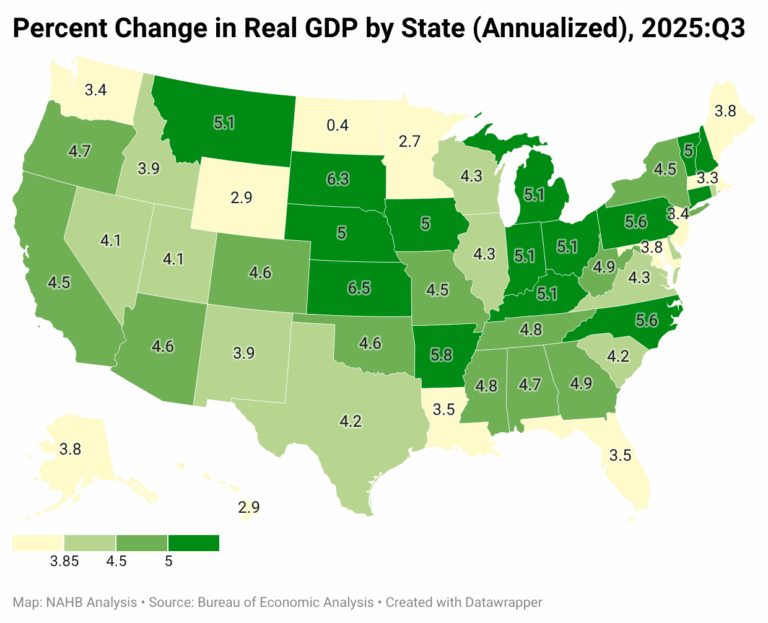

In the third quarter of 2025, the Bureau of Economic Analysis (BEA) reported that real gross domestic product (GDP) expanded nationally, with growth recorded across all states and the District of Columbia. The increase in GDP reflected broad-based economic momentum, supported by contributions from several major industries. At the state level, real GDP growth ranged from a 6.5 percent increase in Kansas to a 0.4 percent increase in North Dakota.

Nationally, real GDP, measured at a seasonally adjusted annual rate, increased 4.4 percent in the third quarter of 2025, led by growth in information; finance and insurance; and professional, scientific, and technical services.

Regionally, real GDP increased in all eight regions between the second and the third quarters of 2025. Growth was widespread, with regional gains ranging from a 4.2 percent increase in the New England region to a 4.8 percent increase in the Great Lakes region, underscoring broad economic strength across the country.

Service-providing sectors, including information, finance and insurance, and professional and business services, were key drivers of growth across many states. Agriculture and related industries played an especially important role in select states, including Kansas and South Dakota, which recorded the two highest growth rates in real GDP during the quarter. Manufacturing activity, particularly in durable goods, also contributed to higher output in several regions, including Arkansas and Connecticut, which posted the third- and fourth-largest increases in real GDP, respectively. While most states experienced strong expansion, a small number of states and the District of Columbia posted more modest gains, highlighting regional differences in economic performance.

At the industry level, information services, finance and insurance, and professional, scientific, and technical services were the most consistent contributors to GDP growth nationwide. However, several sectors weighed on growth in specific regions, including management of companies and enterprises; government and government enterprises; nondurable goods manufacturing; and construction, all of which contracted during the third quarter.

Overall, the third quarter state GDP data point to a broadly expanding U.S. economy, with growth evident across all states and supported by a diverse mix of industries. Although the drivers of growth varied by region, reflecting differences in industrial composition, the widespread gains in economic output underscore resilient economic activity at both the state and national levels and suggest continued momentum in overall GDP.


This article was originally published by a eyeonhousing.org . Read the Original article here. .
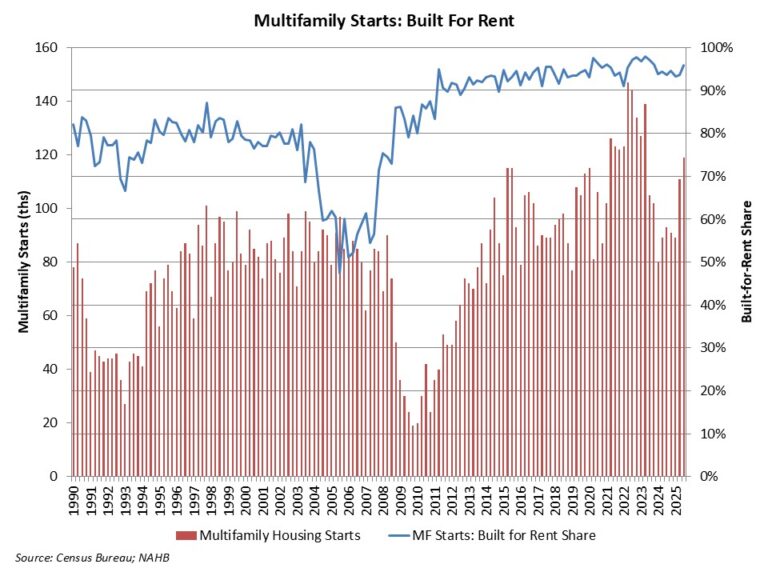

According to NAHB analysis of quarterly Census data, the count of multifamily, for-rent housing starts increased during the third quarter of 2025. For the quarter, 119,000 multifamily residences started construction. Of this total, 114,000 were built-for-rent. This built-for-rent total was 31% higher than the third quarter of 2024. This marks a significant increase, and it is possible these numbers will be revised lower in future Census data given other multifamily data reporting.

The market share of rental units of multifamily construction starts was 95% for the third quarter. A historical low market share of 47% for built-for-rent multifamily construction was set during the third quarter of 2005, during the condo building boom. An average share of 80% was registered during the 1980-2002 period.

For the third quarter, there were 5,000 multifamily condo unit construction starts, a decrease from a year ago.

An elevated rental share of multifamily construction is holding the typical apartment size below levels seen during the pre-Great Recession period. According to the third quarter 2025 data, the average square footage of multifamily construction starts decreased to 1,052 square feet. The median declined to 1,006 square feet. These measures are consistent with the elevated share of multifamily built-for-rent construction.


This article was originally published by a eyeonhousing.org . Read the Original article here. .

Real gross domestic product (GDP) increased in ten states in the first quarter of 2025 compared to the last quarter of 2024, according to the U.S. Bureau of Economic Analysis (BEA). Thirty-nine states reported real GDP declines, while the District of Columbia and Delaware reported no change during this time. The percent change in real GDP ranged from a 1.7 percent increase at an annual rate in South Carolina to a 6.1 percent decline in Iowa and Nebraska.

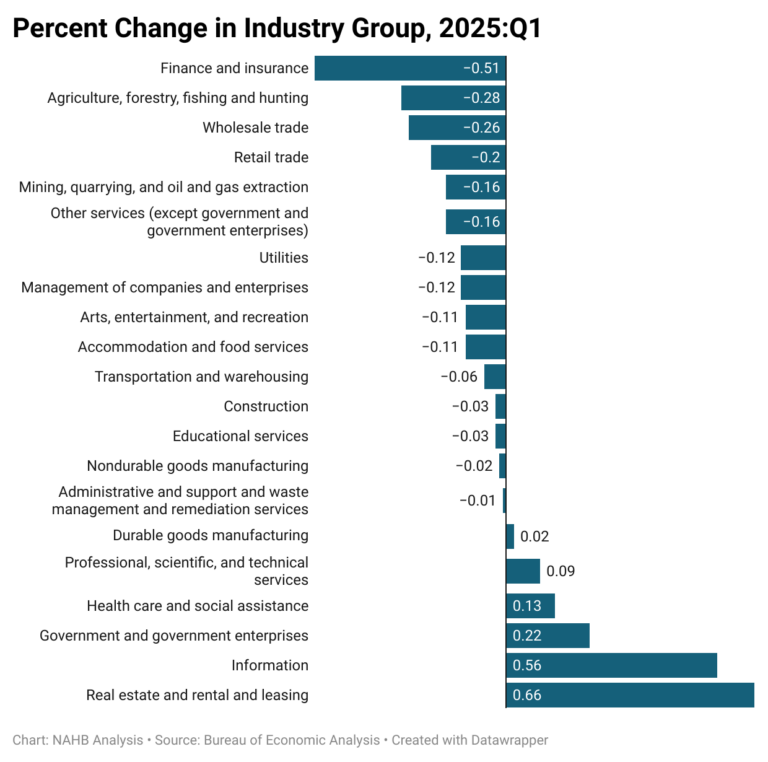
Nationwide, growth in real GDP (measured on a seasonally adjusted annual rate basis) declined 0.5 percent in the first quarter of 2025. This is the first decline in quarterly real GDP levels in three years. The leading contributors to the decrease in real GDP across the country were finance and insurance; agriculture, forestry, fishing and hunting; and wholesale trade.

Regionally, real GDP growth declined in seven out of the eight regions between the last quarter of 2024 and the first quarter of 2025. The Southeast region was the only territory to post a meager 0.3 percent increase. The percent change in real GDP declines ranged from a 0.3 percent decline in the Southwest and Far West regions, to a 3.3 percent decline in the Plains region.

At the state level, South Carolina posted the highest GDP growth rate (1.7 percent), followed by Florida (1.4 percent) and Alabama (1.0 percent). The percent increase in real GDP ranged from a 1.7 percent increase in South Carolina to a 0.1 percent increase in Georgia. On the other hand, 39 states reported real GDP declines ranging from a 0.1 percent decline in New Hampshire, Ohio, and Texas, to a 6.1 percent decline in Iowa and Nebraska for the first quarter of 2025.

Looking at industry contributions to GDP across states, the “real estate and rental and leasing industry” was the leading contributor to growth in all 50 states and the District of Columbia. In contrast, the agriculture, forestry, fishing, and hunting industry led a decrease in 39 states, and was the leading contributor to economic contraction in 11 states.

Discover more from Eye On Housing

Subscribe to get the latest posts sent to your email.


This article was originally published by a eyeonhousing.org . Read the Original article here. .
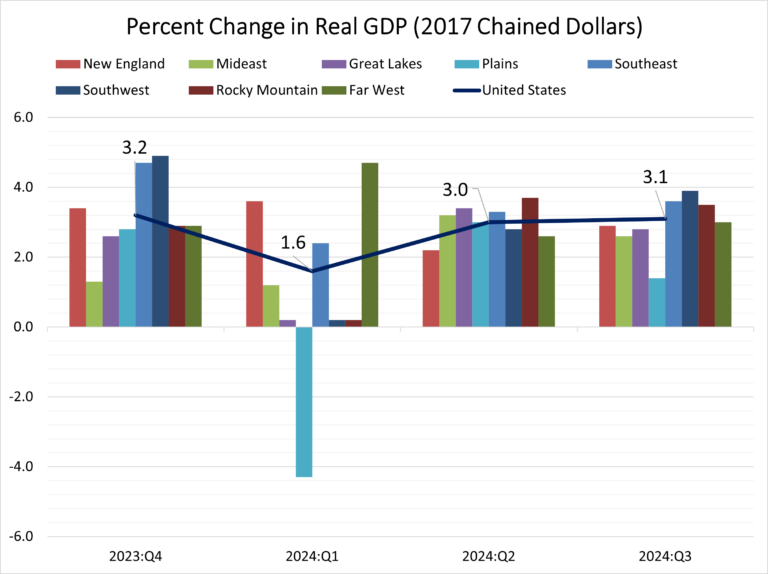

Real gross domestic product (GDP) increased in 45 states and the District of Columbia in the third quarter of 2024 compared to the second quarter of 2024 according to the U.S. Bureau of Economic Analysis (BEA). Iowa reported no change during this time. The percent change in real GDP ranged from a 6.9 percent increase at an annual rate in Arkansas to a 2.3 percent decline in North Dakota.

Nationwide, growth in real GDP (measured on a seasonally adjusted annual rate basis) increased 3.1 percent in the third quarter of 2024, which is roughly the same as the second quarter level of 3.0 percent. Retail trade, health care and social assistance, and information were the leading contributors to the increase in real GDP across the country.

Regionally, real GDP growth increased in all eight regions between the second and the third quarter. The percent change in real GDP ranged from a 3.9 percent increase in the Southwest region (Arizona, New Mexico, Oklahoma, and Texas) to a 1.4 percent increase in the Plains region (Iowa, Kansas, Minnesota, Missouri, Nebraska, North Dakota, and South Dakota).

At the state level, Arkansas posted the highest GDP growth rate (6.9 percent) followed by Alabama (6.0 percent) and Mississippi (5.1 percent). On the other hand, three out of the seven states that makes up and Plains region, South Dakota (-0.8 percent), Nebraska (-1.4 percent), and North Dakota (-2.3 percent) along with Montana (-0.1 percent) posted an economic contraction in the third quarter of 2024.

The agriculture, forestry, fishing, and hunting industry increased in 25 states, was the leading contributor to growth in five states including Arkansas, Alabama, and Mississippi, the states with the largest increases in real GDP. In contrast, this industry was the leading offset to growth in 14 states including North Dakota, Nebraska, South Dakota, and Montana, the only states with declines in real GDP.

Discover more from Eye On Housing

Subscribe to get the latest posts sent to your email.


This article was originally published by a eyeonhousing.org . Read the Original article here. .
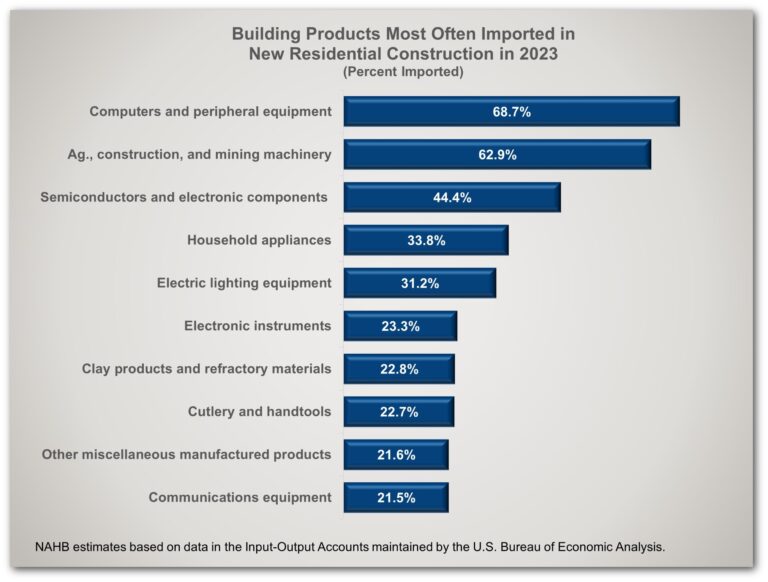

NAHB estimates that $184 billion worth of goods were used in the construction of both new multifamily and single-family housing in 2023. Additionally, we estimate that $13 billon of those goods were imported from outside of the U.S. These figures lead to 7% of all goods used in new residential construction originating from a foreign nation. This data come from the BEA input-output accounts, which reveals important details of numerous industries across the U.S. detailing what products they produce, use and import in the economy. The latest tables are from 2017 and the data is adjusted to 2023 dollar value.

Import use varies significantly by type of building product. Shown above are the ten most import reliant products that are used in new residential construction. These products are defined by North American Industry Classification System (NAICS).

The U.S Census Bureau reports data on international trade of goods by NAICS definitions. With this, we can locate which nations are responsible for importing products used in residential construction into the U.S. Using the commodities that are used in residential construction, a significant share comes from China, at 27%. Mexico was the second most important nation with around 11% followed by Canada at 8%. Shown below are the countries with the 10 highest shares along with the remaining 27% from countries outside the top 10.

Tariff Impact

During the election campaign, President Trump promised the enactment of a tariff plan ranging from 10%-20% on imported goods, with 60% tariffs on imports from China. A tariff is essentially a tax on an imported good, meaning the importer pays an additional tax for importing such an item from another country. For example, say a business in the United States needed to purchase a $100 worth of screws from China. With a 60% tariff, the business would then need to pay an additional $60 to the U.S. Government to receive the screws. The exporter in China would still receive the $100 from the business and not pay the added tariff costs. The tariff cost falls on the importer, who would absorb the higher costs through lower profit margins or raising their own prices for consumers.

Without additional detail for these tariff proposals, it is difficult to estimate the impact of these tariffs. Using our best estimate, a 10% tariff on all imports with a 60% tariff on imports directly from China would result in a $3.2 billion increase in the cost of imported building materials used in residential construction. By product, the largest increase in cost would be for household appliances, where 54% of imports come from China, this tariff adds $670 million for these imported products. Additionally, a 20% tariff coupled with 60% imports from China would result in $4.2 billion in added cost of imported residential building products.  

From Canada, the U.S. imports a significant amount of wood related products. In 2023, 70% of sawmill and wood product imports came from Canada. Many of these wood products from Canada are already subject to tariffs, with the current rate at 14.5%. Total imports of sawmill and wood products from Canada in 2023 was $5.8 billion. The highest valued import from Canada was nonferrous metals, totaling $17.6 billion in 2023.

Turning to Mexico, 71% of lime and gypsum products imported in 2023 originated from Mexico. While this share is particularly high, the total value of imports in 2023 of lime and gypsum was only $456 million. The highest valued import from Mexico at $28.6 billion in 2023 was computer equipment, where imports from Mexico made up 23% of total imports of computer equipment in 2023.

Discover more from Eye On Housing

Subscribe to get the latest posts sent to your email.


This article was originally published by a eyeonhousing.org . Read the Original article here. .
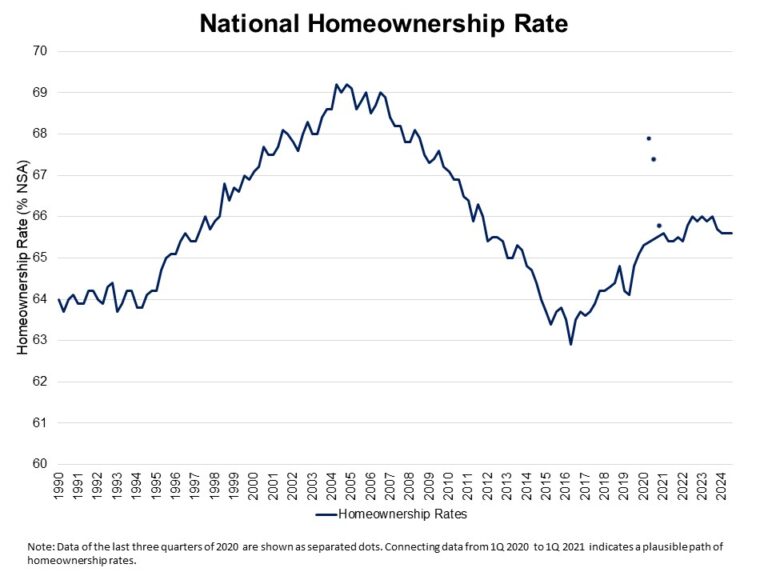

The homeownership rate for those under the age of 35 dropped to 37% in the third quarter of 2024, reaching the lowest level since the first quarter of 2020, according to the Census’s Housing Vacancy Survey (HVS). Amidst elevated mortgage interest rates and tight housing supply, housing affordability is at a multidecade low. The youngest age group, who are particularly sensitive to mortgage rates, home prices, and the inventory of entry-level homes, saw the largest decline among all age categories.

The U.S. homeownership rate held steady at 65.6% in the third quarter of 2024, showing a flat trend over the last three quarters.  However, this marks the lowest rate in the last two years. The homeownership rate remains below the 25-year average rate of 66.4%.

The national rental vacancy rate went up to 6.9% for the third quarter of 2024, and the homeowner vacancy rate inched up to 1%. The homeowner vacancy rate remains close to the survey’s 67-year low of 0.7%.

Homeownership rates declined across all age groups compared to a year ago, except for those aged 55-64. Householders under 35 experienced the largest drop, declining by 1.3 percentage points from 38.3% to 37%. The 45-54 age group also saw a 1.3 percentage point decrease, decreasing from 71% to 69.7%. For householders aged 35-44, who experienced a modest 0.6 percentage point decline. Among those 65 years and over, homeownership inched down slightly from 79.2% to 79.1%. In contrast, the homeownership rate of the 55–64 age group rose to 75.9% from 75.4%.

The housing stock-based HVS revealed that the count of total households increased to 132.1 million in the third quarter of 2024 from 130.3 million a year ago. The gains are largely due to gains in both renter household formation (1.1 million increase), and owner-occupied households (655,000 increase).

Discover more from Eye On Housing

Subscribe to get the latest posts sent to your email.


This article was originally published by a eyeonhousing.org . Read the Original article here. .
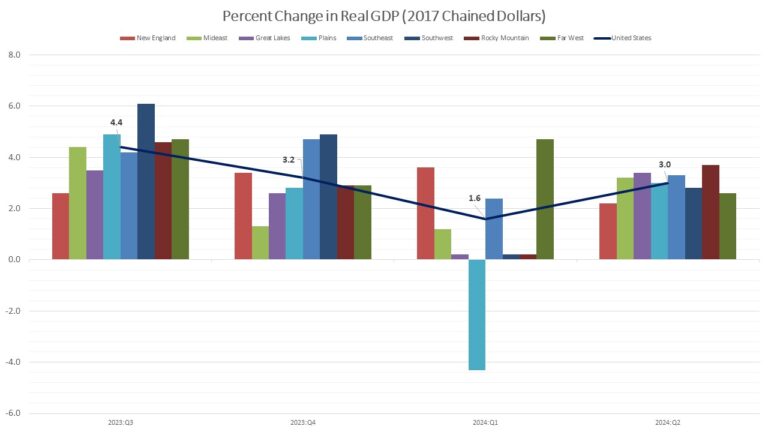

Real gross domestic product (GDP) increased in 49 states and the District of Columbia in the second quarter of 2024 compared to the last quarter of 2023 according to the U.S. Bureau of Economic Analysis (BEA). Alaska reported an economic contraction during this time. The percent change in real GDP ranged from a 5.9 percent increase at an annual rate in Idaho to a 1.1 percent decline in Alaska.

Nationwide, growth in real GDP (measured on a seasonally adjusted annual rate basis) increased 3.0 percent in the second quarter of 2024, which is higher than the first quarter level of 1.6 percent. Nondurable-goods manufacturing; finance and insurance; and health care and social assistance were the leading contributors to the increase in real GDP across the country.

Regionally, real GDP growth increased in all eight regions between the first and the second quarter. The percent change in real GDP ranged from a 3.7 percent increase in the Rocky Mountain region (Colorado, Idaho, Montana, Utah, and Wyoming) to a 2.2 percent increase in the New England region (Connecticut, Maine, Massachusetts, New Hampshire, Rhode Island, and Vermont).

At the state level, Idaho posted the highest GDP growth rate (5.9 percent) followed by Kansas (5.6 percent) and Nebraska (5.3 percent). On the other hand, Alaska posted an economic contraction in the second quarter of 2024. The agriculture, forestry, fishing, and hunting industry was the leading contributor to growth in 11 states including Idaho, Kansas, Nebraska, and the states with the highest increases in real GDP, respectively. Mining, which declined in 33 states, was the leading contributor to the decrease in real GDP in Alaska, the only state with a decline in real GDP.

Discover more from Eye On Housing

Subscribe to get the latest posts sent to your email.


This article was originally published by a eyeonhousing.org . Read the Original article here. .

In the latest 2023 NAHB member census, 21% of NAHB builder members listed residential remodeling as their primary business. These remodelers tend to be relatively small, with a median of five employees and a median annual revenue of $1.8 million.  They are thus even smaller than NAHB builder members in general, who had a median of six employees and median annual revenue of $3.4 million, as reported in a recent post.

Among the residential remodelers, 21% reported a dollar volume of less than $500,000 in 2023, 20% reported between $500,000 and $999,999, 47% between $1.0 and $4.9 million, 8% between $5.0 and $9.9 million, 2% between $10.0 million and $14.9 million, and another 2% reported $15.0 million or more. None reported zero business activity in 2023.

The median annual revenue for residential remodelers in 2023 was $1.8 million—considerably below the $3.4 million median calculated across all NAHB builder members, and a small fraction of the $45.0 million threshold the Small Business Administration uses to classify construction businesses as small. Even so, residential remodelers’ median revenue was up from the $1.2 million recorded in 2022.

The median number of payroll employees was also relatively small among NAHB’s residential remodelers in 2023—five, compared to six for all NAHB builder members. Both numbers were unchanged from 2022.

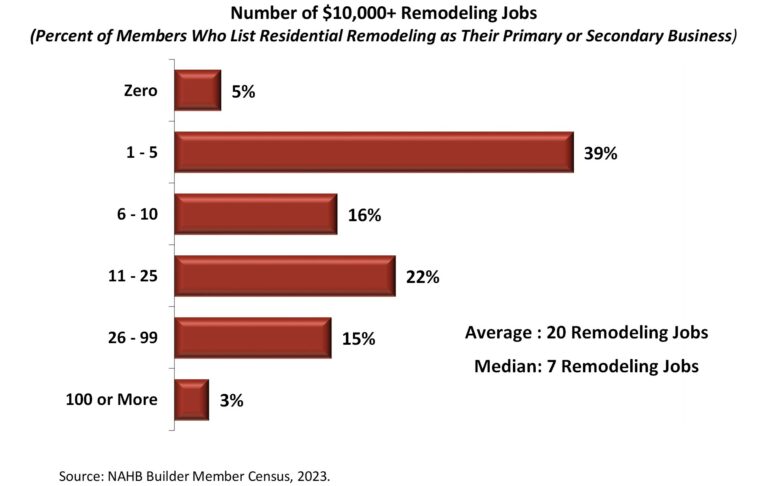
To provide a measure of housing activity roughly analogous to starts, the NAHB census asked builder members who are primarily or secondarily residential remodelers about the number of remodeling jobs they completed in 2023 costing $10,000 or more. The responses show that a plurality of 39% completed 1 to 5 jobs of this size, 16% did 6 to 10, 22% did 11 to 25, 15% did 26 to 99, and 3% completed 100 or more jobs costing more than $10,000. On average, builder members involved in residential remodeling as a primary or secondary activity completed 20 jobs costing $10,000 or more in 2023. The median number was 7.

The numbers are significantly higher if the calculations are confined to the 21% of NAHB builder members who list residential remodeling specifically as their primary activity. These members completed an average of 32 and a median of 15 $10,000-plus jobs in 2023. These results are not significantly different from the ones reported in 2022, when NAHB first included the remodeling jobs question in its member census.

Discover more from Eye On Housing

Subscribe to get the latest posts sent to your email.


This article was originally published by a eyeonhousing.org . Read the Original article here. .


If you’re a homeowner waiting on the sidelines for the perfect time to sell your home, this week could be your time to shine.

Despite mortgage rates inching closer to 7%, a recent research from Realtor.com indicated the week of April 14-20 might be the ideal week for potential sellers to list, as spring historically brings with it higher buyer demand and a market with low inventory, setting the stage for bigger bids.

Some homeowners have been on the sidelines for two years, waiting for mortgage rates to fall, additional survey data from the site showed.

However, while 50% say they’re willing to hold out longer in hopes of rate drops, nearly 30% say they need to sell soon for “personal reasons,” including profits, need for more space, or plans to rent, to name a few.

SELLING YOUR HOUSE? HERE’S THE BEST TIME TO DO IT

The best time to sell your home might be the week of April 14-20, according to Realtor.com data. (REUTERS/Jeff Haynes  / Reuters Photos)

Survey data also showed that sellers are adjusting their expectations to meet the current market, with 8 in 10 settling in on the expectation that the mortgage for a newer home will be higher than their current home. 

“With the market cooling in many areas, 12% expect a bidding war to take place (vs 27% in 2023), and only 15% expect to get more than their asking price (vs 31% last year),” the report continued.

The separate analysis from last month pointed to the April 14-20 listing timeframe by taking into account the number of buyers, listing prices and seasonal trends, to determine the period for the most favorable for home selling conditions.

TIME TO SELL YOUR HOME? HERE ARE 3 QUESTIONS TO ASK YOURSELF

50% of sellers still on the sidelines say they will wait out rates while 29% say they need to sell soon. (FOX Business / Getty Images)

“We’ve got the most favorable balance of all of these factors for sellers. It suggests they will be able to sell quickly at a good price and be happy with the outcome,” said Realtor.com chief economist Danielle Hale.

The report indicated that this week offers a higher-than-average number of buyers along with a lower-than-average time on the market and higher-than-average prices, coming in at 1.1% higher than the average for other weeks throughout the year.

REALTOR DESCRIBES THE SHIFT THAT’S DRIVING REAL ESTATE ‘ACROSS THE BOARD’ IN TOP MARKETS

Realtor.com analysis indicates that homes historically reached higher prices during the week of April 14. (Photo by STEFANI REYNOLDS/AFP via Getty Images / Getty Images)

FOX Business’ Gerri Willis, speaking on “Varney & Co.,” on Monday said “sellers are getting more realistic,” noting that they have to “embrace” current rates.

Rates for 30-year mortgages averaged 6.88% last week, according to Freddie Mac’s latest survey. 

GET FOX BUSINESS ON THE GO BY CLICKING HERE


This article was originally published by a www.foxbusiness.com . Read the Original article here. .
Pin It