Tag

Credit

Browsing


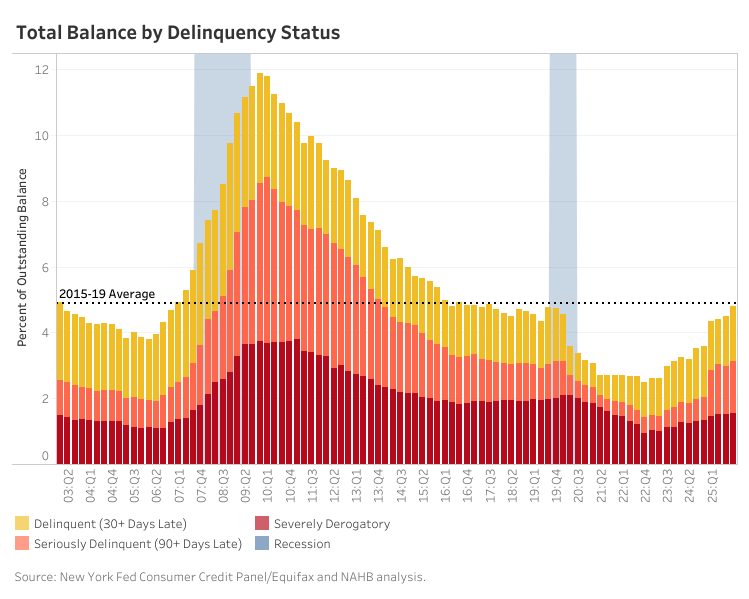
Delinquent consumer loans have steadily increased as pandemic distortions fade, returning broadly to pre-pandemic levels. According to the latest Quarterly Report on Household Debt and Credit from the Federal Reserve Bank of New York, 4.8% of outstanding household debt was delinquent at the end of 2025, 0.3 percentage points higher than the third quarter of 2025 and 1.2% higher from year-end 2024.

This increase reflects a normalization period coming out of the pandemic, when delinquency rates were suppressed by payment forbearance and fiscal support. As these government assistance programs ended and credit reporting normalized, delinquency rates rose steadily and are now on par with pre-pandemic levels.

While aggregate delinquency has normalized, transitions into serious delinquency (defined as 90+ days past due) show diverging patterns across loan types. Student loans and credit cards stand out as having significantly higher inflows into serious delinquency than before the pandemic, while mortgages, HELOC and auto loan transitions remain comparatively stable.

Late student loan payments saw a sharp rise in early 2025, and by the fourth quarter of 2025, 16.2% of student loan balances became seriously delinquent over the past year. This surge reflects the re-entering of delinquent balances into credit reports following a nearly 5-year pause due to the pandemic. Credit cards, on the other hand, show signs of deterioration with new seriously delinquent balances rapidly rising mid-2022 before moderating around 7% in recent years. In the fourth quarter of 2025, about 7.1% of credit card balances transitioned into serious delinquency over the past year, a rate comparable to levels observed during the early stages of the Great Recession.

Mortgage transitions into serious delinquency remain low at around 1.4% annually, despite edging higher in recent years and are currently slightly higher than pre-pandemic levels. In a further analysis on the credit report data from Equifax, the deterioration is concentrated among borrowers living in lower-income zip codes, where serious mortgage delinquency rates for this group of borrowers have reached roughly 3.0% by late 2025.

Comparing delinquency transitions with the overall balance of seriously delinquent loans provides a clearer understanding of current credit conditions. Credit cards display a concerning trend in which both transition rate and overall balance of seriously delinquent loan balances are rising. For example, the share of credit card balances 90+ days past due is only about one percentage point below its post-great recession peak in 2010 at 12.7%, which seems to suggest persistent issues in repayment by borrowers.

Mortgages show the opposite dynamic, whereby the balance of seriously delinquent mortgages has remained stable despite a steady increase in transitions into serious delinquency. This divergence indicates higher recovery rates or shorter delinquency periods, an implication that mortgage borrowers prioritize meeting their mortgage payments which would be rational if borrowers had locked in historic low mortgage rates and have built up sufficient home equity.

While it is too early to determine if elevated transition rates will translate into increasing seriously delinquent student loan balances, this rate remains high at 9.6% at the end of 2025. Furthermore, the credit scores of student loan borrowers that improved during the student loan payment pause, will now be affected and could weigh on borrowers’ demand or ability to access other forms of credit, especially in an environment of tighter labor markets.


This article was originally published by a eyeonhousing.org . Read the Original article here. .


The cost of credit for residential construction and development declined in the fourth quarter of 2025,  according to NAHB’s quarterly survey on Land Acquisition, Development & Construction (AD&C) Financing. In particular, the average contract rate declined on all four categories of loans tracked in the survey: from 7.95% in the third quarter to 7.61% on loans for land acquisition, from 7.68% to 7.44% on loans for land development, from 7.89% to 7.47% on loans for speculative single-family construction, and from 7.90% to 7.16% on loans for pre-sold single-family construction.   

Meanwhile, the average initial points paid by builders and developers fell on three of the four types of AD&C loans: from 0.83% to 0.44% on loans for land development, from 0.75% to 0.34% on loans for speculative single-family construction, and from 0.67% to 0.37% on loans for pre-sold single-family construction. The only exception was loans specifically for land acquisition, on which the average initial points increased slightly—from 0.66% to 0.70%.

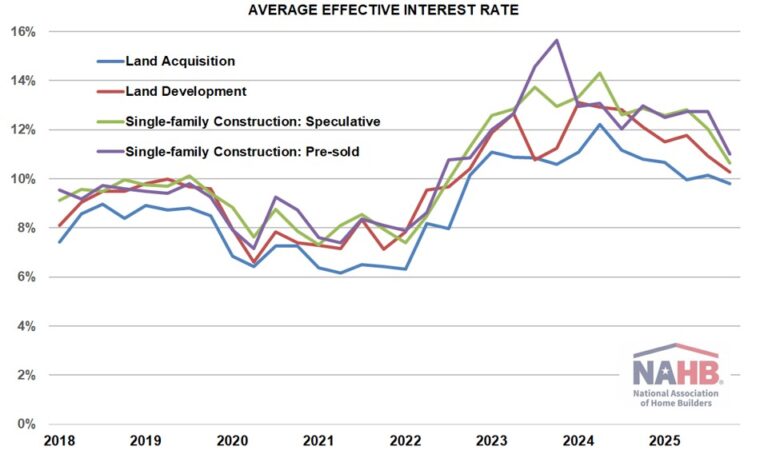
The small increase in points on land acquisition loans was not enough to offset the drop in the contract interest rate, however, so the average effective interest rate (which takes both the contract rate and initial points into account) declined across the board: from 10.15% to 9.81% on loans for land acquisition, from 10.92% to 10.28% on loans for land development, from 12.04% to 10.64% on loans for speculative single-family construction, and from 12.74% to 11.01%  on loans for pre-sold single-family construction.

In all four cases, this was the lowest the average effective rate has been since the period of generally rising interest rates in 2022.

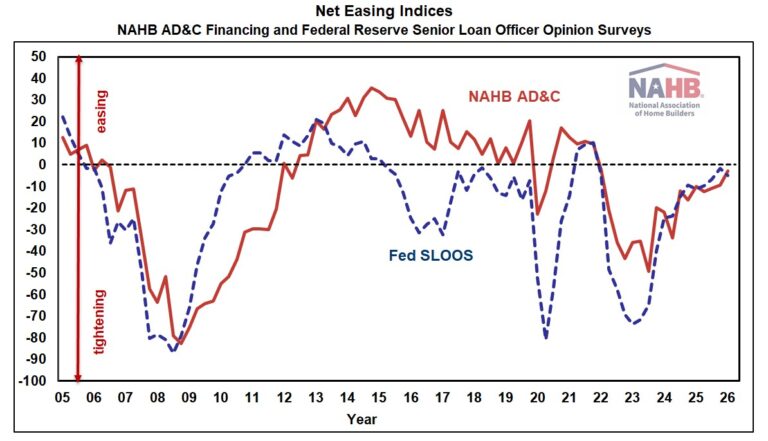
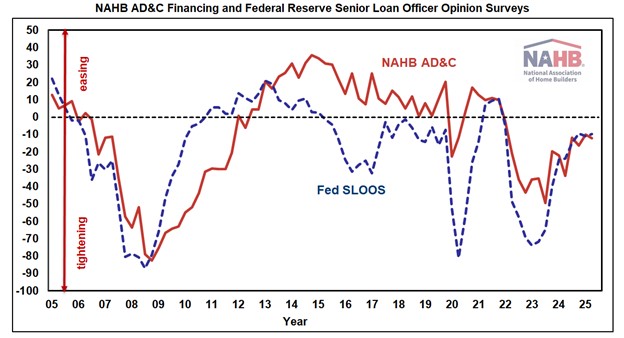
Notwithstanding the drop in rates, builders and developers continued to report tightening credit conditions in the fourth quarter of 2025. The net easing index derived from NAHB’s AD&C survey posted a reading of -9.3 (the negative number indicating that credit has tightened since the previous quarter). This is quite similar to the results from the perspective of lenders reported in the Federal Reserve’s survey of senior loan officers. The net easing index derived from the Fed survey posted a reading of -1.8 in the fourth quarter. Both the NAHB and Fed survey have now reported consistently tightening credit conditions for 16 consecutive quarters. In both cases, however, the net easing index in Q4 2025  came closer to the break-even point of zero (between tightening and easing) than it has at any time since the first quarter of 2022. 

More details from the Fed’s survey of lenders—including measures of demand and net easing for residential mortgages—appeared in a previous post.

Also, in the NAHB AD&C survey, 35% of respondents who built single-family homes during the fourth quarter of 2025 reported financing some of the construction with a construction-to-permanent (one-time-close) loan made to the ultimate home buyer. On average, 59% of the homes these respondents built were financed in this manner.

More detail on credit conditions for residential builders and developers is available on NAHB’s AD&C Financing Survey web page.


This article was originally published by a eyeonhousing.org . Read the Original article here. .

Overall consumer credit continued to expand in the fourth quarter of 2025, with growth in both nonrevolving and revolving credit. Nonrevolving credit, primarily student and auto loans, accounts for 74% of total outstanding consumer credit, while revolving credit, largely credit card balances, makes up the remaining 26%. Student loan and credit card balances continued to rise year-over-year, while auto loan balances declined. Although interest rates remain elevated, both credit card and auto loan rates edged slightly lower.

Total outstanding U.S. consumer credit reached $5.11 trillion for the fourth quarter of 2025, according to the Federal Reserve’s G.19 Consumer Credit Report. This is an increase of 3.04% at a seasonally adjusted annual rate (SAAR) compared to the previous quarter, and a 2.34% increase compared to last year.

Nonrevolving Credit

Nonrevolving credit, largely driven by student and auto loans (the G.19 report excludes mortgage loans), reached $3.78 trillion (SA) in the fourth quarter of 2025. This marks a 2.15% increase (SAAR) from the previous quarter, and a 1.96% increase from last year.

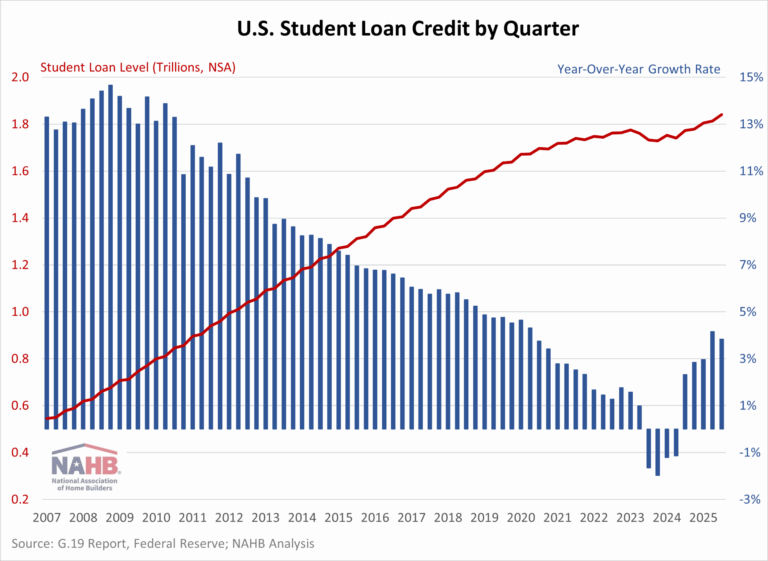
Student loan debt stood at $1.84 trillion (NSA) for the fourth quarter of 2025, marking a 3.22% increase from a year ago. The end of the COVID-19 Emergency Relief—which allowed 0% interest and halted payments until September 1, 2023—led year-over-year growth to decline for four consecutive quarters, from Q3 2023 through Q2 2024 as borrowers resumed payments and took on less new debt. The past six quarters have shown a return to growth.

Auto loans reached a level of $1.56 trillion (NSA), showing a year-over-year decrease of 0.17%, marking one of the first declines since 2010. The deceleration in growth can be attributed to several factors, including stricter lending standards, elevated interest rates, and overall inflation. Auto loan rates for a 60-month new car stood at 7.22% (NSA) for the fourth quarter of 2025, falling 60 basis points from a year ago.

Revolving Credit

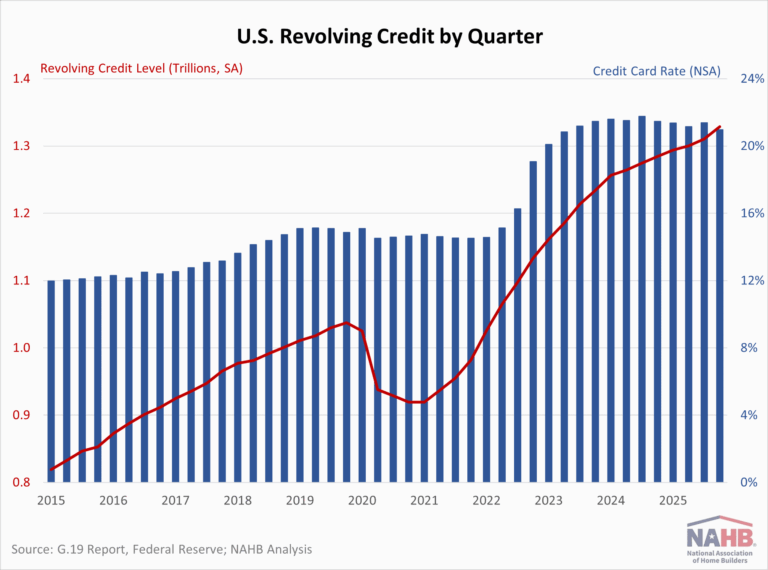
Revolving credit, primarily made up of credit card balances, rose to $1.33 trillion (SA) in the fourth quarter of 2025. This represents a 5.61% increase (SAAR) from the previous quarter and a 3.43% increase year-over-year, both representing an acceleration compared to recent quarters. Although credit card rates have hovered near historic highs since Q4 2022, the past five quarters have shown modest year-over-year declines. The average credit card rate held by commercial banks (NSA) stood at 20.97% in the fourth quarter of 2025, a drop of 50 basis points from a year earlier.


This article was originally published by a eyeonhousing.org . Read the Original article here. .


Credit conditions on loans for residential Land Acquisition, Development & Construction (AD&C) were still tightening in the third quarter of 2025, according to NAHB’s quarterly survey on AD&C Financing.  The net easing index derived from the survey posted a reading of -11.0 (the negative number indicating that credit tightened since the previous quarter). This is in reasonably close agreement with the third quarter reading of -6.6 for the similar net easing index produced from the Federal Reserve’s survey of senior loan officers—marking fifteen consecutive quarters of tightening credit conditions reported by both builders and lenders.

More details from the Fed’s survey of lenders—including measures of demand and net easing for residential mortgages—appeared in a previous post.

According to the NAHB survey, the most common way lenders tightened in the third quarter was by lowering the maximum allowable loan-to-value or loan-to-cost ratio on the loans (cited by 60% of the builders and developers who reported tighter credit). Tied for second place were reducing the amount they are willing to lend, requiring out-of-pocket payment of interest or borrower funding of an interest reserve, and  requiring personal guarantees (cited by 47% each).

Results on the cost of credit in the third quarter were mixed. The average contract rate increased from 7.82% to 7.95% on loans specifically for residential land acquisition—but declined on the other three categories of loans tracked in NAHB’s AD&C survey: from 8.04% to 7.68% on loans for land development, from 8.17% to 7.90% on loans for speculative single-family construction, and from 7.95% to 7.90% on loans for pre-sold single-family construction.   

Meanwhile, the average initial points charged on the loans increased across the board: from 0.56% to 0.66% on loans for land acquisition, from 0.74% to 0.83% on loans for land development, from 0.72% to 0.74% on loans for speculative single-family construction, and from 0.58% to 0.67% on loans for pre-sold single-family construction.

Those combinations of quarter-to-quarter changes caused the effective interest rate (which takes both the contract rate and initial points into account) to increase from 9.95% to 10.15% on loans for land acquisition, but to decline from 11.77% to 10.92% on loans for land development and from 12.82% to 12.04% on loans for speculative single-family construction. The average effective rate on loans for pre-sold single-family construction remained essentially unchanged at 12.74%, compared to 12.73% in the second quarter.

Although results on the average effective interest rate were mixed on a quarter-to-quarter basis, the  rate on each of the four types of AD&C loans has declined significantly since peaking somewhere in the period between 2023 Q3 and 2024 Q2.

Also in the NAHB AD&C survey, 37% of respondents who built single-family homes during the third quarter of 2025 reported financing some of the construction with a construction-to-permanent (one-time-close) loan made to the ultimate home buyer. On average, 63% of the homes these respondents built were financed this way.

More detail on credit conditions for residential builders and developers is available on NAHB’s AD&C Financing Survey web page.


This article was originally published by a eyeonhousing.org . Read the Original article here. .


Overall consumer credit continued to rise for the third quarter of 2025, but the pace of growth remains slow. Student loan balances continue to rise as well, slowly returning to pre-COVID growth. Furthermore, credit card and auto loan balances continue to grow but at historically low rates. Although interest rates are still elevated, credit card and auto loan rates continue to decrease slightly. 

Total outstanding U.S. consumer credit reached $5.08 trillion for the third quarter of 2025, according to the Federal Reserve’s G.19 Consumer Credit Report. This is an increase of 2.72% at a seasonally adjusted annual rate (SAAR) compared to the previous quarter, and a 2.25% increase compared to last year.  

Nonrevolving Credit  

Nonrevolving credit, largely driven by student and auto loans (the G.19 report excludes mortgage loans), reached $3.77 trillion (SA) in the third quarter of 2025. This marks a 2.95% increase (SAAR) from the previous quarter, and a 2.14% increase from last year. 

Student loan debt stood at $1.84 trillion (NSA) for the third quarter of 2025, marking a 3.84% increase from a year ago. The end of the COVID-19 Emergency Relief—which allowed 0% interest and halted payments until September 1, 2023—led year-over-year growth to decline for four consecutive quarters, from Q3 2023 through Q2 2024 as borrowers resumed payments and took on less new debt. The past five quarters have shown a return to growth, nearly matching pre-pandemic growth rates.  

Auto loans reached a level of $1.57 trillion (NSA), showing a year-over-year increase of only 0.30%, marking one of the slowest growth rates since 2010. The deceleration in growth can be attributed to several factors, including stricter lending standards, elevated interest rates, and overall inflation. Auto loan rates for a 60-month new car stood at 7.64% (NSA) for the third quarter of 2025, a historically elevated level. However, auto rates have slowed modestly, decreasing by 0.76 percentage points compared to a year ago.  

Revolving Credit 

Revolving credit, primarily made up of credit card debt, rose to $1.31 trillion (SA) in the third quarter of 2025. This represents a 2.04% increase (SAAR) from the previous quarter and a 2.55% increase year-over-year. Both measures reflect a notable slowdown, marking some of the weakest growth in revolving credit in several years. This deceleration comes as credit card interest rates remain elevated, with the average rate held by commercial banks (NSA) at 21.39%. Although rates have hovered near historic highs since Q4 2022, the past three quarters have shown modest year-over-year declines, reflecting the impact of rate cuts that began in 2024. 


This article was originally published by a eyeonhousing.org . Read the Original article here. .

For the fourteenth consecutive quarter, builders and developers reported tighter credit conditions on loans for residential Land Acquisition, Development & Construction (AD&C) in NAHB’s quarterly survey on AD&C Financing.  

In the second quarter of 2025, the NAHB survey’s net easing index posted a reading of -12.3 (the negative number indicating that credit tightened since the previous quarter).  This is in reasonably close agreement with the second quarter reading of -9.7 for the similar net easing index derived from the Federal Reserve’s survey of senior loan officers.  Like the NAHB net easing index, the one from the Fed has been in negative territory (indicating credit tightening) for fourteen consecutive quarters.  Over the past year the additional tightening indicated by both indices has been relatively modest, with index levels hovering between -20 and 0.  Modest or not, however, after fourteen straight quarters of tightening, many builders are probably wondering how much room lenders have left to tighten further.    

More details from the Fed’s survey of lenders—including measures of demand and net easing for residential mortgages—appeared in a previous post.

According to NAHB builders, the most common ways lenders tightened credit on AD&C loans in the second quarter were by reducing the amount they are willing to lend (cited by 60% of the builders who reported tighter credit), requiring personal guarantees (53%), increasing the interest rate and not making new loans (47% each), and increasing documentation requirements (40%). 

Also in the second quarter, the cost of credit declined on loans made specifically for residential land acquisition (the “A” in AD&C).  The average contract interest rate on the loans declined from 8.23% to 7.82%, while the average initial points dropped from 0.71% to 0.56%.  As a result, the average effective interest rate (which takes both the contract rate and initial points into account) on land acquisition loans declined from 10.68% to 9.95%.

For the other three categories of AD&C loans tracked in the NAHB survey, credit became more expensive since the previous quarter.  The average contract interest rate increased on loans for land development (from 7.86% to 8.04%) and speculative single-family construction (from 8.08% to 8.17%), while declining only slightly (from 7.96% to 7.95%) on loans for pre-sold single-family construction.  Meanwhile, average initial points were unchanged at 0.74% on loans for land development, but increased from 0.68% to 0.72% on loans for speculative single-family construction, and from 0.45% to 0.58% on loans for pre-sold single-family construction.

Those combinations of quarter-to-quarter changes took the effective interest up from 11.50% to 11.77%  on loans for land development, from 12.59% to 12.82% on loans for speculative single-family construction, and from 12.49% to 12.73% on loans for pre-sold single-family construction.

Although the average effective interest rate was higher in 2025 Q2 than in 2025 Q1 for three of the four categories of AD&C loans, the rate was down year-over-year for all four. 

Financing costs for builders and developers could decline further over the next quarter, especially if (as NAHB expects) the Federal Reserve reduces the target federal funds rate at its September meeting.  In fact, as discussed in NAHB’s post on the Fed’s July meeting, a reduction in construction financing costs rather than an effect on mortgage rates is the main benefit builders can expect from easier monetary policy.

More detail on credit conditions for residential builders and developers is available on NAHB’s AD&C Financing Survey web page.

Discover more from Eye On Housing

Subscribe to get the latest posts sent to your email.


This article was originally published by a eyeonhousing.org . Read the Original article here. .

The cost of credit for residential Land Acquisition, Development & Construction (AD&C) eased in the first quarter of 2025, according to NAHB’s survey on AD&C Financing. During the quarter, the average contract interest rate declined on three of the four categories of loans tracked in the NAHB survey: from 8.48% in 2024 Q4 to 8.23% on loans for land acquisition, from 8.28% to 7.86% on loans for land development, and from 8.34% to 8.08% on loans for speculative single-family construction. The average rate on loans for pre-sold single-family construction meanwhile bucked the trend, increasing from 7.75% to 7.96%.

In addition to interest, lenders also typically charge initial points on the loans. The points can affect credit costs as much as the interest rate—especially for loans paid off as quickly as most of those for single-family construction. In the first quarter of 2025, average points declined from 0.75% to 0.74% on loans for land development, and from 0.67% to 0.45% on loans for pre-sold single-family construction; but increased from 0.55% to 0.71% on loans for land acquisition, and from 0.64% to 0.68% on loans for speculative single-family construction.

The change in points was sufficient to offset the increase in interest rates on loans for pre-sold single-family construction, but not the reduction in rates on the other three categories of AD&C loans. As a result, the average effective interest rate (calculated taking both the contract rate and initial points into account) declined in all four cases: from 10.79% to 10.68% on loans for land acquisition, from 12.12% to 11.50% on loans for land development, from 12.86% to 12.59% on loans for speculative single-family construction, and from 12.98% to 12.49% on loans for pre-sold single-family construction.

Except for what now looks like a temporary reversal for construction loans in 2024 Q4, the average effective rate on AD&C loans has been trending downward for about a year. This stands in contrast to the average rate on 30-year fixed-rate mortgages, which has levelled off and even started to edge up again after coming off its 2023 peak.

While the cost of AD&C credit was declining, the NAHB survey shows that lending standards on AD&C loans were still tightening in the first quarter, although the reports of tightening were less widespread than they had been at any other time over the past three years. The net easing index derived from the survey posted a 2025 Q1 reading of -10.0 (the negative numbers indicating that net credit had become tighter since the previous quarter). This is the closest the NAHB index has come to hitting the break-even point of zero since the first quarter of 2022.

At the same time, the similar net easing index derived from the Federal Reserve’s survey of senior loan officers posted a 2025 Q1 reading of -11.1. This is down slightly from the previous quarter, but still ranks as the second highest reading for the Fed index since the first quarter of 2022. The Fed survey of lenders and the NAHB survey of builders and developers have been telling very similar stories recently, especially over the past five quarters. More details from the Fed’s survey of lenders—including measures of demand and net easing for residential mortgages—are discussed in a previous post.

Perhaps surprisingly, given the above results on declining credit costs, raising interest rates (cited by 57% of builders and developers who reported that availability of credit had worsened in the first quarter) has displaced lowering the loan-to-value or loan-to-cost ratio (50%) as the number-one way NAHB members say lenders are tightening conditions on AD&C loans. It is important to remember that relatively few NAHB members reported worse credit availability in the first place in 2025 Q1, so these percentages are based on a relatively small sample. Tied for third place, each cited by 43% of builders and developers, are increasing documentation requirements and requiring personal guarantees or collateral not related to the project. Meanwhile, the share of builders and developers who say lenders are reducing the amount they are willing to lend fell to 36%—the lowest percentage for this mode of tightening since 2018.

More detail on credit conditions for residential builders and developers is available on NAHB’s AD&C Financing Survey web page.

Discover more from Eye On Housing

Subscribe to get the latest posts sent to your email.


This article was originally published by a eyeonhousing.org . Read the Original article here. .

Consumer credit continued to rise in early 2025, but the pace of growth has slowed. Student loan balances rose year-over-year as borrowers resumed payments following the end of pandemic-era relief. However, growth remains modest. Credit card and auto loan debt also increased, though both experienced their slowest annual growth rates in years. Despite historically high interest rates, credit card and auto loan rates have begun to ease slightly, providing some relief for consumers facing elevated borrowing costs.

Total outstanding U.S. consumer credit reached $5.01 trillion for the first quarter of 2025, according to the Federal Reserve’s G.19 Consumer Credit Report. This is an increase of 1.53% at a seasonally adjusted annual rate (SAAR) compared to the previous quarter, and a 1.93% increase compared to last year. Both rates have slowed from the previous quarter.

Nonrevolving Credit

Nonrevolving credit, largely driven by student and auto loans (the G.19 report excludes mortgage loans), reached $3.68 trillion (SA) in the first quarter of 2025. This marks a 1.23% increase (SAAR) from the previous quarter, and a 1.56% increase from last year.

Student loan debt balances stood at $1.80 trillion (NSA) for the first quarter of 2025, marking a 2.48% increase from a year ago. The end of the COVID-19 Emergency Relief—which allowed 0% interest and halted payments until September 1, 2023—led year-over-year growth to decline for four consecutive quarters, from Q3 2023 through Q2 2024, as borrowers resumed payments and took on less new debt. While the past three quarters have shown a return to growth, the current pace of growth remains below pre-pandemic levels.

Auto loans reached a level of $1.56 trillion (NSA), showing a year-over-year increase of only 0.26%, marking the slowest growth rate since 2010. The deceleration in growth can be attributed to several factors, including stricter lending standards, elevated interest rates, and overall inflation. Auto loan rates for a 60-month new car stood at 8.04% (NSA) for the first quarter of 2025, a historically elevated level. However, auto rates have slowed modestly, decreasing by 0.18 percentage points compared to a year ago.

Revolving Credit

Revolving credit, primarily made up of credit card debt, rose to $1.32 trillion (SA) in the first quarter of 2025. This represents a 2.36% increase (SAAR) from the previous quarter and a 2.98% increase year-over-year. Both measures reflect a notable slowdown, marking the weakest growth in revolving credit in several years. This deceleration comes as credit card interest rates remain elevated, with the average rate held by commercial banks (NSA) at 21.37%. Although rates have hovered near historic highs since Q4 2022, the past two quarters have shown modest year-over-year declines, reflecting the impact of rate cuts that began in 2024.

Discover more from Eye On Housing

Subscribe to get the latest posts sent to your email.


This article was originally published by a eyeonhousing.org . Read the Original article here. .


Borrowers and lenders agreed that credit for residential Land Acquisition, Development & Construction (AD&C) tightened further in the fourth quarter of 2024, according to NAHB’s survey on AD&C Financing and the Federal Reserve’s survey of senior loan officers. The net easing index derived from the NAHB survey posted a reading of -16.3, while the similar index derived from the Fed survey posted a reading of -9.5 (the negative numbers indicating that credit tightened since the previous quarter). Although the additional net tightening in the fourth quarter was modest (as indicated by negative numbers much closer to 0 than -100), this marks the twelfth consecutive quarter during which both surveys reported net tightening of credit for AD&C.

According to the NAHB survey, the most common ways in which lenders tightened in the fourth quarter were by lowering the loan-to-value or loan-to-cost ratio (reported by 72% of builders and developers) and reducing the amount they are willing to lend (61%).  Additional information from the Fed’s survey of lenders—including measures of demand and net easing for residential mortgages—is discussed in an earlier post.

For the second consecutive quarter, the contract interest rate declined on all four categories of loans tracked in the NAHB AD&C survey.  In the fourth quarter of 2024, the average contract interest rate declined from 8.50% in 2024 Q3 to 8.48% on loans for land acquisition, from 8.83% to 8.28% on loans for land development, from 8.54% to 8.34% on loans for speculative single-family construction, and from 8.11% to 7.75% on loans for pre-sold single-family construction.

In addition to the contract rate, initial points charged on the loans can be an important component of the overall cost of credit, especially for loans paid off as quickly as typical single-family construction loans. In the fourth quarter, trends on initial points were mixed. The average points declined on loans for land acquisition, from 0.77% in 2024 Q3 to 0.55%. However, average points increased quarter-over-quarter on loans for land development (from 0.68% to 0.75%), pre-sold single-family construction (from 0.26% to 0.67%) and speculative single-family construction (from 0.49% to 0.64%).

Not surprisingly, the conflicting trends described above resulted in mixed results for the overall cost of AD&C credit, as indicated by the average effective interest rate (which takes both the contract rate and initial points into account).  In the fourth quarter of 2024, the average effective rate declined  on loans for land acquisition from 11.17% in 2024 Q3 to 10.79%, and on loans on land development from 12.82% to 12.12%.  Meanwhile, the average effective rate increased on loans for speculative single-family construction from 12.61% to 12.86%, and on loans for pre-sold single-family construction from 12.03% to 12.98%. Even after these disparate changes between 2024 Q3 and 2024 Q4, the average effective interest rates on all four categories of AD&C loans were at least slightly lower in 2024 Q4 than they were in 2024 Q2.

More detail on credit conditions for residential builders and developers is available on NAHB’s AD&C Financing Survey web page.

Discover more from Eye On Housing

Subscribe to get the latest posts sent to your email.


This article was originally published by a eyeonhousing.org . Read the Original article here. .

Total outstanding U.S. consumer credit stood at $5.15 trillion for the fourth quarter of 2024, increasing at an annualized rate of 4.22% (seasonally adjusted), according to the Federal Reserve’s G.19 Consumer Credit Report. This is an uptick from the third quarter of 2024’s rate of 2.47%. 

The G.19 report excludes mortgage loans, so the data primarily reflects consumer credit in the form of student loans, auto loans, and credit card plans. As consumer spending has outpaced personal income, savings rates have been declining, and consumer credit has increased. Previously, consumer credit growth had slowed, as high inflation and rising interest rates led people to reduce their borrowing. However, in the last two quarters, growth rates have increased, reflecting the rate cuts that took place at the end of the third quarter.  

Nonrevolving Credit  

Nonrevolving credit, largely driven by student and auto loans, reached $3.76 trillion (SA) in the fourth quarter of 2024, marking a 3.11% increase at a seasonally adjusted annual rate (SAAR). This is an uptick from last quarter’s rate of 2.28%, and the highest in two years.  

Student loan debt balances stood at $1.78 trillion (NSA) for the fourth quarter of 2024. Year-over-year, student loan debt rose 2.77%, the largest yearly increase since the second quarter of 2021. This shift partially reflects the expiration of the COVID-19 Emergency Relief for student loans’ 0-interest payment pause that ended September 1, 2023. 

Auto loans reached a total of $1.57 trillion, showing a year-over-year increase of only 0.93%. This marks the second slowest growth rate since 2010, slightly above last quarter’s rate of 0.91%. The deceleration in growth can be attributed to several factors, including stricter lending standards, elevated interest rates, and overall inflation. Although interest rates for 5-year new car loans fell to 7.82% in the fourth quarter from a high of 8.40% in the third quarter, they remain at their highest levels in over a decade. 

Revolving Credit 

Revolving credit, primarily credit card debt, reached $1.38 trillion (SA) in the fourth quarter, rising at an annualized rate of 7.34%. This marked a significant increase from the third quarter’s 3.01% rate but was notably down from the peak growth rate of 17.58% seen in the first quarter of 2022. The surge in credit card balances in early 2022 was accompanied by an increase in the credit card rate which climbed by 4.51 percentage points over 2022. This was an exceptionally steep increase, as no other year in the past two decades had seen a rate jump of more than two percentage points.  

Comparatively, so far in 2024 the credit card rate decreased 0.12 percentage points. For the fourth quarter of 2024, the average credit card rate held by commercial banks (NSA) was 21.47%. 

Discover more from Eye On Housing

Subscribe to get the latest posts sent to your email.


This article was originally published by a eyeonhousing.org . Read the Original article here. .
Pin It