Tag

Continues

Browsing


The Fed continued its current pause for rate reductions at the conclusion of the March meeting of the Federal Open Market Committee, the central bank’s monetary policy body. The Fed held the short-term federal funds rate at a top rate of 3.75%, the level set in December of last year. This marked the second policy pause since the Fed resumed easing in September of 2025.

Characterizing current economic conditions, the Fed stated that “uncertainty about the economic outlook remains elevated.” The central bank also noted that “the implications of developments in the Middle East for the U.S. economy are uncertain.” The March statement noted:

Available indicators suggest that economic activity has been expanding at a solid pace. Job gains have remained low, and the unemployment rate has been little changed in recent months. Inflation remains somewhat elevated.

Chair Powell noted during his press conference that activity in the housing sector remains “weak.” Despite elevated uncertainty, Chair Powell noted there is expectation of ongoing progress for inflation, describing policy as mildly restrictive.

The Fed’s statement noted the central bank will continue to consider risks associated with both sides of its dual mandate, to maintain maximum employment and stable prices.

There was only one dissenting vote (Miran), who voted for a quarter point cut. Governor Miran has previously made the argument for more dovish monetary policy due to limited tariff effects and an improving productivity outlook that would mute future inflation pressure.  During the press conference there was discussion about the uncertain scale effects from higher oil prices and the merit of looking through supply-side shocks that can have offsetting effects on inflation (higher) and growth (lower).

Chair Powell has one remaining meeting at the helm at the Fed. President Trump has nominated former Federal Reserve Governor Kevin Warsh as the next Chair of the Federal Reserve. Powell said today he will stay on as Chair pro tem until Warsh is confirmed. Powell has not made a decision regarding whether he will remain as a Governor after his term as Chair ends. Powell can remain a Governor until the end of January, 2028.

NAHB had forecasted two additional rate cuts for 2026, based on the expectation of modest easing of inflation and a cool labor market. However, consistent with market expectations, our forecast will reduce this to just one rate cut for 2026 due to higher inflation pressure related to headline issues, including increased oil prices due to the Iran war. A longer conflict will have a relatively greater impact on the delay for future Fed rate cuts.

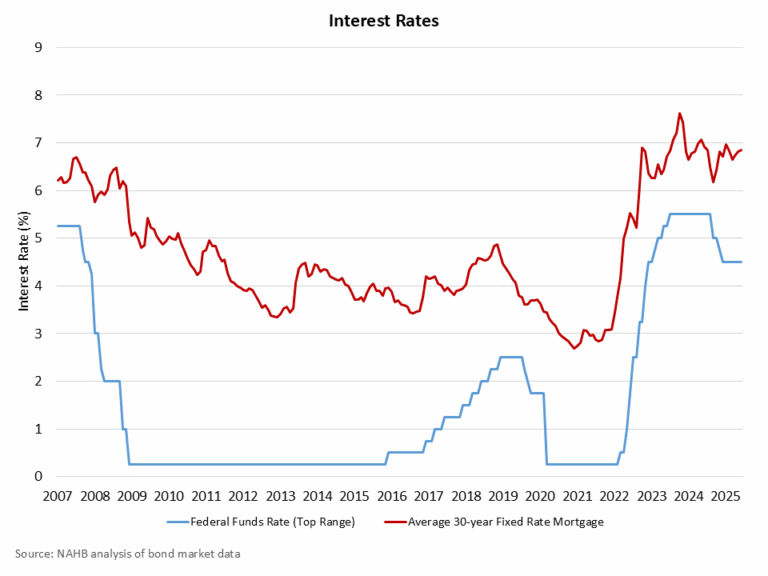
While reductions for the federal funds rate do not have a direct effect on mortgage interest rates, which remain slightly above 6%, federal funds rate reductions do lower interest rates on builder and developer loans, helping the supply-side of the housing market. Supplying more housing and at lower cost is key to solving the ongoing housing affordability challenge. Lower financing costs are part of the overall solution.

Looking forward, the Fed’s outlook for the economy and monetary policy is mixed. Estimates from the central bank’s updated Summary of Economic Projections (SEP) indicate an improved economic growth outlook, with a 2.4% fourth quarter year-over-year growth rate for 2026 (revised up from 2.3% as projected in December) and 2.3% for 2027 (revised up from 2%).

The SEP estimates also reveal an expectation of a 4.4% unemployment rate in 2026 and higher expectation for inflation (core PCE) of 2.7%, revised higher from 2.4% in December. The revised SEP does not anticipate the economy reaching the Fed’s target inflation rate of 2% until 2028.

With respect to policy, the SEP outlook suggests one rate cut in 2026 and one final rate cut in 2027. The “dot plot” of individual responses suggests one member expecting four rate cuts in 2026.


This article was originally published by a eyeonhousing.org . Read the Original article here. .


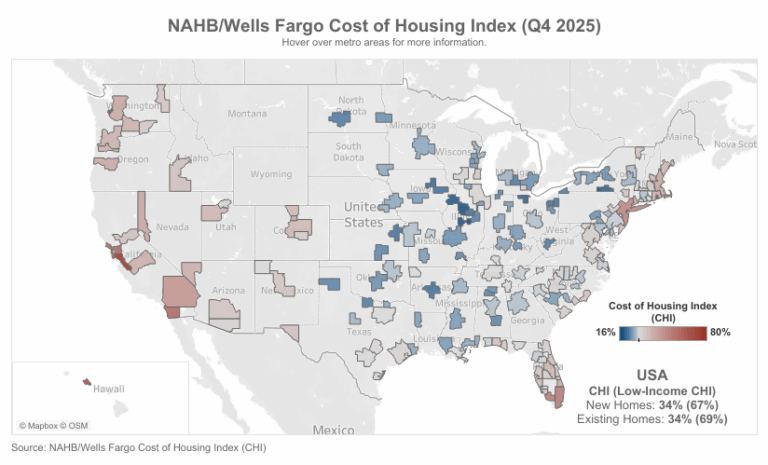
Though new and existing homes remain largely unaffordable, the needle moved slightly in the right direction in the second half of 2025, according to the latest data from the National Association of Home Builders (NAHB)/Wells Fargo Cost of Housing Index (CHI). The CHI results from the fourth quarter of 2025 show that a family earning the nation’s median income of $104,200 needed 34% of its income to cover the mortgage payment on a median-priced new home. Low-income families, defined as those earning only 50% of median income, would have to spend 67% of their earnings to pay for the same new home.

In the last three quarters of 2025, the income share needed to buy a new home declined from 36% in the second quarter, to 35% in the third quarter and 34% in the final quarter of 2025. These figures indicate a slight improvement in affordability.

The same trend holds true for existing homes. A typical family would have to pay 37% of their income for a median-priced existing home in the second quarter, 36% in the third quarter and 34% in the final three months of 2025. A low-income family would need to pay 69% of their earnings to make the same mortgage payment on an existing home in the fourth quarter.

The U.S. data for the percentage of earnings needed to purchase a new home in the fourth quarter is based on a national median new home price of $405,300 and median income of $104,200. The fourth quarter median new home price is down 1.2% from $410,100 in the third quarter. The corresponding price for an existing home in the fourth quarter fell to $414,900, 2.8% down from $426,800 in the previous quarter. The average 30-year mortgage rate moved lower from 6.65% in the third quarter to 6.32% in the fourth quarter.

CHI is also available for 175 metropolitan areas, calculating the percentage of a family’s income needed to make the mortgage payment on an existing home based on the local median home price and median income in those markets.

In eight out of 175 markets in the fourth quarter, the typical family is severely cost-burdened (must pay more than 50% of their income on a median-priced existing home). In 69 other markets, such families are cost-burdened (need to pay between 31% and 50%). There are 98 markets where the CHI is 30% of earnings or lower.

The Top 5 Severely Cost-Burdened Markets

San Jose-Sunnyvale-Santa Clara, Calif., was the most severely cost-burdened market in the CHI, where 80% of a typical family’s income is needed to make a mortgage payment on an existing home. This was followed by:

Urban Honolulu, Hawaii (69%)

San Francisco-Oakland-Fremont, Calif. (63%)

San Diego-Chula Vista-Carlsbad, Calif. (62%)

Barnstable Town, Mass. (56%)

Miami-Fort Lauderdale-West Palm Beach, Fla. (56%)

Naples-Marco Island, Fla. (56%)

Low-income families would have to pay between 111% and 159% of their income in all seven of the above markets to cover a mortgage.

The Top 5 Least Cost-Burdened Markets

By contrast, many of the least cost-burdened markets were located in Illinois. In the top five least cost-burdened markets, typical families needed to spend just 16-18% of their income to pay for a mortgage on an existing home. These markets are:

Decatur, Ill. (16%)

Elmira, N.Y. (16%)

Springfield, Ill. (17%)

Peoria, Ill. (17%)

Davenport-Moline-Rock Island, Iowa-Ill. (18%)

Low-income families in these markets would have to pay between 32% and 36% of their income to cover the mortgage payment for a median-priced existing home.

Visit nahb.org/chi for tables and details.


This article was originally published by a eyeonhousing.org . Read the Original article here. .


Reflecting most forecasters’ expectations for the June FOMC meeting, the Federal Reserve continued its post-2024 pause for federal funds rate cuts, retaining a target rate of 4.5% to 4.25%. The pause comes after a 100 basis point series of reductions in late 2024. Despite these cuts, mortgage rates have remained in the high 6% range. The Fed also held unchanged its ongoing quantitative tightening program, which is more strongly focused on balance sheet reduction for mortgage-backed securities (MBS).

The Fed reaffirmed its policy commitment to achieve maximum employment and reduce inflation to a two percent target rate. During the 2025 policy pause, the Fed remains data dependent in a “wait and see” mode for developments in areas like tariff policy. Chair Powell noted that we learn more about tariffs later this summer. NAHB’s forecast incorporates two rate cuts from the Fed for 2025, one in the third quarter and one in the fourth quarter.

The Fed noted that economic activity continues at a “solid pace,” however swings in imports affected the first quarter GDP data. The central bank also stated that the unemployment rate remains low and inflation remains “somewhat elevated.”

I would note that the primary driver of this elevated inflation is ongoing high rates of shelter inflation, which reflect significant, underlying increases for residential construction costs for the post-covid period. During his press conference, Chair Powell cited that the housing market suffers from both long-run and short-run issues, involving affordability and a [structural] housing shortage. In prior comments to Congress, Powell has noted that home builders face a perfect storm of challenges from both the demand- and supply-sides of the market.

The Federal Reserve also published an update for its Summary of Economic Projections (SEP). Compared to its prior March projections, the Fed reduced its 2025 GDP forecast from 1.7% to 1.4% (year-over-year rate from the fourth quarter). During his press conference, Chair Powell linked policy uncertainty as a complicating factor for economic growth. Additionally in the SEP, the Fed slightly increased its 2025 forecast for the unemployment rate in the fourth quarter from 4.4% to 4.5%.

The central bank also increased its core PCE inflation projection for the final quarter of the year from 2.8% to 3.1%. During his press conference, Chair Powell noted that economic forecasters cited tariff policy as a contributing factor for a higher than expected level of inflation for 2025. He specifically projected that a measurable amount of inflation will arrive to the economy this summer. There is some debate among economists whether tariffs would have just a one-time impact on the aggregate price level, which would not be inflation pressure felt over a sustained period of time, or would in fact be a factor increasing inflation as a series of price increases.

Looking forward to future monetary policy, the “dot plot” projections of the SEP leave the Fed forecasting two rate cuts in 2025, followed by just one reduction in 2026 and one more cut in 2027. This projection removes one rate cute from both 2026 and 2027 compared to the March dot plot, although the Fed continues to point to 3% as the long-run, terminal rate for the federal funds rate.

Discover more from Eye On Housing

Subscribe to get the latest posts sent to your email.


This article was originally published by a eyeonhousing.org . Read the Original article here. .


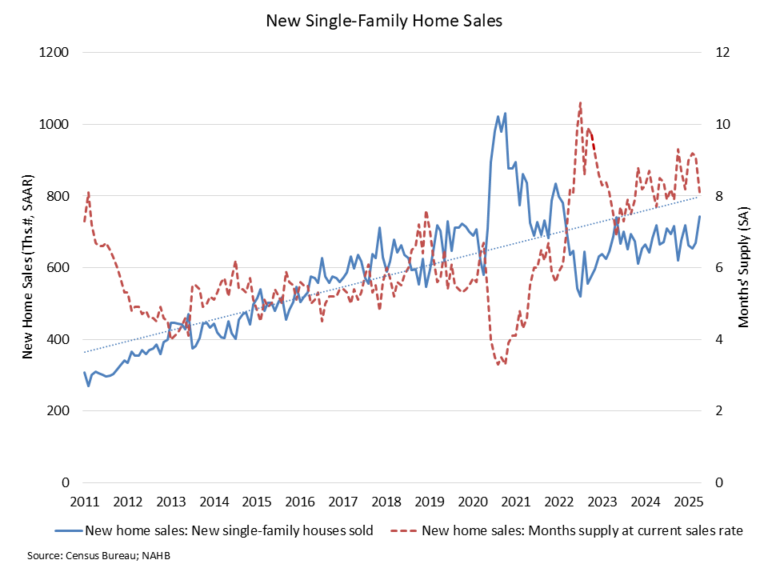
The Census estimate of new home sales posted an unexpected gain in April even as builders and consumers continue to deal with economic uncertainty, elevated interest rates and rising building material costs.

Sales of newly built, single-family homes in April increased 10.9% to a 743,000 seasonally adjusted annual rate from a downwardly revised March number, according to newly released data from the U.S. Department of Housing and Urban Development and the U.S. Census Bureau. The pace of new home sales in April was up 3.3% compared to a year earlier.

The April new home sales figure may be revised as it runs counter to market commentary and the fact that builder sentiment moved markedly lower in May. A less volatile look at the market would be the year-to-date figures, which show new home sales are down 1.2% thus far in 2025 on elevated interest rates, ongoing policy uncertainty and rising construction costs.

Rising inventory in the resale market is likely to place pressure on both pricing and sales activity for home builders during the second half of the year. The April new home data reflects this as new home inventory is leveling off near a half million of residences marketed for sale, up just 1.6% from January.

In April, new home inventory totaled 504,000 residences marketed for sale. While this is 8.6% higher than a year ago, it is only 1.6% higher from January. At the current sales pace, the months’ supply for new home stands at 8.1 compared to 7.7 a year ago.

To further illustrate the challenges builders are facing during the spring home buying season, 61% of home builders are using various kinds of sales incentives, including mortgage rate buydowns, to facilitate sales due to lackluster demand.

A new home sale occurs when a sales contract is signed, or a deposit is accepted. The home can be in any stage of construction: not yet started, under construction or completed. In addition to adjusting for seasonal effects, the April reading of 743,000 units is the number of homes that would sell if this pace continued for the next 12 months. This estimate may be revised lower next month.

Further, when accounting for existing, single-family home sales (a market which is showing rising inventory levels), total home inventory (new plus existing homes) is at a 4.8 months’ supply as of April. This is up from 4.6 from March and up from 4.1 from a year ago. The current reading is the highest since late 2015. Prior analysis indicates that the market will face notable inventory impacts on production as this measure approaches 5.5.

The median new home sale price in April was $407,200, compared to $415,300 a year ago.

Regionally, on a year-to-date basis, new home sales are down 32.5% in the Northeast, 14.8% in the Midwest and 2.4% in the West. Sales are up 5.7% in the South.

Discover more from Eye On Housing

Subscribe to get the latest posts sent to your email.


This article was originally published by a eyeonhousing.org . Read the Original article here. .


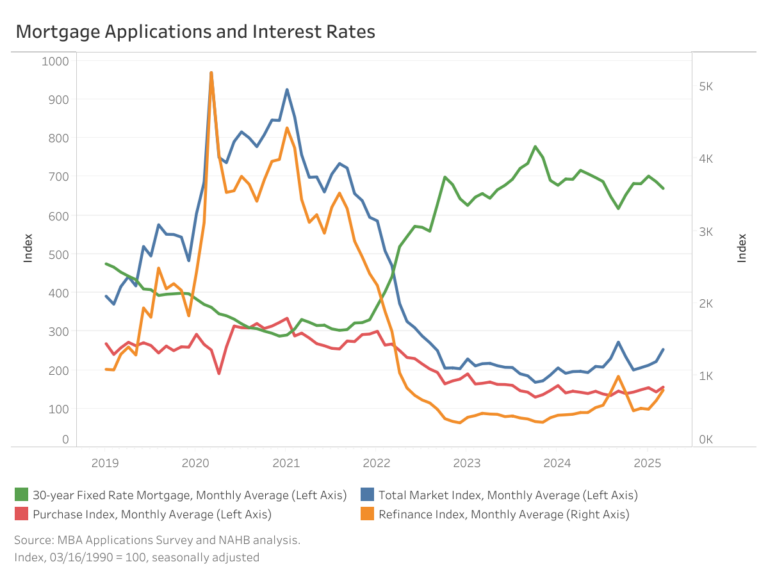
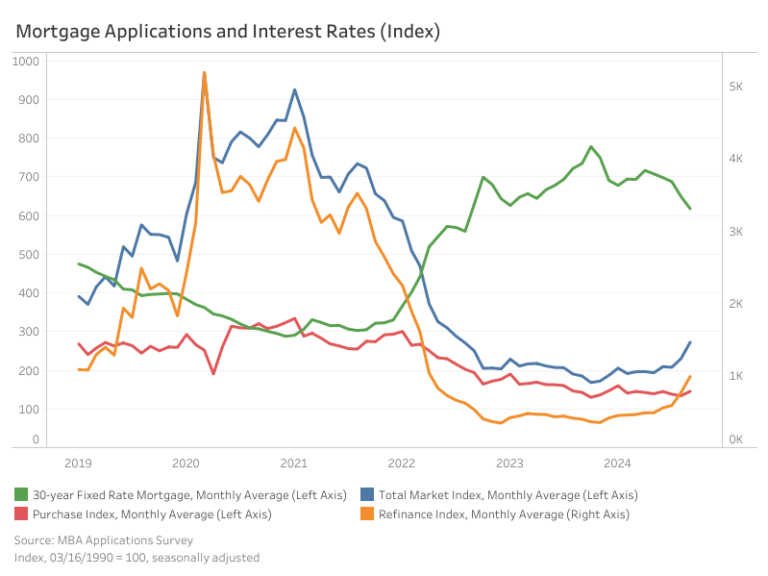
The Market Composite Index, which measures mortgage loan application volume based on the Mortgage Bankers Association (MBA) weekly survey, rose 14.0% month-over-month on a seasonally adjusted (SA) basis, driven primarily by a surge in refinancing activity. Year-over-year, the index is up 29.2% compared to March 2024.

The Purchase Index rebounded 8.3% (SA) from the previous month as mortgage rates declined. Meanwhile, the Refinance Index surged 22.2% (SA), continuing its strong upward trend. Compared to a year ago, purchase applications are up 7.6%, while refinance activity has jumped 72.9%.

Economic uncertainty continues to drive treasury yield volatility, impacting mortgage rates. In March, the average 30-year fixed-rate mortgage reported in the MBA survey fell 17 basis points (bps) to 6.7%, marking a 23 bps decline from a year ago.

Loan sizes have continued to rise since the start of the year. In March, the average loan size across the total market (including purchases and refinances) increased 3.5% month-over-month (NSA) to $403,300. For purchase loans, the average size edged up 0.9% to $450,000, while refinance loans saw a sharper increase of 10.4%, reaching $337,500. Meanwhile, the average loan size for adjustable-rate mortgages (ARMs) rose slightly by 1.1%, from $1.13 million to $1.14 million.

Discover more from Eye On Housing

Subscribe to get the latest posts sent to your email.


This article was originally published by a eyeonhousing.org . Read the Original article here. .


After a period of slowing associated with declines for some elements of the residential construction industry, the count of open construction sector jobs trended lower in the October data, per the Bureau of Labor Statistics’ Job Openings and Labor Turnover Survey (JOLTS). The data indicates the demand for construction labor market remains weaker than a year ago.

In contrast, after revisions, the number of open jobs for the overall economy increased from 7.37 million to 7.74 million in October. Nonetheless, this is notably smaller than the 8.69 million estimate reported a year ago and is a sign of a softening aggregate labor market. Previous NAHB analysis indicated that this number had to fall below 8 million on a sustained basis for the Federal Reserve to feel more comfortable about labor market conditions and their potential impacts on inflation. With estimates remaining below 8 million for national job openings, the Fed is underway easing credit conditions.

The number of open construction sector jobs fell from a revised 258,000 in September to a softer 249,000 in October. Elements of the construction sector slowed in prior months as tight Fed policy persisted. The October reading of opening, unfilled construction jobs is lower than that registered a year ago: 413,000.

The construction job openings rate fell back to 2.9% in October and continues to trend lower, albeit with a fair amount of statistical month-to-month noise in the recent data.

The layoff rate in construction moved lower to 1.2% in October after a 2% rate in September. This was the lowest layoff rate for construction in the data series (going back to late 2000). The quits rate in construction increased to 1.9% in October.

Discover more from Eye On Housing

Subscribe to get the latest posts sent to your email.


This article was originally published by a eyeonhousing.org . Read the Original article here. .


The Market Composite Index, a measure of mortgage loan application volume by the Mortgage Bankers Association’s (MBA) weekly survey, rose 18.4% month-over-month on a seasonally adjusted (SA) basis, driven primarily by a surge in refinancing activity. Compared to September 2023, the index increased by 47%. The Market Composite Index which includes the Purchase and Refinance Indices saw monthly gains, rising by 8.6% and 29%, respectively. Year-over-year, the Purchase Index showed a modest increase of 1.9%, while the Refinance Index jumped 149.9%.

The average 30-year fixed mortgage rate continued its downward trajectory for the fifth consecutive month, with September seeing a decline of 31 basis points (bps), bringing the rate to 6.18%. This is 117 bps lower than the same time last year.

Loan sizes also saw growth across the board. The average loan size for the total market (including purchases and refinances) was $400,450 on a non-seasonally adjusted (NSA) basis, an increase of 5.1% from August. Purchase loans grew by 3% to an average of $439,600, while refinance loans jumped by 11.6% to $363,825. Adjustable-rate mortgages (ARMs) saw an 8.2% increase in average loan size, rising from $1.1 million to $1.2 million.

Discover more from Eye On Housing

Subscribe to get the latest posts sent to your email.


This article was originally published by a eyeonhousing.org . Read the Original article here. .


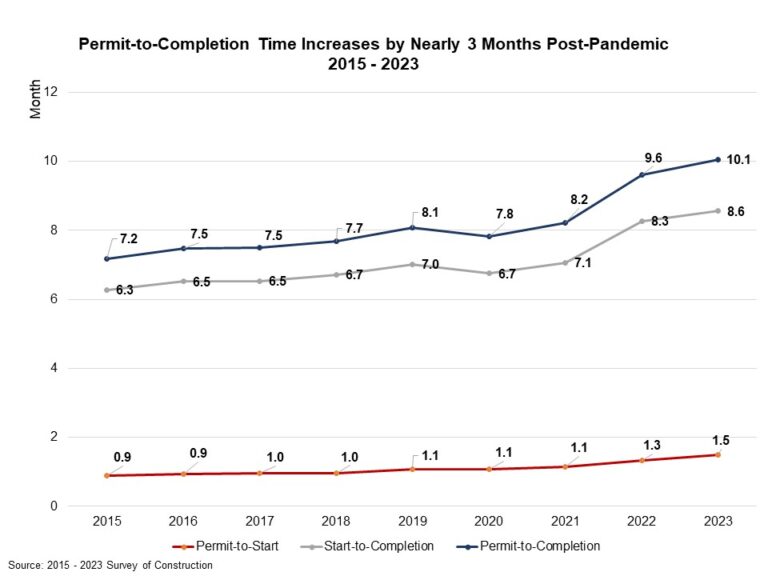
The average completion time of a single-family house in 2023 was approximately 10.1 months, breaking down to 1.5 months for authorization to start construction and another 8.6 months to finish construction. According to the Census Bureau’s Survey of Construction, the permit-to-completion time has been on an upward trend since 2015. Currently, it is almost 3 months longer than the average completion time in 2015. This extended duration is largely attributable to a more stringent regulatory environment, ongoing supply-chain challenges and a shortage of skilled labor.

Among all single-family houses completed in 2023, homes built for sale required the shortest amount of time, 8.9 months from obtaining building permits to completion. Meanwhile, homes built by owners (custom builds) required the longest time, 15.2 months. Homes built by hired contractors tookabout12.1 months, and homes built-for-rent took about 12.2 months from authorization to completion.

The time from permit to start for all types of homes was longer in 2023. The period of time necessary to start construction required, on average, 1.5 months in 2023. In contrast, prior to 2017 construction typically started within the same month after obtaining building authorization. Between authorization and the start of construction, built for sale and built by contractors on owner’s land required 1.5 months and 1.4 months respectively. The permit-to-start time was even longer for homes built-for-rent and custom builds (1.6 months).

The chart below illustrates that permit-to-completion time differs across home sizes. The smallest single-family homes, under 1,200 sq. ft., required 13 months to finish, relatively longer than larger homes under 5,000 sq. ft. This prolonged period is primarily because half of these smaller homes are constructed specifically for rental purposes, which typically takes longer building time from authorization. In contrast, homes ranging from 1,200 to 3,999 sq. ft. are built at the average building time, typically around 10 months. As the size increases beyond 4,000 sq. ft., there is a noticeable upward trend in completion times. Homes with 4,000-4,999 sq. ft. take about 12 months, while those between 5,000- 5,999 sq. ft. extend to a little more than 14 months. Homes over 6,000 sq. ft. take the longest to build, requiring almost 18 months from permit to finish.

The average time from authorization to completion also varies across divisions. The division with the longest duration was New England (13.9 months), followed by the Middle Atlantic (13.2 months), the Mountain division (11.4 months), and the Pacific division (11.2 months) in 2023. These four divisions exceeded the nation’s average of10.1 months. The shortest period, 8.9 months, is registered in the South Atlantic division. The average waiting period from permit to construction start varies from the shortest time of 0.9 months in the East North Central to the longest of 2 months in New England.

The SOC also collects additional information for houses built for sale, including a sale date when buyers sign sale contracts or make a deposit. Looking at single-family homes built for sale and completed in 2023, 17.2% were sold before construction started, 41.8% sold while under construction, 15.6% sold during the month of completion, and 19.7% sold after completion. The share of completed houses remaining unsold was 5.8% at point of survey.

Discover more from Eye On Housing

Subscribe to get the latest posts sent to your email.


This article was originally published by a eyeonhousing.org . Read the Original article here. .


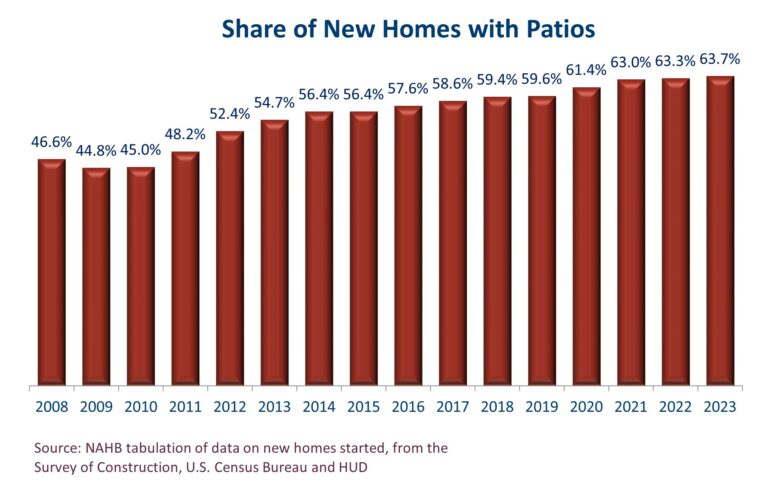
The share of new homes with patios increased to yet another record high in 2023. Of the roughly 950,000 single-family homes started during the year, 63.7% came with patios. This is up from 63.3% in 2022 and marks the eighth consecutive year the percentage set a new record high. The source for these numbers is NAHB tabulation of data from the Survey of Construction (conducted by the U.S. Census Bureau with partial funding from the Department of Housing and Urban Development).

Historically, fewer than half of new homes came with patios during the 2008-2011 period of extreme weakness in housing markets. But soon thereafter, the share jumped to 52.4% in 2012 and has been climbing ever since. The percentage has now increased in thirteen of the past fourteen years. The only exception was 2015, when the percentage was unchanged.

While patios for new homes have generally become more common over time, the parts of the country where they tend to be most common have remained consistent. At the low end, only 17% percent of new single-family homes built in New England and 20% in the Middle Atlantic came with patios in 2023. At the high end, the incidence of patios on new homes was over 80% in the West South Central and close to 70% in the South Atlantic and Mountain divisions. The geographic tendencies are similar to the ones reported in last year’s post.

Additional detail on the characteristics of new-home patios is available from the Annual Builder Practices Survey (BPS) conducted by Home Innovation Research Labs.

For the U.S. as a whole, the 2024 BPS report (based on homes built in 2023, like the SOC-based statistics cited above) shows that the average size of a new-home patio is about 290 square feet, but with considerable geographic variation. The average is over 400 square feet in the East South Central and about 380 square feet in New England; but under 200 square feet in the West South Central, and only a little over 200 square feet in the adjacent West North Central division.

In most parts of the country, poured concrete dominates all other building materials used in new-home patios. In the East South Central, for instance, poured concrete accounts for over 90% of new-home patios on a square-foot basis. To the extent that there are exceptions, they occur on the east coast. In the South Atlantic, concrete and brick pavers each have about a quarter of the market, and poured concrete has less than half. In New England, the market is more or less equally divided among poured concrete, concrete pavers and natural stone. In the Mid-Atlantic, brick pavers are the most popular choice for new-home patios by a substantial margin.

Discover more from Eye On Housing

Subscribe to get the latest posts sent to your email.


This article was originally published by a eyeonhousing.org . Read the Original article here. .


In July, job growth decelerated significantly, and the unemployment rate increased to a nearly three-year high of 4.3%. The July data indicates that the labor market is slowing, which signals monetary policy easing in the months ahead.

Additionally, wage growth slowed for the second month in a row. In July, wages grew at a 3.6% year-over-year (YOY) growth rate, down 1.0 percentage point from a year ago. This marks the lowest YOY wage gain in the past four years.

Total nonfarm payroll employment increased by 114,000 in July, following a downwardly revised increase of 179,000 jobs in June, as reported in the Employment Situation Summary. The estimates for the previous two months were revised down. The monthly change in total nonfarm payroll employment for May was revised down by 2,000, from +218,000 to +216,000, while the change for June was revised down by 27,000 from +206,000 to +179,000. Combined, the revisions were 29,000 lower than the original estimates.

Despite restrictive monetary policy, nearly 7.8 million jobs have been created since March 2022, when the Fed enacted the first interest rate hike of this cycle. In the first seven months of 2024, 1,419,000 jobs were created. Additionally, monthly employment growth averaged 203,000 per month, compared with the 251,000 monthly average gain for 2023.

In July, the unemployment rate rose for the fourth straight month to 4.3%, the highest rate since October 2021. The number of unemployed persons rose by 352,000, while the number of employed persons was barely changed.

Meanwhile, the labor force participation rate, the proportion of the population either looking for a job or already holding a job, rose 1.0 percentage point to 62.7% for July. Moreover, the labor force participation rate for people aged between 25 and 54 ticked up to 84.0%, the highest level since March 2001. While the overall labor force participation rate is still below its pre-pandemic levels at the beginning of 2020, the rate for people aged between 25 and 54 exceeds the pre-pandemic level of 83.1%.

For industry sectors, health care (+55,000), construction (+25,000), and transportation and warehousing (+14,000) have notable job gains in July, while information employment lost 20,000 jobs.

Employment in the overall construction sector increased by 25,000 in July, after 20,000 gains in June. While residential construction gained 9,100 jobs, non-residential construction employment added 16,200 jobs for the month.

Residential construction employment now stands at 3.4 million in July, broken down as 950,000 builders and 2.4 million residential specialty trade contractors. The 6-month moving average of job gains for residential construction was 6,067 a month. Over the last 12 months, home builders and remodelers added 67,600 jobs on a net basis. Since the low point following the Great Recession, residential construction has gained 1,387,400 positions.

In July, the unemployment rate for construction workers rose to 4.4% on a seasonally adjusted basis. The unemployment rate for construction workers remained at a relatively lower level, after reaching 15.3% in April 2020, due to the housing demand impact of the COVID-19 pandemic.

Discover more from Eye On Housing

Subscribe to get the latest posts sent to your email.


This article was originally published by a eyeonhousing.org . Read the Original article here. .

Pin It