Tag

Continue

Browsing


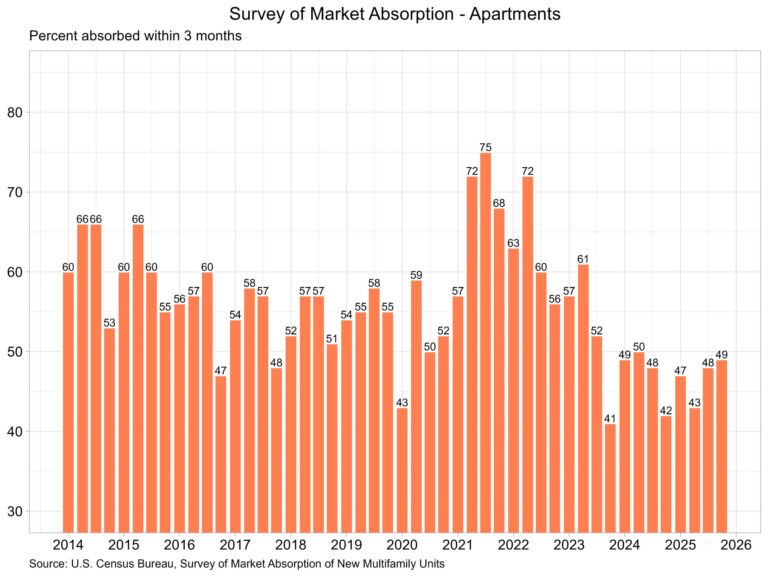
The percentage of new apartment units that were absorbed within three months after completion was up one percentage point in the fourth quarter, according to the Census Bureau’s latest release of the Survey of Market Absorption of New Multifamily Units (SOMA). The survey covers new units in multifamily residential buildings with five or more units. The number of new multifamily units completed was 77,380 in the fourth quarter, the lowest quarterly completions since the second quarter of 2022 (76,630).

Apartments

The percentage of apartments absorbed within three months after completion was 49% for those completed in the fourth quarter of 2025. This was the sixth consecutive quarter for which new apartments were absorbed at a rate below 50%. The median asking rent for apartments completed in the fourth quarter was $2,034, up 4.5% from $1,946 last year. This also marks the first quarter where the median asking rent topped $2,000.

Along with the three-month absorption rate and completions, SOMA also reports absorption rates at six, nine, and twelve months after completion. For apartments completed six months ago (97,210 units), 68% have been absorbed into the market. For apartments completed (93,140 units) nine months ago, 80% have been absorbed. For those completed twelve months ago (92,760 units), 90% have been absorbed into the multifamily market.

Condominiums and Cooperative Units

The three-month absorption rate for new condominiums and cooperative units rose to 70%. Total completions of new condominiums and cooperative units, according to SOMA, was 4,831 in the fourth quarter of 2025.


This article was originally published by a eyeonhousing.org . Read the Original article here. .


Residential construction permitting activity presented a mixed picture through the first quarter of 2026, as weakness in the single-family market contrasted with continued strength in multifamily development. Elevated financing costs, ongoing affordability challenges, and softer builder sentiment continued to weigh on single-family construction activity, while multifamily permitting remained supported by demand for rental housing.

Over the first three months of the year, the number of single-family permits issued nationwide reached 214,655. On a year-over-year basis, this represents a 7.6 percent decline compared with the March 2025 total of 232,221. On the other hand, multifamily permitting activity was stronger, with 121,404 permits issued nationwide, marking a 7.1 percent increase from the same period last year.

Regionally, year-to-date single-family permitting declined in all four regions through March. The Midwest was essentially flat, the South declined by 7.4 percent, the West dropped 9.3 percent, and the Northeast fell 17.1 percent. Multifamily permits increased in three of the four regions, led by gains in the Northeast (up 47.0 percent), followed by the West (up 38.0 percent), and the Midwest (up 2.2 percent). The South saw a decline of 13.3 percent, driven largely by a 42.0 percent decrease in the Houston-Pasadena-The Woodlands, TX metropolitan area and a 29.0 percent drop in the Miami-Fort Lauderdale-West Palm Beach, FL metropolitan area.

At the state level, 12 states recorded year-over-year increases in single-family permits in March, with gains ranging from 18.6 percent in Alabama to 0.2 percent in Minnesota. The District of Columbia reported no change. The remaining 38 states reported declines, led by Maryland, which posted the steepest drop at 25.4 percent.

The ten states issuing the highest number of single-family permits accounted for 63.7 percent of all single-family permits issued nationwide. Texas led the country with 35,231 permits issued at the end of the first quarter of 2026, although this represented an 8.3 percent decline compared with March 2025. Florida, the second-highest state, saw permits fall by 6.7 percent, while North Carolina, ranked third, experienced a decline of 15.4 percent.

Between March 2026 and March 2025, 29 states recorded increases in multifamily building permits, while 21 states and the District of Columbia experienced declines. Rhode Island posted the largest percentage increase, with multifamily permits surging 397.2 percent, rising from 109 to 542 units. In contrast, Nevada recorded the steepest decline, with permits falling 81.6 percent, from 2,299 to 422 units.

The ten states issuing the highest number of multifamily permits accounted for 62.8 percent of all multifamily permits issued nationwide. Over the first three months of 2026, California, which issued the most multifamily permits, recorded a substantial increase of 105.4 percent. Texas, the second-highest state, posted a decline of 2.9 percent, while New York, ranking third, saw multifamily permits rise by 154.8 percent.

At the local level, the following are the ten metropolitan areas with the highest number of single-family permits issued.

Below are the ten metropolitan areas with the highest levels of multifamily permitting activity.


This article was originally published by a eyeonhousing.org . Read the Original article here. .
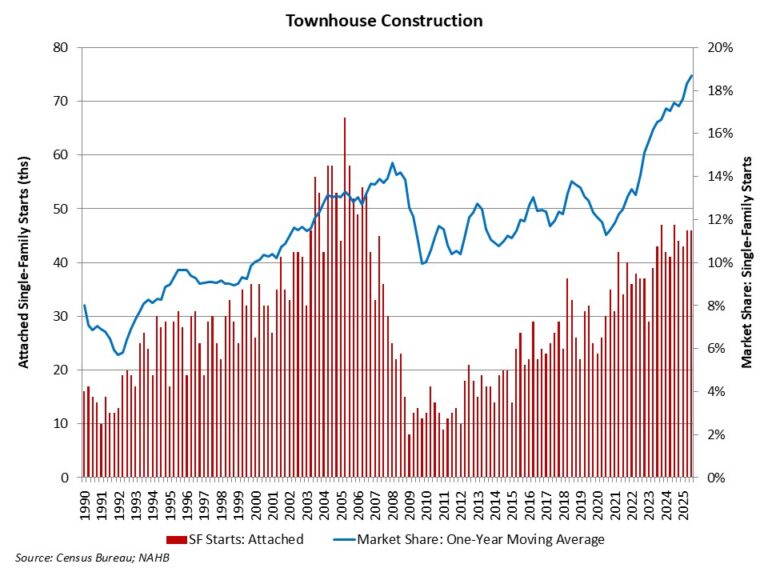

Townhouse construction gained single-family construction market share during the third quarter of 2025.

According to NAHB analysis of the most recent Census data of Starts and Completions by Purpose and Design, during the third quarter of 2025, single-family attached starts totaled 46,000. Over the last four quarters, townhouse construction starts totaled a strong 179,000 homes, which is 1% higher than the prior four-quarter period (177,000). Townhouses made almost 20% all of single-family housing starts for the third quarter of the year.

Using a one-year moving average, the market share of newly-built townhouses stood at 18.7% of all single-family starts for the third quarter. With gains over the last year, the four-quarter moving average market share is the highest on record, for data going back to 1985.

Prior to the current cycle, the peak market share of the last two decades for townhouse construction was set during the first quarter of 2008, when the percentage reached 14.6% on a one-year moving average basis. This high point was set after a fairly consistent increase in the share beginning in the early 1990s.

The long-run prospects for townhouse construction are positive given growing numbers of homebuyers looking for medium-density residential neighborhoods, such as urban villages that offer walkable environments and other amenities. Where it can be zoned, it can be built.


This article was originally published by a eyeonhousing.org . Read the Original article here. .
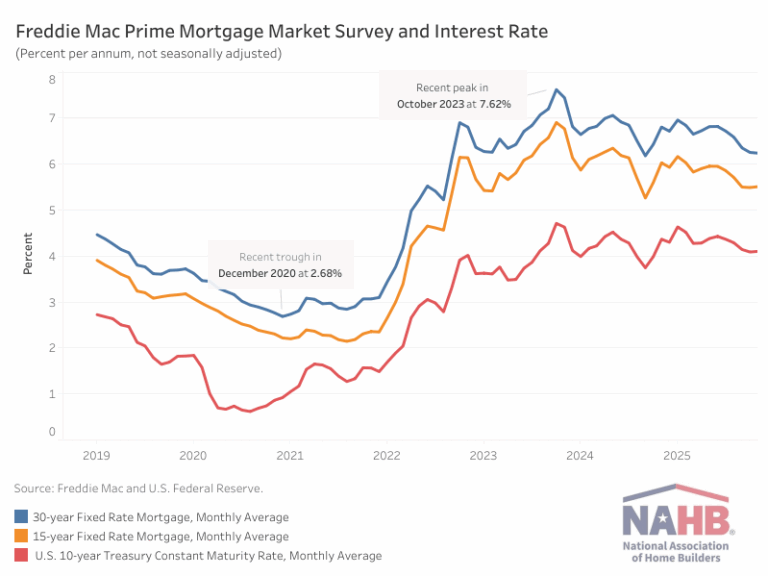

The average mortgage rate in November continued to trend lower to its lowest level in over a year. According to Freddie Mac, the 30-year fixed-rate mortgage averaged 6.24% in November, 2 basis points (bps) lower than in October. Meanwhile, the 15-year rate increased 3 bps to 5.51%. Both the 30-year and 15-year rates remain lower than a year ago, dropping by 57 bps and 52 bps year-over-year, respectively.

The 10-year Treasury yield, a key benchmark for long-term borrowing, averaged 4.09% in November– a 3-basis point increase from the previous month. The spread between the 30-year fixed mortgage rate and the 10-year Treasury remains somewhat elevated at 215 basis points, well above the roughly 150-180 basis points seen in a stable market. While the spread has narrowed from the wide gap in 2023, it continues to reflect ongoing market uncertainty, keeping mortgage rates higher than their historical relationship to 10-year Treasury yields.

Falling mortgage rates have shown some impact on housing activity. Mortgage application activity continues to strengthen, led by increases in adjustable-rate mortgages and refinancing applications. Additionally, existing home sales rose to an eight-month high in October. There is no data available for new home sales in October due to the government shutdown.


This article was originally published by a eyeonhousing.org . Read the Original article here. .


Credit conditions on loans for residential Land Acquisition, Development & Construction (AD&C) were still tightening in the third quarter of 2025, according to NAHB’s quarterly survey on AD&C Financing.  The net easing index derived from the survey posted a reading of -11.0 (the negative number indicating that credit tightened since the previous quarter). This is in reasonably close agreement with the third quarter reading of -6.6 for the similar net easing index produced from the Federal Reserve’s survey of senior loan officers—marking fifteen consecutive quarters of tightening credit conditions reported by both builders and lenders.

More details from the Fed’s survey of lenders—including measures of demand and net easing for residential mortgages—appeared in a previous post.

According to the NAHB survey, the most common way lenders tightened in the third quarter was by lowering the maximum allowable loan-to-value or loan-to-cost ratio on the loans (cited by 60% of the builders and developers who reported tighter credit). Tied for second place were reducing the amount they are willing to lend, requiring out-of-pocket payment of interest or borrower funding of an interest reserve, and  requiring personal guarantees (cited by 47% each).

Results on the cost of credit in the third quarter were mixed. The average contract rate increased from 7.82% to 7.95% on loans specifically for residential land acquisition—but declined on the other three categories of loans tracked in NAHB’s AD&C survey: from 8.04% to 7.68% on loans for land development, from 8.17% to 7.90% on loans for speculative single-family construction, and from 7.95% to 7.90% on loans for pre-sold single-family construction.   

Meanwhile, the average initial points charged on the loans increased across the board: from 0.56% to 0.66% on loans for land acquisition, from 0.74% to 0.83% on loans for land development, from 0.72% to 0.74% on loans for speculative single-family construction, and from 0.58% to 0.67% on loans for pre-sold single-family construction.

Those combinations of quarter-to-quarter changes caused the effective interest rate (which takes both the contract rate and initial points into account) to increase from 9.95% to 10.15% on loans for land acquisition, but to decline from 11.77% to 10.92% on loans for land development and from 12.82% to 12.04% on loans for speculative single-family construction. The average effective rate on loans for pre-sold single-family construction remained essentially unchanged at 12.74%, compared to 12.73% in the second quarter.

Although results on the average effective interest rate were mixed on a quarter-to-quarter basis, the  rate on each of the four types of AD&C loans has declined significantly since peaking somewhere in the period between 2023 Q3 and 2024 Q2.

Also in the NAHB AD&C survey, 37% of respondents who built single-family homes during the third quarter of 2025 reported financing some of the construction with a construction-to-permanent (one-time-close) loan made to the ultimate home buyer. On average, 63% of the homes these respondents built were financed this way.

More detail on credit conditions for residential builders and developers is available on NAHB’s AD&C Financing Survey web page.


This article was originally published by a eyeonhousing.org . Read the Original article here. .
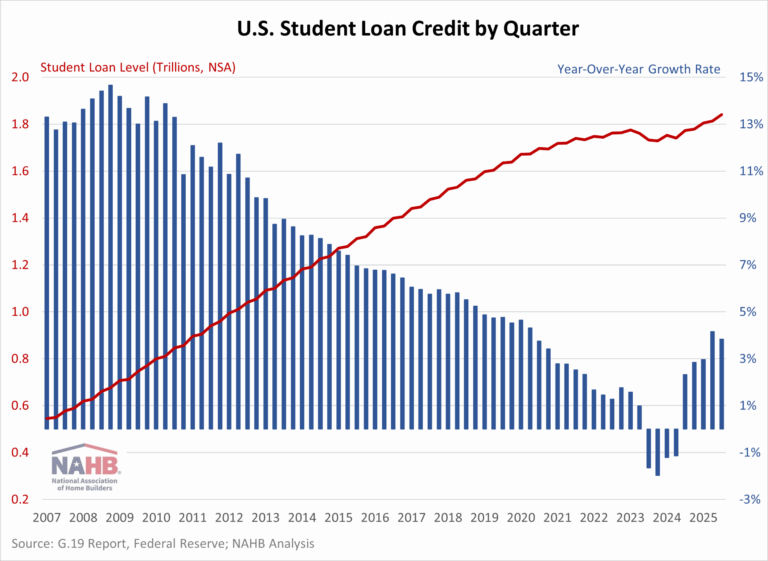

Overall consumer credit continued to rise for the third quarter of 2025, but the pace of growth remains slow. Student loan balances continue to rise as well, slowly returning to pre-COVID growth. Furthermore, credit card and auto loan balances continue to grow but at historically low rates. Although interest rates are still elevated, credit card and auto loan rates continue to decrease slightly. 

Total outstanding U.S. consumer credit reached $5.08 trillion for the third quarter of 2025, according to the Federal Reserve’s G.19 Consumer Credit Report. This is an increase of 2.72% at a seasonally adjusted annual rate (SAAR) compared to the previous quarter, and a 2.25% increase compared to last year.  

Nonrevolving Credit  

Nonrevolving credit, largely driven by student and auto loans (the G.19 report excludes mortgage loans), reached $3.77 trillion (SA) in the third quarter of 2025. This marks a 2.95% increase (SAAR) from the previous quarter, and a 2.14% increase from last year. 

Student loan debt stood at $1.84 trillion (NSA) for the third quarter of 2025, marking a 3.84% increase from a year ago. The end of the COVID-19 Emergency Relief—which allowed 0% interest and halted payments until September 1, 2023—led year-over-year growth to decline for four consecutive quarters, from Q3 2023 through Q2 2024 as borrowers resumed payments and took on less new debt. The past five quarters have shown a return to growth, nearly matching pre-pandemic growth rates.  

Auto loans reached a level of $1.57 trillion (NSA), showing a year-over-year increase of only 0.30%, marking one of the slowest growth rates since 2010. The deceleration in growth can be attributed to several factors, including stricter lending standards, elevated interest rates, and overall inflation. Auto loan rates for a 60-month new car stood at 7.64% (NSA) for the third quarter of 2025, a historically elevated level. However, auto rates have slowed modestly, decreasing by 0.76 percentage points compared to a year ago.  

Revolving Credit 

Revolving credit, primarily made up of credit card debt, rose to $1.31 trillion (SA) in the third quarter of 2025. This represents a 2.04% increase (SAAR) from the previous quarter and a 2.55% increase year-over-year. Both measures reflect a notable slowdown, marking some of the weakest growth in revolving credit in several years. This deceleration comes as credit card interest rates remain elevated, with the average rate held by commercial banks (NSA) at 21.39%. Although rates have hovered near historic highs since Q4 2022, the past three quarters have shown modest year-over-year declines, reflecting the impact of rate cuts that began in 2024. 


This article was originally published by a eyeonhousing.org . Read the Original article here. .
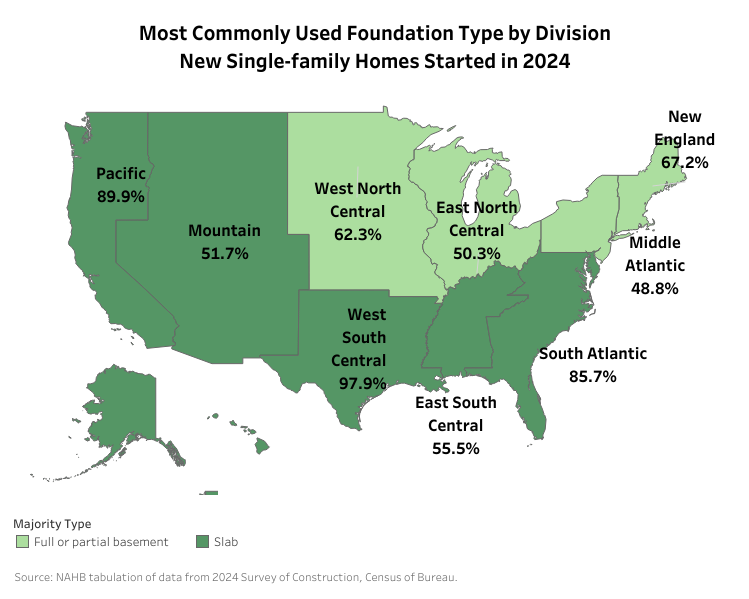

In 2024, 73% of new single-family homes started were built on slab foundations, according to NAHB analysis of the U.S. Census Bureau’s Survey of Construction (SOC). Although this was a modest year-over-year increase of 0.6 percentage points, it continues the upward trend in slab adoption, widening the gap between slabs and other foundation types. In comparison, basements (full or partial) accounted for 17% of new homes, while crawl spaces made up just 9.2%.

Foundation type continues to follow regional climate patterns. In colder northern divisions, where foundations to extend below the frost line, basements are more common. In 2024, the majority of homes in New England (67.2%), West North Central (62.3%), East North Central (50.3%), and the Middle Atlantic (48.8%) were built with full or partial basements. Among these, East North Central (1,119 sq. ft.) and the Middle Atlantic (1,113 sq. ft.) had the largest average finished basement areas, both exceeding the national average of 1,112 sq. ft. West North Central followed with 940 sq. ft., and New England averaged 810 sq. ft.

In contrast, warmer regions favor slab foundations for their affordability and efficiency. Nearly all new single-family homes in West South Central (97.9%), Pacific (89.9%), and South Atlantic (85.7%) divisions were built on slabs in 2024. The cost advantages of slabs have also led to increased adoption in some northern divisions – especially post-pandemic, as rising material costs and supply chain disruptions pushed builders to prioritize cost-effective construction methods.

Crawl space foundations have seen a long-term decline. While East South Central and Pacific divisions have historically led in crawl space usage, both have experienced noticeable decreases, particularly the Pacific, which saw a sharp drop in the past decade. Interestingly, the Mountain division has seen a gradual rebound in crawl space use, now ranking second in crawl space share. Meanwhile, divisions such as East North Central, New England, and West South Central have consistently maintained shares of new homes started below 10%, reflecting persistent regional preferences. Notably, the West North Central division surpassed the 10% threshold in 2024 after several years of incremental growth, although it remains unclear whether this marks a lasting shift or a one-time fluctuation.

Discover more from Eye On Housing

Subscribe to get the latest posts sent to your email.


This article was originally published by a eyeonhousing.org . Read the Original article here. .
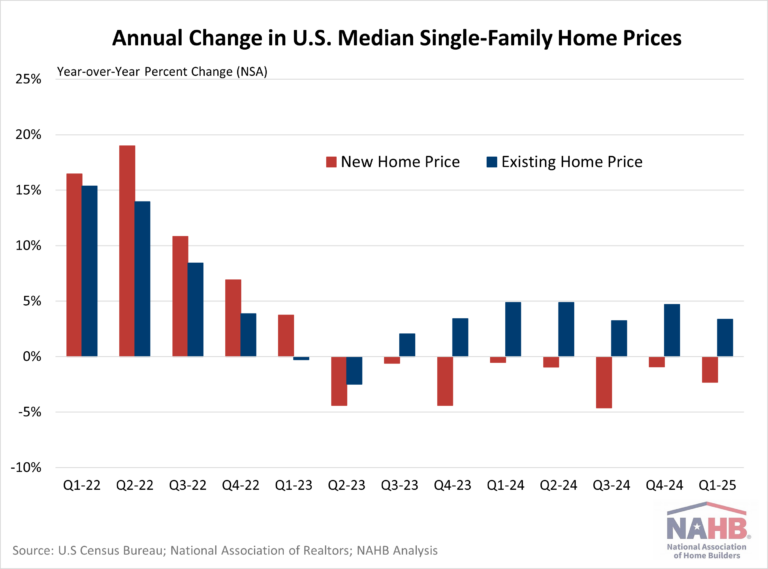

The median price for a new single-family home sold in the first quarter of 2025 was $416,900, a mere $14,600 above the existing home sale price of $402,300, according to U.S. Census Bureau and National Association of Realtors data (not seasonally adjusted – NSA).

Typically, new homes carry a price premium over existing homes. However, the median existing home price exceeded the new home price in the second quarter of 2024 and again in the third quarter of 2024. The first quarter of 2025’s $14,600 price difference is considerably modest by historical standards. Just over two years ago in Q4 2022, the price gap hit a peak with new homes selling for $64,200 more than existing homes. The average difference over the last five years was $26,700, while the decade (2010-2019) prior saw a much wider gap of $66,000.

Both new and existing homes saw dramatic increases in prices post-pandemic due to higher construction costs and limited supply. While overall home prices remain elevated compared to historical norms, new home prices have moderated due to builder business decisions, but existing home prices continue to increase because of lean supply.

The median price for a new single-family home sold in the first quarter of 2025 decreased 2.32% from the previous year. New home prices have continued to experience year-over-year declines for eight consecutive quarters.

Meanwhile, the median price for existing single-family homes increased 3.38% from one year ago. Existing home prices have continued to experience year-over-year increases for seven consecutive quarters.

There are several factors as to why new and existing homes are selling at similar price points. Tight inventory continues to push up prices for existing homes, as many homeowners who secured low mortgage rates during the pandemic are hesitant to sell due to current high interest rates.

Meanwhile, new home pricing is more volatile – prices change due to the types and locations of homes being built. Despite various challenges facing the industry, home builders are adapting to affordability challenges by building on smaller lots, constructing smaller homes, and offering incentives. Additionally, there has been a shift in home building toward the South, associated with less expensive homes because of policy effects.

The least expensive region for homes in the first quarter was the Midwest, with a median price of $367,500 for new homes and $297,800 for existing homes. The South followed closely, with a median new home price of $376,000 and an existing home price of $361,800.

New homes were most expensive in the Northeast with a median price of $784,900, while the West sold at $522,100. However, for existing homes, the West led as the most expensive region at $626,000, followed by the Northeast at $482,700.

The new home price premium was most pronounced in the Northeast, where new homes sold for $302,200 more than existing homes. In contrast, the South saw little difference with a modest $14,200— similar to the national trend. Uniquely, this pattern reversed in the West, where existing homes were $103,900 more than new homes.

Discover more from Eye On Housing

Subscribe to get the latest posts sent to your email.


This article was originally published by a eyeonhousing.org . Read the Original article here. .
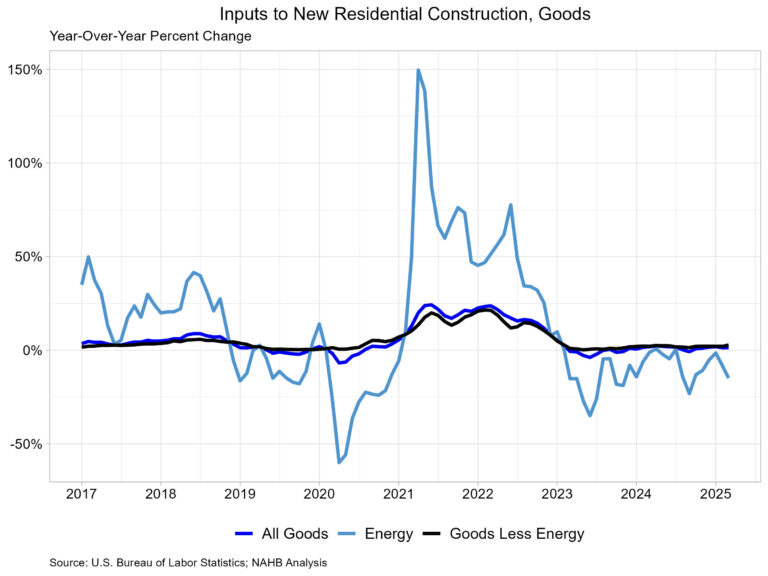

Prices for inputs to new residential construction—excluding capital investment, labor, and imports—were up 0.6% in March according to the most recent Producer Price Index (PPI) report published by the U.S. Bureau of Labor Statistics. The increase in February was revised upward to 0.7%. The Producer Price Index measures prices that domestic producers receive for their goods and services; this differs from the Consumer Price Index which measures what consumers pay and includes both domestic products as well as imports.

The inputs to the New Residential Construction Price Index grew 1.3% from March of last year. The index can be broken into two components—the goods component also increased 1.3% over the year, with services increasing 1.3% as well. For comparison, the total final demand index, which measures all goods and services across the economy, increased 2.7% over the year, with final demand with respect to goods up 0.9% and final demand for services up 3.6% over the year.

Input Goods

The goods component has a larger importance to the total residential construction inputs price index, representing around 60%. For the month, the price of input goods to new residential construction was up 0.5% in March.

The input goods to residential construction index can be further broken down into two separate components, one measuring energy inputs with the other measuring goods less energy inputs. The latter of these two components simply represents building materials used in residential construction, which makes up around 93% of the goods index.

Energy input prices fell 3.9% between February and March and were 14.9% lower than one year ago. Building material prices were up 0.8% between February and March and up 2.7% compared to one year ago. Energy costs have continued to fall on a year-over-year basis, as this marks the eighth consecutive month of lower input energy costs.

Metal products used in residential construction saw the largest price increases in the month of March. Across all inputs to new residential construction, ornamental and architectural metal work increased the most, up 21.0%. Ornamental and architectural metal work products increased 11.2% on a month-to-month basis, by far their largest monthly increase for the product, with the next closes being 7.9% back in October of 2021.

Input Services

While prices of inputs to residential construction for services were down 0.1% over the year, they were up 1.1% in March from February. The price index for service inputs to residential construction can be broken out into three separate components: a trade services component, a transportation and warehousing services component, and a services excluding trade, transportation and warehousing component (other services). The most significant component is trade services (around 60%), followed by other services (around 29%), and finally transportation and warehousing services (around 11%). The largest component, trade services, was up 0.7% from a year ago. The other services component was up 1.6% over the year. Lastly, prices for transportation and warehousing services advanced 3.6% compared to March last year.

Discover more from Eye On Housing

Subscribe to get the latest posts sent to your email.


This article was originally published by a eyeonhousing.org . Read the Original article here. .
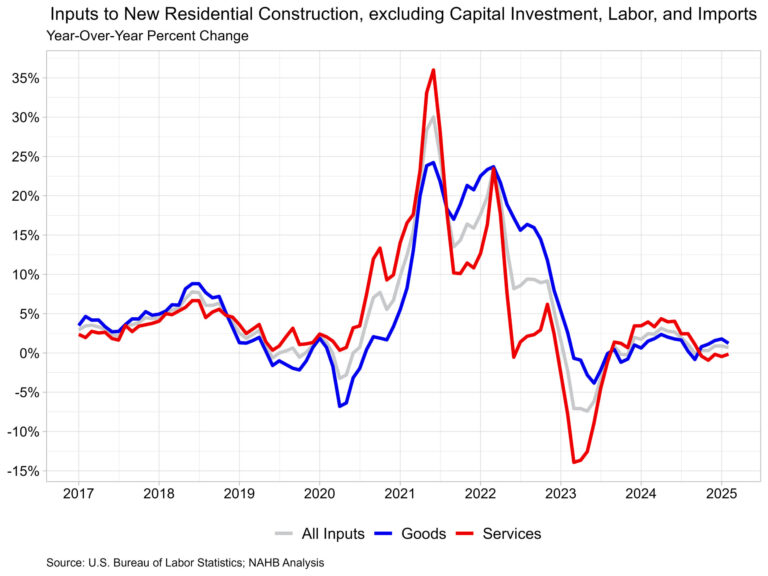

Prices for inputs to new residential construction—excluding capital investment, labor, and imports—were up 0.5% in February according to the most recent Producer Price Index (PPI) report published by the U.S. Bureau of Labor Statistics. The increase in January was revised downward to 1.1%. The Producer Price Index measures prices that domestic producers receive for their goods and services, this differs from the Consumer Price Index which measures what consumers pay and includes both domestic products as well as imports.

The inputs to the New Residential Construction Price Index grew 0.7% from February of last year. The index can be broken into two components—the goods component increased 1.2% over the year, while services decreased 0.1%. For comparison, the total final demand index, which measures all goods and services across the economy, increased 3.2% over the year, with final demand with respect to goods up 1.7% and final demand for services up 3.9% over the year.

Input Goods

The goods component has a larger importance to the total residential construction inputs price index, representing around 60%. For the month, the price of input goods to new residential construction was up 0.6% in February.

The input goods to residential construction index can be further broken down into two separate components, one measuring energy inputs with the other measuring goods less energy inputs. The latter of these two components simply represents building materials used in residential construction, which makes up around 93% of the goods index.

Energy input prices grew 2.6% between January and February but remained 8.5% lower compared to one year ago. Building material prices were up 0.5% between January and February while they were up 2.0% compared to one year ago.

Among materials used in residential construction, lumber and wood products ranks 3rd in terms of importance for the Inputs to New Residential Construction Index. Nonmetallic mineral products and metal products rank 1st and 2nd, respectively. The top lumber and wood products include general millwork, prefabricated structural members, not-edge worked softwood lumber, softwood veneer/plywood and hardwood veneer/plywood. Prices for these wood commodities experienced little growth for most of 2024. Currently, softwood lumber prices were 11.7% higher compared to one year ago while on a monthly basis, prices rose 3.0%. This marks the fourth straight month where yearly price growth was above 10% for softwood lumber.

Input Services

While prices of inputs to residential construction for services were down 0.1% over the year, they were up 0.4% in February from January. The price index for service inputs to residential construction can be broken out into three separate components: a trade services component, a transportation and warehousing services component, and a services excluding trade, transportation and warehousing component. The most significant component is trade services (around 60%), followed by services less trade, transportation and warehousing (around 29%), and finally transportation and warehousing services (around 11%). The largest component, trade services, was down 1.5% from a year ago. The services less trade, transportation and warehousing component was up 1.6% over the year.  Lastly, prices for transportation and warehousing services advanced 2.2% compared to February last year.

Discover more from Eye On Housing

Subscribe to get the latest posts sent to your email.


This article was originally published by a eyeonhousing.org . Read the Original article here. .
Pin It