Tag

Climb

Browsing


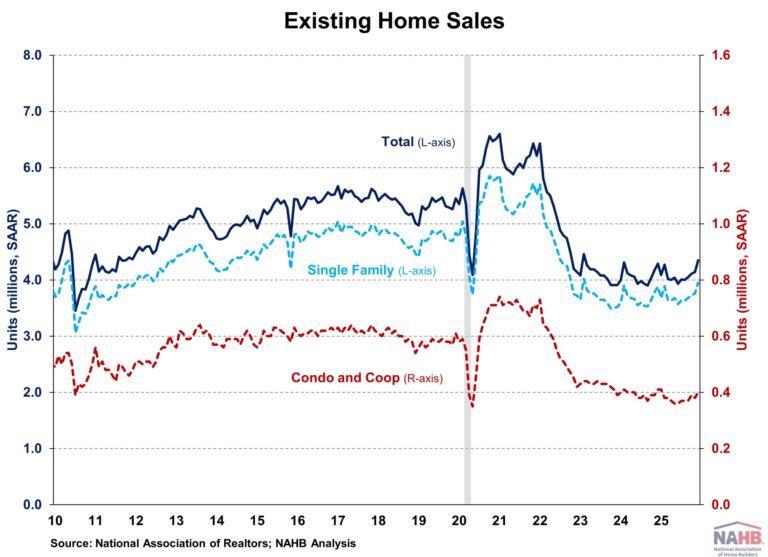
Existing home sales rose in December to the fastest pace in nearly three years, but annual sales for 2025 remained at a 30-year low as elevated home prices and mortgage rates kept buyers on the sidelines, according to the National Association of Realtors (NAR). While mortgage rates have eased from 7% seen at the start of 2025 to near 6% by year-end, tight inventory continued to push home prices higher as more homeowners took listings off the market. Resale inventory dropped to its lowest level since January 2025. Though home price appreciation has been slowed in recent months, housing affordability remains a challenge.

Total existing home sales, including single-family homes, townhomes, condominiums, and co-ops, rose 5.1% to a seasonally adjusted annual rate of 4.35 million in December, the highest level for 2025 and highest since February 2023. On a year-over-year basis, sales were 1.4% higher than a year ago. For the year 2025, existing home sales totaled 4.06 million, unchanged from 2024 and matching the lowest level since 1995.

The existing home inventory level was 1.18 million units in December, down 18.1% from November but up 3.5% from a year ago. At the current sales rate, December unsold inventory sits at a 3.3-months’ supply, down from 4.2-months in November but up from 3.2-months in December 2024. Inventory between 4.5 to 6 months’ supply is generally considered a balanced market.

The December median sales price of all existing homes was $405,400, up 0.4% from last year. This marks the 30th consecutive month of year-over-year increases. The median condominium/co-op price in December was up 1.5% from a year ago at $364,400.  Recent gains for home inventory will put downward pressure on resale home prices in most markets in 2026. All four major regions saw an increase in sales in December, with gains ranging from 2.0% in the Northeast and Midwest to 6.9% in the South. However, sales were mixed on a year-over-year basis. Sales remained unchanged in the Midwest and West, rose 3.6% in the South, and fell 1.9% in the Northeast.

The Pending Home Sales Index (PHSI) is a forward-looking indicator based on signed contracts. The PHSI rose from 76.7 to 79.2 in November due to lower mortgage rates. On a year-over-year basis, pending sales were 2.6% higher than a year ago, according to the National Association of Realtors’ data.


This article was originally published by a eyeonhousing.org . Read the Original article here. .
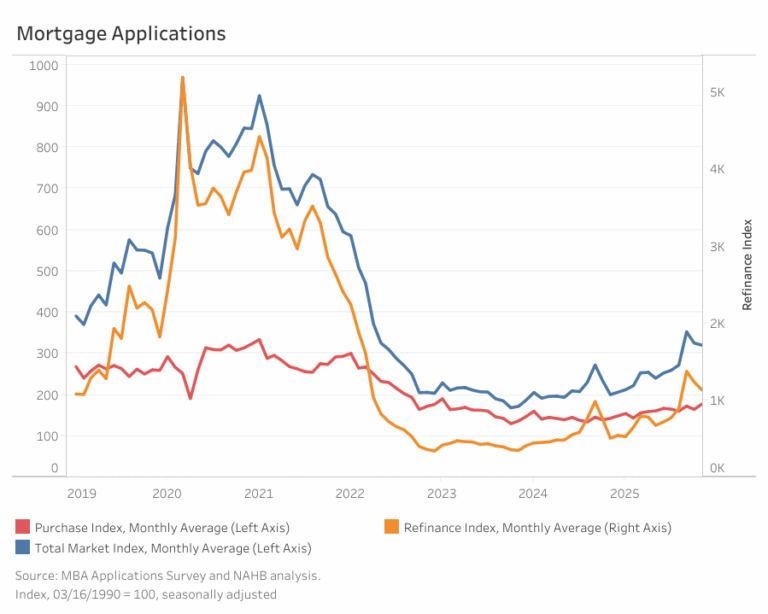

Mortgage activity continued to climb in November, posting the largest year-over-year increase in more than five years. Every major category increased on a year-over-year basis as mortgage rates continue to trend lower, led by strong increases in refinancing and adjustable-rate mortgage activity. 

The Mortgage Bankers Association’s (MBA) Market Composite Index, a measure of total mortgage application volume, fell 1.6% from October on a seasonally adjusted basis but was 60% higher than a year ago.  

The average contract interest rate for 30-year fixed mortgages basis continued to fall for the sixth month in a row to 6.36%, the lowest in over a year. After a strong jump in September, refinancing activity in November decreased 8.3% month-over-month. However, refinancing increased 123.7% on an annual basis, the largest gain in over a year. Meanwhile, purchase applications increased 7.9% over the month and rose 34.1% compared to a year ago, the highest increase since 2021.  

By loan type, fixed-rate mortgage applications were unchanged from October but were 57.6% higher year-over-year. Adjustable-rate mortgage applications dropped 19% month-over-month, yet surged 94.9% from a year earlier, following an 116% annual gain in October.  

The average loan size across all mortgages was $396,000, down 3% from the previous month. The average purchase loan size was $429,000, down 2% from last month, while the average refinance loan size declined 4% to $369,000. For adjustable-rate mortgages, the average loan size increased 3% to $969,000, compared to a 2% decline for fixed-rate mortgages to $348,000.


This article was originally published by a eyeonhousing.org . Read the Original article here. .
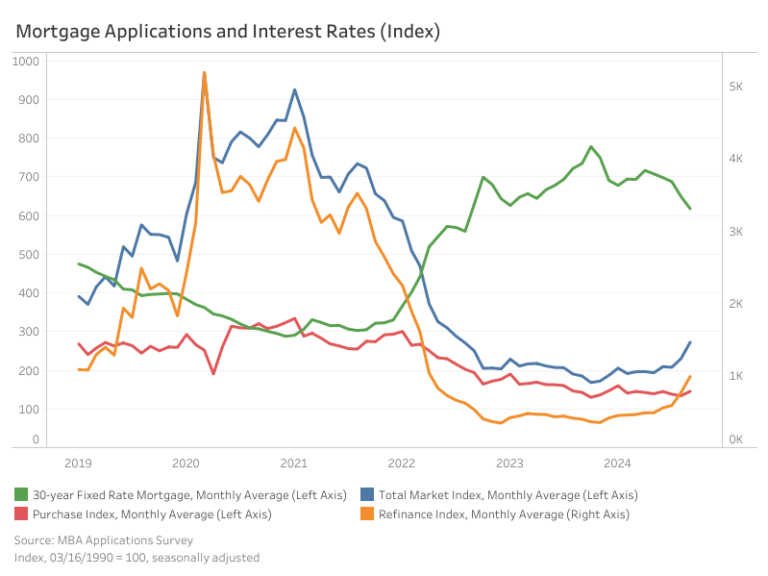

The Market Composite Index, a measure of mortgage loan application volume by the Mortgage Bankers Association’s (MBA) weekly survey, rose 18.4% month-over-month on a seasonally adjusted (SA) basis, driven primarily by a surge in refinancing activity. Compared to September 2023, the index increased by 47%. The Market Composite Index which includes the Purchase and Refinance Indices saw monthly gains, rising by 8.6% and 29%, respectively. Year-over-year, the Purchase Index showed a modest increase of 1.9%, while the Refinance Index jumped 149.9%.

The average 30-year fixed mortgage rate continued its downward trajectory for the fifth consecutive month, with September seeing a decline of 31 basis points (bps), bringing the rate to 6.18%. This is 117 bps lower than the same time last year.

Loan sizes also saw growth across the board. The average loan size for the total market (including purchases and refinances) was $400,450 on a non-seasonally adjusted (NSA) basis, an increase of 5.1% from August. Purchase loans grew by 3% to an average of $439,600, while refinance loans jumped by 11.6% to $363,825. Adjustable-rate mortgages (ARMs) saw an 8.2% increase in average loan size, rising from $1.1 million to $1.2 million.

Discover more from Eye On Housing

Subscribe to get the latest posts sent to your email.


This article was originally published by a eyeonhousing.org . Read the Original article here. .
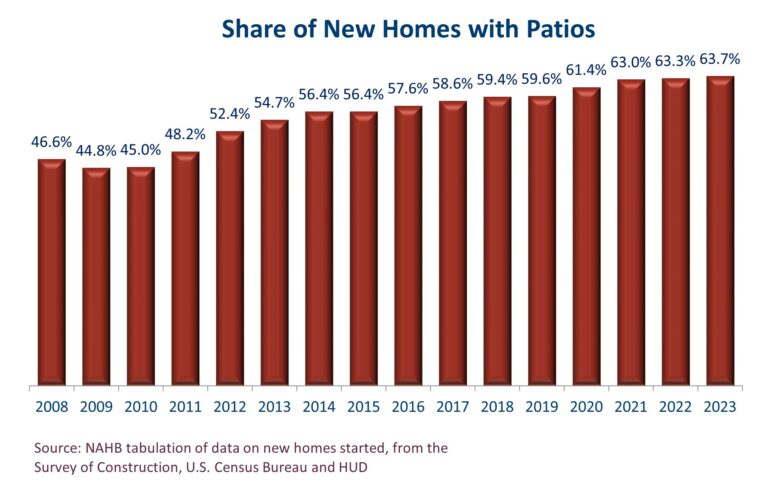

The share of new homes with patios increased to yet another record high in 2023. Of the roughly 950,000 single-family homes started during the year, 63.7% came with patios. This is up from 63.3% in 2022 and marks the eighth consecutive year the percentage set a new record high. The source for these numbers is NAHB tabulation of data from the Survey of Construction (conducted by the U.S. Census Bureau with partial funding from the Department of Housing and Urban Development).

Historically, fewer than half of new homes came with patios during the 2008-2011 period of extreme weakness in housing markets. But soon thereafter, the share jumped to 52.4% in 2012 and has been climbing ever since. The percentage has now increased in thirteen of the past fourteen years. The only exception was 2015, when the percentage was unchanged.

While patios for new homes have generally become more common over time, the parts of the country where they tend to be most common have remained consistent. At the low end, only 17% percent of new single-family homes built in New England and 20% in the Middle Atlantic came with patios in 2023. At the high end, the incidence of patios on new homes was over 80% in the West South Central and close to 70% in the South Atlantic and Mountain divisions. The geographic tendencies are similar to the ones reported in last year’s post.

Additional detail on the characteristics of new-home patios is available from the Annual Builder Practices Survey (BPS) conducted by Home Innovation Research Labs.

For the U.S. as a whole, the 2024 BPS report (based on homes built in 2023, like the SOC-based statistics cited above) shows that the average size of a new-home patio is about 290 square feet, but with considerable geographic variation. The average is over 400 square feet in the East South Central and about 380 square feet in New England; but under 200 square feet in the West South Central, and only a little over 200 square feet in the adjacent West North Central division.

In most parts of the country, poured concrete dominates all other building materials used in new-home patios. In the East South Central, for instance, poured concrete accounts for over 90% of new-home patios on a square-foot basis. To the extent that there are exceptions, they occur on the east coast. In the South Atlantic, concrete and brick pavers each have about a quarter of the market, and poured concrete has less than half. In New England, the market is more or less equally divided among poured concrete, concrete pavers and natural stone. In the Mid-Atlantic, brick pavers are the most popular choice for new-home patios by a substantial margin.

Discover more from Eye On Housing

Subscribe to get the latest posts sent to your email.


This article was originally published by a eyeonhousing.org . Read the Original article here. .
Pin It