This article was originally published by a www.houzz.com . Read the Original article here. .
This article was originally published by a www.houzz.com . Read the Original article here. .


Windsor recommends you anticipate issues that could be important to the homeowner early in the project. Her team does this by asking new clients how they found the experience of hiring renovation professionals in the past.
“This usually gives us a good understanding of what is most important to our client and how they might react when we hit the lowest part of the build,” she says.
For example, if the client complains that their builders were always late or didn’t inform them of everything, you will know that timekeeping and full communication are important to them.
For this, Windsor says she would put an action plan in place to ensure they have a platform where all information can be shared instantly and where everyone on site is aware.
Houzz Pro all-in-one business management software will help you do this, as you can set up a Client Dashboard to communicate quickly and clearly throughout the whole project. You can also share all those essential pieces of information easily, such as estimates, product specifications, floor plans, schedules and mood boards, so the client is kept in the picture all the way through.
Learn more about Houzz Pro software
This article was originally published by a www.houzz.com . Read the Original article here. .

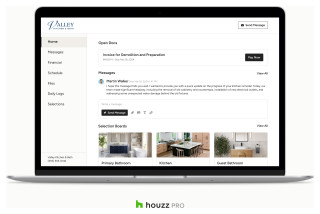
When you work with a pro who uses Houzz Pro tools, they can give you access to a Client Dashboard to monitor, track and advance your home remodeling or design project or new build. This is a private portal that includes your communication history, project details, timeline, financial documents, project progress photos and more, and it can be accessed via desktop or mobile.
Using the Client Dashboard can help build a positive working relationship with your professional — increasing transparency, reducing stress and fostering trust.
Here are six things the Client Dashboard offers to improve your project experience.
1. Improved Communication
The Houzz Pro Client Dashboard gives you easy access to your communication history and project details in one central place, where you can access it at a glance. Your pro can make communications, schedules, daily logs and more available to you so you’ll never lose track of requests, conversations or approvals.
Can’t remember the details of a conversation you had with your pro? The Client Dashboard acts as a reference point where you can access information instantly, rather than having to go through endless emails or texts. It can be viewed 24/7, giving you round-the-clock access for peace of mind, reducing the need for back-and-forth messaging with your pro.
Find home professionals on Houzz
This article was originally published by a www.houzz.com . Read the Original article here. .

The end of your newsletter is arguably the most important part as it’s where you’ll encourage clients to engage with your content and your company.
When crafting your call to action, first consider what you want to achieve. Do you just want clients to engage with your content, to take advantage of a special limited-time offer, to reach out about their upcoming remodel or redecoration project? Tailor your message so your customers know exactly what you’d like them to do.
Happy creating and connecting!
Share: What’s the one essential you always include in your end-of-year newsletter? Tell us in the Comments.
More for Pros on Houzz
Read more stories for pros
Learn about Houzz Pro software
Talk with your peers in pro-to-pro discussions
Join the Houzz Trade Program
This article was originally published by a www.houzz.com . Read the Original article here. .
Terry Vinn of Totus Construction says he finds clients can be influenced by television renovation shows. “This can result in a costly mistake as clients have often already paid fees for an architect’s drawings or planning,” he says. “They realize they’re way off in terms of their budget.”
Cat Hoad of Absolute Project Management agrees, saying she often finds a budget is too low for the client’s aspirations in terms of scope and finish.
Solution: “Showing clients the best options and the reality of these costs is the best we can do to inform their choices,” Spencer says. “We always let our clients know they can purchase suggested items over time to spread the cost too.”
Encouraging clients to consider phasing the work is another option — tackling phase one now with the initial budget, then phase two a year or so later when the budget has recovered.
Vinn underlines the value of getting clients to engage with the builder at the concept stage of the project. “Builders can explain the cost differences between various design options, preventing the need to go back to the drawing board at a later stage, which would equal additional architect’s fees.”
Hoad agrees with starting the conversation early. “One of the first bits of paid work is to set up an outline budget,” she says. Her outline will have headings with the approximate cost for the various professionals involved and estimated costs for each part of the second fix.
“The total can, of course, change dramatically, but it’s a means for the client to see clearly how their money is likely to be spent, and it helps them to make decisions and prioritize accordingly,” she says.