Tag

Capacity

Browsing


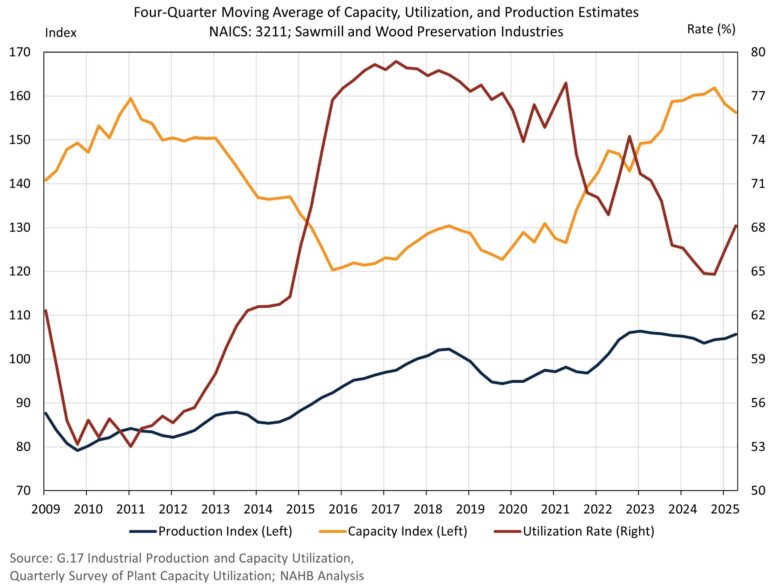
Sawmill production has remained essentially flat over the past two years, according to the Federal Reserve G.17 Industrial Production report. This most recent data release contained an annual revision, which resulted in higher estimates for both production and capacity in U.S. sawmills. While in previous analysis, production had remained stagnant since 2017; this revision shows current levels above 2017 by 7.5%. This revision also leads to an increased production capacity estimate, now peaking in the fourth quarter of 2024, and exceeding the capacity level seen in the early 2010s.

The sawmill utilization rate is a ratio of actual production and potential full production that is released quarterly by the Census Bureau. The utilization rate has experienced an overall downward trend since 2017 as a result of added capacity, yet stagnant production. However, the second quarter of 2025, on a four-quarter moving average, experienced a slight uptick from 66.5% to 68.1%. Meanwhile, sawmill production, based on a four-quarter moving average, is 0.9% higher in the second quarter of 2025 compared to the first quarter. However, sawmill production remains just 0.3% above 2023 levels.

The current sawmill capacity estimate is down 1.2% from the first quarter of 2025. Despite this quarterly decline, capacity is higher than a few years ago. Compared to the second quarter of 2023, the estimate is up 4.5%. This is the expected result due to flat production over this period coupled with a declining utilization rate.

In the previous two years, especially in 2024, lumber prices experienced declines as supply outpaced demand. Lower prices have led to sawmill curtailments and closures with excess lumber capacity, which may be why the capacity index started to show declines in early 2025. Another notable trend is the continued declines in sawmill employment levels, with no strong impact on production levels. Some of this likely has to do with the technological advancements in place from new investment into sawmills resulting in fewer workers being able to produce higher levels of output.

Looking ahead, lumber production and pricing in 2026 remains highly uncertain. The latest lumber prices in December continue to remain low, despite combined duties of nearly 45% on U.S. imports of softwood lumber from Canada. Waning housing production over the course of 2025 created an environment where lumber supply was continually above demand, especially over the second half of the year. Next year, depending on residential construction, we may see lumber prices enter a period of volatility. Mills across North America have been producing at a loss for much of 2025, creating conditions where closures and curtailments potentially lead to a lower supply of lumber next year.


This article was originally published by a eyeonhousing.org . Read the Original article here. .
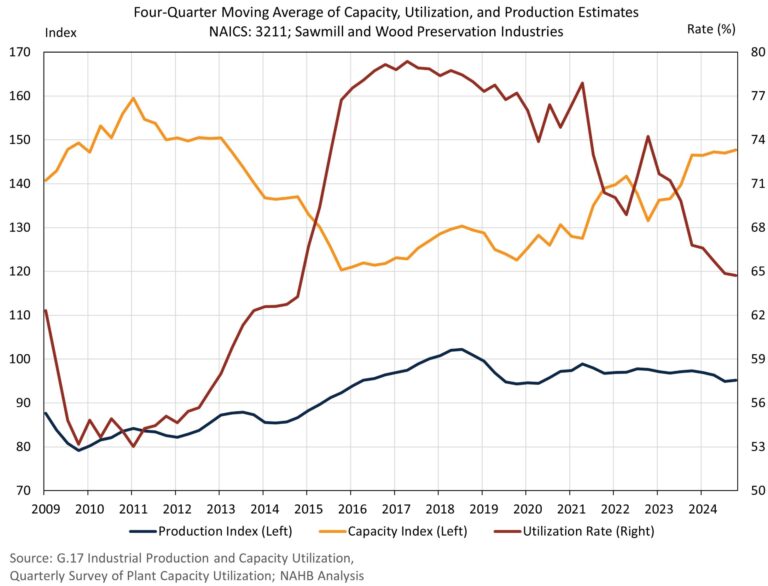

Sawmill and wood preservation firms reported lower capacity utilization rates coupled with level production and capacity throughout 2024. Despite no growth in production in 2024, utilization rates have trended downwards since 2017 as sawmills have expanded production capability. Even with more production capability, real output has not followed as output remains lower than 2018.

Capacity utilization rates are a ratio of actual production and potential production capabilities for firms. The utilization rate for sawmills and wood preservations firms was 64.7% in the fourth quarter on a four-quarter moving average basis. As utilization rates have shifted lower, the gap between full production capability and actual production has grown. Actual production is typically lower than full capability due to multiple factors ranging from insufficient materials and orders to lack of labor.

By combining the Federal Reserve’s production index and the Census Bureau’s utilization rate, we can compose a rough index estimate of what the current production capacity is for U.S. sawmills and wood preservation firms. Shown below is a quarterly estimate of the production capacity index. This capacity index measures the real output if all firms were operating at their full capacity.

Based on the data above, sawmill production capacity has increased from 2015 but remains lower than peak levels in 2011. Most of the recent capacity gains took place between 2023 and 2024, followed by little gain over the course of 2024. As evident above, there is ample room to increase production of domestic lumber, but current production levels remain much unchanged over the past several years.

Employment is an important factor for ensuring firms reach their full capacity. For sawmill and wood preservation firms, the number of employees declined to its lowest level since 2021, reporting an average of just over 89,000 employees across the industry in the fourth quarter. Employment declines, likely due to a weak lumber market in 2024, help explain why utilization rates have fallen. With fewer workers, it is less likely that a firm can increase production to its full capability.

Imports

Since U.S. firms do not produce at their full potential, imports help to supplement domestic supply, especially in the softwood lumber market. According to Census international trade data, existing tariffs on Canadian softwood lumber have not reduced the need for imports to meet domestic consumption but have made the U.S. more reliant on non-North American lumber, resulting in unnecessarily complex supply chains. The current AD/CVD Canadian softwood lumber tariff rate stands at 14.5% and is expected to double under the administrative review process by the Department of Commerce. Potential tariffs on lumber, such as the ongoing 232 investigation and 25% on all Canadian goods, could push tariffs rates on Canadian softwood lumber above 50% later this year. Higher tariffs on softwood lumber mean higher costs for builders who use lumber as a key input to construction. Given the current housing unaffordability crisis, any additional costs will continue push homeownership and affordable housing further out of reach for households in the U.S.

Discover more from Eye On Housing

Subscribe to get the latest posts sent to your email.


This article was originally published by a eyeonhousing.org . Read the Original article here. .
Pin It