Tag

Businesses

Browsing


Despite historically low self-employment rates and the rising market share of top ten builders, residential construction remains an industry dominated by independent entrepreneurs, with nearly 80% of home builders and specialty trade contractor firms being self-employed independent contractors. Even among firms with paid employees, the industry continues to be dominated by small businesses, with 63% of homebuilders and two out of three specialty trade contractors generating less than one million dollars in total business receipts. The new estimates are based on the 2022 Economic Census and Nonemployer Statistics data.

The Economic Census covers several construction subsectors within the home building industry:

 Residential Building Construction (RBC)

Single-family general contractors (excluding for-sale builders)

Multifamily general contractors (excluding for-sale builders)

For-sale new housing builders

Residential remodelers

Land Subdivision (or land developers)

Specialty Trade Contractors (STC)

The 2022 statistics show that the majority of residential construction businesses are self-employed independent contractors.  There are over 813,000 nonemployer firms in residential building construction (RBC), accounting for close to 80% of all establishments. In land subdivision, more than 9,000 independent contractors account for 68% of land subdivision firms.  Over 1.9 million specialty trade independent contractors make up 79% of all STC establishments. These nonemployer firms also account for almost half of the full-time employees (FTE) in residential building construction, 26% in land subdivision, and 28% in STC. 

Most of these self-employed mom-and-pop firms are very small, with annual receipts averaging under $103,000 for residential building construction, and under $70,000 for specialty trade contractors. Self-employed independent contractors in land subdivision average around $288,000 in annual business receipts. As a result, these nonemployer firms make up only 12% of all sales and receipts generated by residential building construction and land subdivision, and 9% of specialty trade contractors’ revenue.

Among residential construction businesses with paid employees, remodeling, land subdivision, and specialty trade subcontractors (STC) companies tend to be smaller.  Three out of four remodeling establishments, 63% of land developers, and 59% of STC companies generate under $1 million in receipts.  

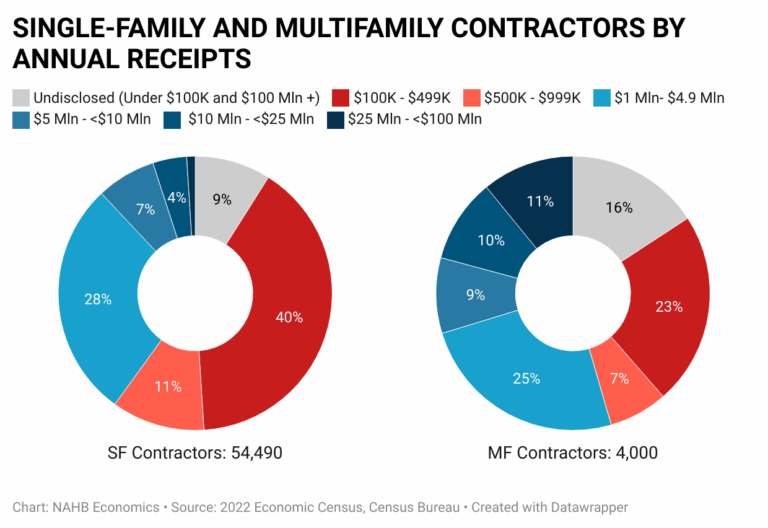
Home builders are typically somewhat larger, with about 45% of companies reporting annual sales over $1 million. Among homebuilders, multifamily general contractors tend to be the largest. However, the Census Bureau did not disclose the number of the largest (with revenue over $100 million) and smallest (with revenue under $100K) multifamily and single-family custom builders in 2022. As a result, the revenue spectrum for MF and SF contractors is incomplete and is presented in a separate chart. 

Multifamily contractors are typically larger compared to single-family contractors and for-sale builders (who build on land they own and control). Ten percent of multifamily contractors reported annual sales between $10 million and 25 million, and an additional 11% earned between $25 million and $100 million in 2022.  

Under the most recent U.S. Small Business Administration (SBA) size standards, the vast majority of residential construction companies qualify as small businesses. The most recent small business size limits for all types of builders are $45 million, $34 million for land subdivision, and $19 million for specialty trade contractors. By these standards, almost all remodelers and single-family contractors, and at least 98% of land developers, and 96% of specialty trade contractors, easily qualify as small businesses. 


This article was originally published by a eyeonhousing.org . Read the Original article here. .

The residential construction industry plays a crucial role in driving economic growth and local community development. It has a lasting impact on local communities by creating jobs, improving infrastructure, boosting local businesses, and enhancing property values.

The residential construction industry is more reliant on labor than capital in the United States. As of October 2024, about 3.4 million people work in the residential construction industry in the United States, with 957,000 builders and 2.4 million residential specialty trade contractors.

The NAHB analysis of the Quarterly Census of Employment and Wages (QCEW) data provides an insight into employment and establishment concentration of the residential construction industry across metro areas (MSA).

Location quotients (LQ) are ratios that compare the concentration of the residential construction industry within a metro area to the concentration of the industry nationwide. LQs are used in this article to evaluate the employment and establishment concentration of the residential construction industry in local areas.  

Employment

The March 2024 QCEW data indicates that employment in the residential construction industry, while found throughout the country, was more highly concentrated in some metro areas than others.

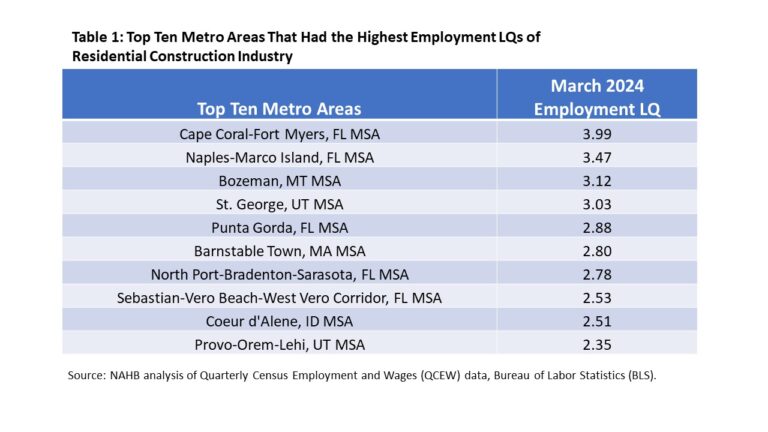
Among 387 metro areas, employment LQs ranged from 0.02 to 3.99. Cape Coral-Fort Myers, FL had the highest employment concentration of the residential construction industry with an LQ of 3.99. It was followed by Naples-Marco Island, FL (LQ: 3.47) and Bozeman, MT (LQ: 3.12).

Florida, experiencing a rapid growth in population, reported a relatively high employment concentration in residential construction. All metro areas in Florida had a higher employment concentration than the nation’s concentration. Moreover, half of the top ten metro areas with the highest employment concentrations of the residential construction industry were in Florida.

Various metro areas in the Mountain Division also have a high reliance on the residential construction industry for employment. Bozeman, MT (LQ: 3.12), St. George, UT (LQ: 3.03), Coeur d’Alene, ID (LQ: 2.51), and Provo-Orem-Lehi, UT (LQ: 2.35) were ranked in the top ten markets with a higher employment concentration of the residential construction industry.

Metro areas in the South reported the three lowest employment LQs of the residential construction industry. The lowest was Owensboro, KY with a LQ of 0.02, followed by Dalton, GA (LQ: 0.03) and Eagle Pass, TX (LQ: 0.05).

Establishment

On aggregate, New York-Newark-Jersey City, NY-NJ, Los Angeles-Long Beach-Anaheim, CA, and Miami-Fort Lauderdale-West Palm Beach, FL were the three metro areas that not only had the most employment in residential construction but also had the largest number of residential construction establishments among all metro areas. However, these three metro areas didn’t have higher establishment concentrations of the residential construction industry than the nation.

Among all the 387 metro areas, 104 of them had a higher establishment concentration of the residential construction industry than the nation. St. George, UT had the highest establishment concentration of the residential construction industry, which was more than three times that of the nation, followed by Barnstable Town, MA (LS: 2.42) and Cape Coral-Fort Myers, FL (LQ: 2.38).

The three metro areas in the South that reported the lowest employment LQs of the residential construction industry also had the lowest establishment LQs of the residential construction industry.

For more information on QCEW, please check the “Handbook of Methods” published by BLS.

Discover more from Eye On Housing

Subscribe to get the latest posts sent to your email.


This article was originally published by a eyeonhousing.org . Read the Original article here. .


The majority of NAHB builder members are small businesses, according to the annual census of its members NAHB has been conducting since 2008. The most recent installment of the census was conducted at the end of 2023 and covered business activity through 2023.

The census shows that, on average, NAHB builders started 59.2 homes in 2023 (37.3 single-family and 21.9 multifamily). However, the median number of homes started was only six. Because the data include a small percentage of very large builders, the average number of starts is much higher than the median. For that reason, the median may better represent the experience of the typical NAHB builder.

Another, conventional way to evaluate the size of a business is by the annual revenue it generates. In the 2023 NAHB census, 14% of builders reported a dollar volume of less than $500,000, 12% reported between $500,000 and $999,999, 38% between $1.0 and $4.9 million, 15% between $5.0 and $9.9 million, 6% between $10.0 million and $14.9 million, and 14% reported $15.0 million or more. Only 1% reported no business activity at all in 2023. The median edged up to $3.4 million (from $3.3 million in 2021 and 2022). For comparison, the Small Business Administration’s size standards classify residential builders and remodelers as small if they have average annual receipts of $45.0 million or less ($34.0 million or less for land developers).

Historically, NAHB initiated the current version of its member census during the industry-wide downturn of 2008, when the median annual revenue of builder members was only around $1.0 million. Median annual revenue began rising in 2013, as the industry slowly recovered, plateauing at $2.6 to $2.7 million from 2017 through 2020, before jumping to $3.3 million in 2021 and 2022 and then edging up by another $0.1 million in 2023.

Due to their status as small businesses and extensive use of subcontractors, many builders carry relatively few employees on their payrolls. In NAHB’s 2023 census, builder members reported a median of six employees, including employees in both construction and non-construction jobs.

Whether based on the median of six employees, the median of six homes started, or the median annual revenue of $3.4 million, it is safe to conclude that the majority of NAHB’s builder members qualify as small businesses.

For more detail on the 2023 NAHB Builder Member Census, including a profile for each of the seven major categories of builder, please see the July 2024 Special Study.

Discover more from Eye On Housing

Subscribe to get the latest posts sent to your email.


This article was originally published by a eyeonhousing.org . Read the Original article here. .
Pin It