Overall consumer credit continued to expand in the fourth quarter of 2025, with growth in both nonrevolving and revolving credit. Nonrevolving credit, primarily student and auto loans, accounts for 74% of total outstanding consumer credit, while revolving credit, largely credit card balances, makes up the remaining 26%. Student loan and credit card balances continued to rise year-over-year, while auto loan balances declined. Although interest rates remain elevated, both credit card and auto loan rates edged slightly lower.
Total outstanding U.S. consumer credit reached $5.11 trillion for the fourth quarter of 2025, according to the Federal Reserve’s G.19 Consumer Credit Report. This is an increase of 3.04% at a seasonally adjusted annual rate (SAAR) compared to the previous quarter, and a 2.34% increase compared to last year.
Nonrevolving Credit
Nonrevolving credit, largely driven by student and auto loans (the G.19 report excludes mortgage loans), reached $3.78 trillion (SA) in the fourth quarter of 2025. This marks a 2.15% increase (SAAR) from the previous quarter, and a 1.96% increase from last year.
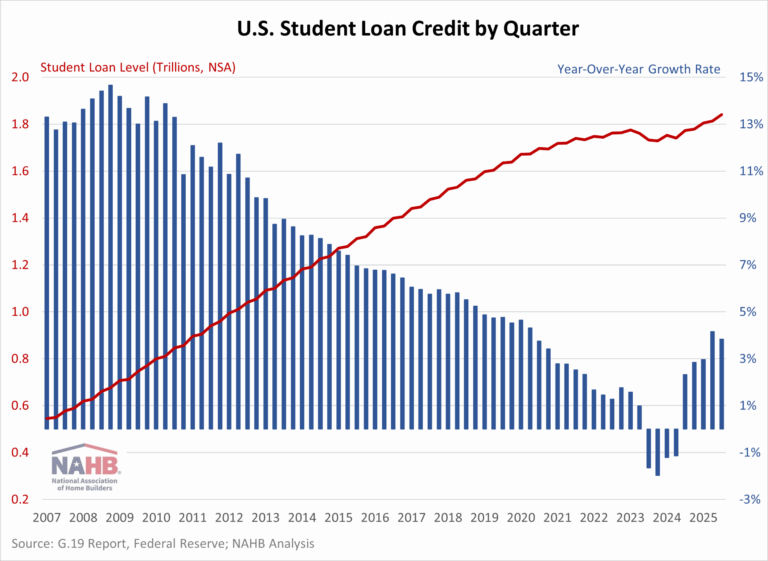
Student loan debt stood at $1.84 trillion (NSA) for the fourth quarter of 2025, marking a 3.22% increase from a year ago. The end of the COVID-19 Emergency Relief—which allowed 0% interest and halted payments until September 1, 2023—led year-over-year growth to decline for four consecutive quarters, from Q3 2023 through Q2 2024 as borrowers resumed payments and took on less new debt. The past six quarters have shown a return to growth.
Auto loans reached a level of $1.56 trillion (NSA), showing a year-over-year decrease of 0.17%, marking one of the first declines since 2010. The deceleration in growth can be attributed to several factors, including stricter lending standards, elevated interest rates, and overall inflation. Auto loan rates for a 60-month new car stood at 7.22% (NSA) for the fourth quarter of 2025, falling 60 basis points from a year ago.
Revolving Credit
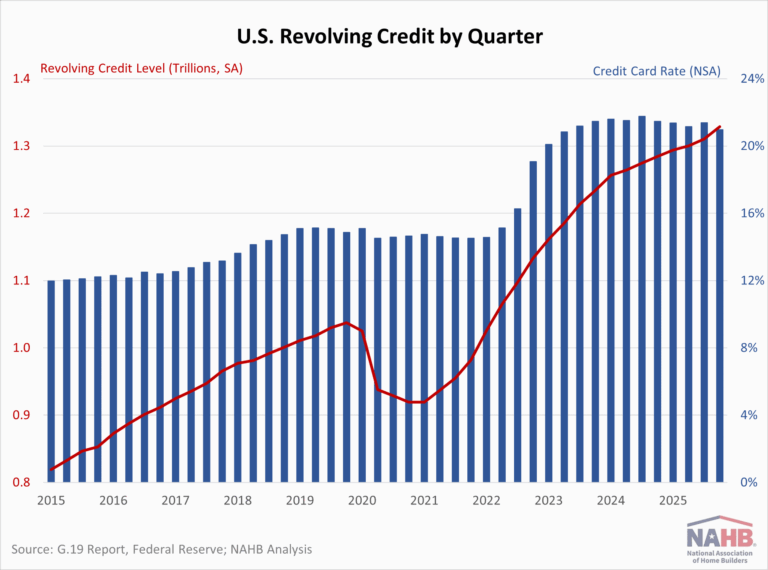
Revolving credit, primarily made up of credit card balances, rose to $1.33 trillion (SA) in the fourth quarter of 2025. This represents a 5.61% increase (SAAR) from the previous quarter and a 3.43% increase year-over-year, both representing an acceleration compared to recent quarters. Although credit card rates have hovered near historic highs since Q4 2022, the past five quarters have shown modest year-over-year declines. The average credit card rate held by commercial banks (NSA) stood at 20.97% in the fourth quarter of 2025, a drop of 50 basis points from a year earlier.
This article was originally published by a eyeonhousing.org . Read the Original article here. .