This article was originally published by a www.houzz.com . Read the Original article here. .
This article was originally published by a www.houzz.com . Read the Original article here. .

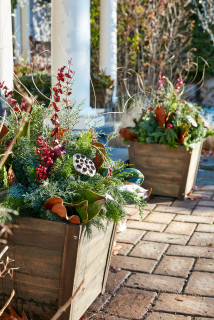
Flowers that bloom when the rest of the garden is quiet in winter can have an uplifting effect in the landscape and in containers. Camellias (Camellia spp.), as seen in this photo uploaded by Le jardinet, can be reliable winter container options in regions with mild climates. Most camellias fall into zones 7 to 9, while some are hardy to Zone 6.
Other winter-flowering container plants to consider in warm areas include winter daphne (Daphne odora, zones 7 to 9), winter skimmia (Skimmia japonica, zones 6 to 9), hellebore (Helleborus spp., zones 4 to 9) and cool-season annuals such as pansy (Viola spp., winter-hardy in zones 7 to 11) and florist’s cyclamen (Cyclamen persicum, zones 9 to 11).
This article was originally published by a www.houzz.com . Read the Original article here. .
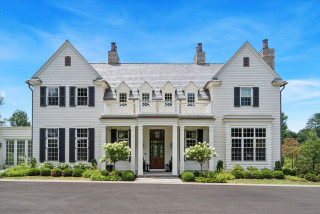
Changing wall surfaces is a bigger project, but the impact can also be big. Nearly 3 in 5 renovating homeowners (58%) upgrade their home’s exterior walls as part of their exterior projects. Natural wood is the leading wall surface material, chosen by 23% of those with an exterior wall surface project, but fiber cement (22%) and stucco (19%) are close behind. Among homeowners choosing natural wood, the format breakdown is: lap siding (53%), vertical siding (49%) and shakes or shingles (24%).
Among homeowners changing their exterior wall colors, neutrals are the top choice, specifically white (23%), gray (19%), beige (10%) and black (8%). But green is right up there with black, at 8%, and some bolder colors make an appearance too, such as blue (4%), red (3%), yellow (3%) and orange (1%).
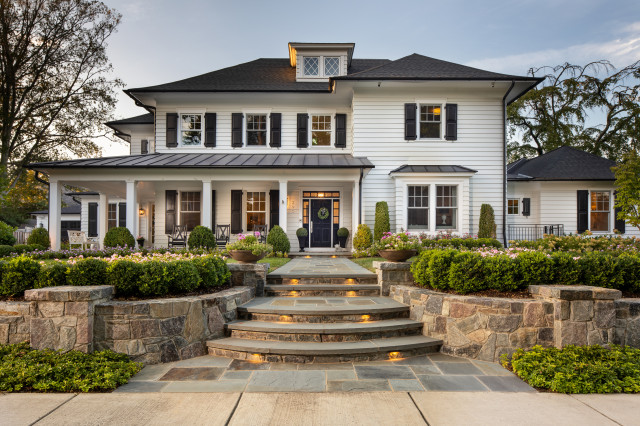
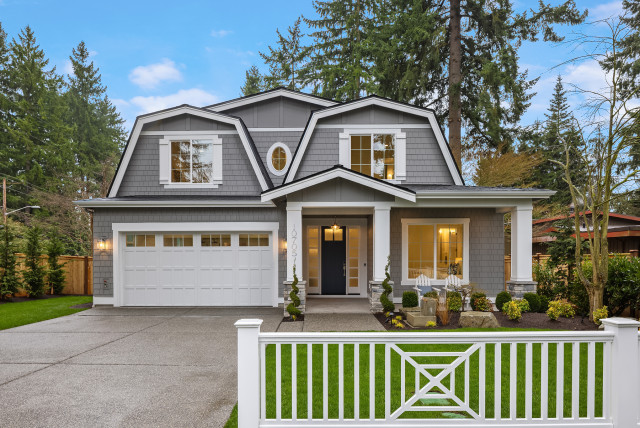
The majority of renovating homeowners (71%) choose a wall color that contrasts with the trim color, as exemplified by this Kirkland, Washington, home by Merit Homes.
10 Surefire Ways to Boost Curb Appeal
This article was originally published by a www.houzz.com . Read the Original article here. .
Changing wall surfaces is a bigger project, but the impact can also be big. Nearly 3 in 5 renovating homeowners (58%) upgrade their home’s exterior walls as part of their exterior projects. Natural wood is the leading wall surface material, chosen by 23% of those with an exterior wall surface project, but fiber cement (22%) and stucco (19%) are close behind. Among homeowners choosing natural wood, the format breakdown is: lap siding (53%), vertical siding (49%) and shakes or shingles (24%).
Among homeowners changing their exterior wall colors, neutrals are the top choice, specifically white (23%), gray (19%), beige (10%) and black (8%). But green is right up there with black, at 8%, and some bolder colors make an appearance too, such as blue (4%), red (3%), yellow (3%) and orange (1%).
The majority of renovating homeowners (71%) choose a wall color that contrasts with the trim color, as exemplified by this Kirkland, Washington, home by Merit Homes.
10 Surefire Ways to Boost Curb Appeal
This article was originally published by a www.houzz.com . Read the Original article here. .

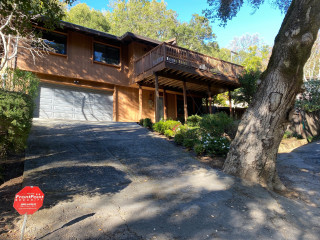
Look closely at the left side of this photo, where the original siding meets the new fiber cement siding, to see a thoughtful detail. The new siding juts out from the rest of the facade. “This added a thickness and clearly defined the entry and the area underneath the deck,” Shoup says.
This is an “upside-down” house, meaning the bedrooms are on the ground floor, and the living room opens onto the deck. The deck also can be viewed from the kitchen, as the floor plan is open. It’s easy for the homeowners to pour themselves a cup of coffee in the morning and then enjoy it outside among the tree canopies.
This article was originally published by a www.houzz.com . Read the Original article here. .
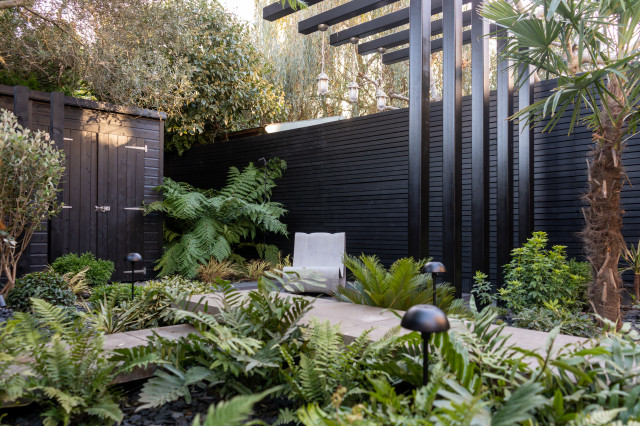
You can also see one of the ways she gave the small space depth, with the eye going from the black patio door frames to the steel pergola to the black wood posts attached to the shed.
Bejanaru also planted four new trees, placing the two tallest nearer to the house and the two shorter ones at the back. “The plants in front draw the eye upward, then the shorter ones — visually below the other two — draw your eye to the back of the [yard], so you have several focal points,” she says.
The new trees consist of two Tasmanian tree ferns (Dicksonia antarctica, USDA zones 9 to 10; find your zone) — one on the front left and the other at the back right; a tall windmill palm (Trachycarpus fortunei, zones 7 to 11) and a pineapple guava (Acca sellowiana, zones 8 to 10) in front of the shed.
The huge olive tree was already there. “We kept it, of course, because it’s beautiful and I also love the color of the bark, which stands out,” Bejanaru says.
9 Design Tips to Enhance Views of Your Garden From Indoors