Tag

Apartment

Browsing


The average time needed to complete construction of a multifamily building after obtaining authorization edged down in 2025, according to the 2025 Survey of Construction (SOC) from the Census Bureau. On average, it took 18.9 months from permit to completion, about 0.7 months shorter than in 2024. While construction timelines remain lengthy, this modest decline occurred despite the industry continuing to face a shortage of skilled labor.

Although multifamily construction time shortened in 2025, it remained lengthy compared to historical trends. The average time from permit to completion was still 3.5 months longer than the 15.4 months recorded in 2009 and almost 7 months longer than the period low of 12 months in 2013. Most of this long-term increase occurred during the construction phase. The average time from start to completion rose from 13.4 months in 2009 to 16.5 months in 2025, partly due to the growing share of larger multifamily buildings. The share of multifamily buildings with 50 units or more increased from 43% in 2009 to 57% in 2025, and larger buildings generally take longer to complete.

The average time to build multifamily homes varies with the number of units in the building. Despite the modest improvement for most building sizes in 2025, the construction times remained much longer than they were a decade earlier. In 2025, buildings with 20 or more units took the longest to build after obtaining authorization at 21.7 months, compared with 16.2 months in 2015 and 22.1 months in 2024. By contrast, 2-to-4-unit buildings were finished the fastest, averaging 14.9 months, up from 12 months in 2015 but slightly below 15.3 months in 2024. Mid-sized projects fell in between, with 10-to-19-unit buildings averaging 18.5 months in 2025, compared with 14 months in 2015 and 19.2 months in 2024, while buildings with 5-to-9-units averaged 21.5 months, up sharply from 13.2 months in 2015 and 19.1 months in 2024.

The 2025 SOC data also show a significant regional variation in the average construction duration of multifamily buildings. The Northeast had the longest time from authorization to completion at 21.9 months, followed by the West at 20.6 months, and then the South with 17.5 months. The shortest permit-to-completion period happened in the Midwest with 16.6 months.


This article was originally published by a eyeonhousing.org . Read the Original article here. .
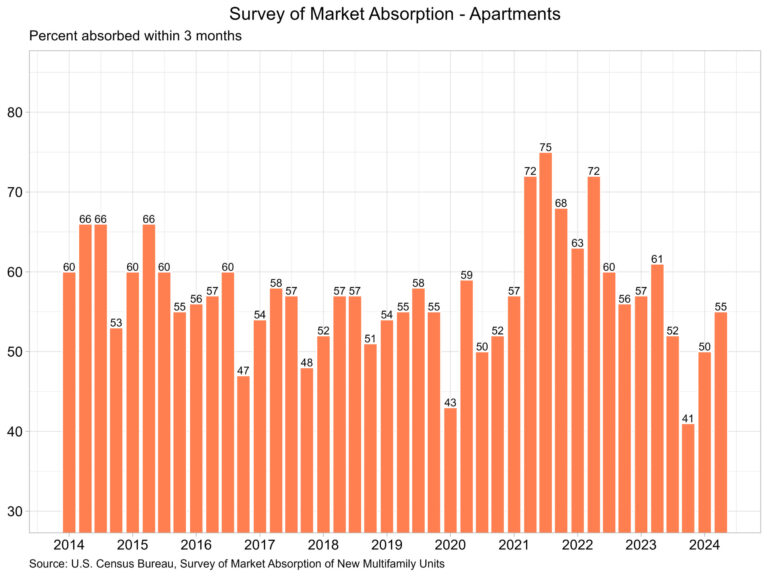

The percentage of new apartment units that were absorbed within three months of completion rose from 50% to 55% in the second quarter of 2024, according to the Census Bureau’s latest release of the Survey of Market Absorption of New Multifamily Units (SOMA). The survey covers new units in multifamily residential buildings with five or more units. Meanwhile, the absorption rate within three months for condominiums and cooperative units fell over the quarter, from 80% to 66%.

Apartments

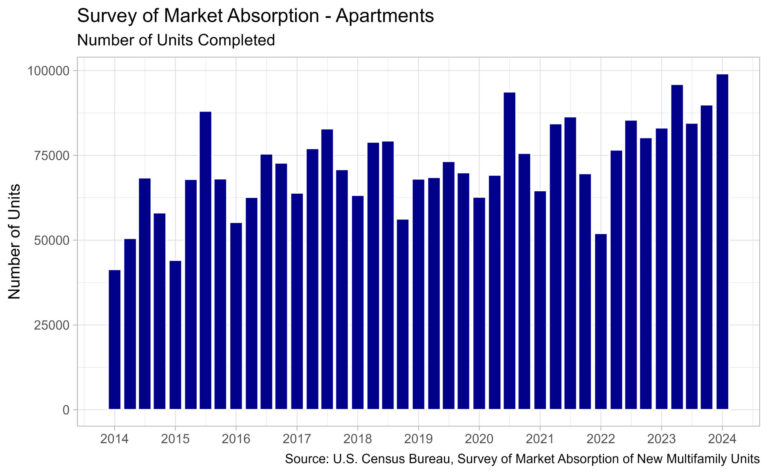
The percentage of apartments absorbed within three months has fallen significantly from its peak of 75% in the third quarter of 2021, as shown in the graph above. Currently, the rate stands at 55% which is coupled with an uptick in completions, as the SOMA estimates show a new high of completions at 118,600 units in the second quarter of 2024. This is well above the level of completions a year ago, which stood at 83,140. The pace of multifamily units being completed has picked up, as many units under construction over the past year are reaching the market. Since the first quarter of 2022, completions have been above 75,000 for nine consecutive quarters, as seen in the graph below.  The level of completions has also risen for the past three quarters.

Along with the three-month absorption rate and completions, SOMA reports absorption rates within six-months, nine-months, and 12-months of completion. The absorption rates for all time periods follow similar downward trends as the number of apartments completed has ticked upwards over the past two years. For apartments completed in the 1st quarter of 2024, the absorption rate within six months of completion was 75%, down from a peak of 88% in the third quarter of 2021 but up from 69% the previous quarter.

For the nine-month period, the absorption rate of apartments completed in the fourth quarter of 2023 fell to 83% down for the third consecutive quarter. This rate also peaked at 96% in the same quarter as the other periods, the third quarter of 2021.

Finally, apartment units completed in the third quarter of 2023 were 93% absorbed within a year following completion. The trend remains the same for the 12-month period as the other time periods, as it peaked in the third quarter of 2021 at 98%.

Condominiums and Cooperative Units

The absorption rate for new condominiums and cooperative units fell to 66% for the quarter. The previous quarter’s rate was significantly revised, up from 69% to 80%, which helps to explain the dramatic decline.

Total completions of new condominiums and cooperative units, according to the SOMA, rose over the quarter up from 2,829 to 4,366. Quarterly completions of these units peaked in the second quarter of 2018, at 7,996 completions but have steadily fallen since that peak.

Discover more from Eye On Housing

Subscribe to get the latest posts sent to your email.


This article was originally published by a eyeonhousing.org . Read the Original article here. .
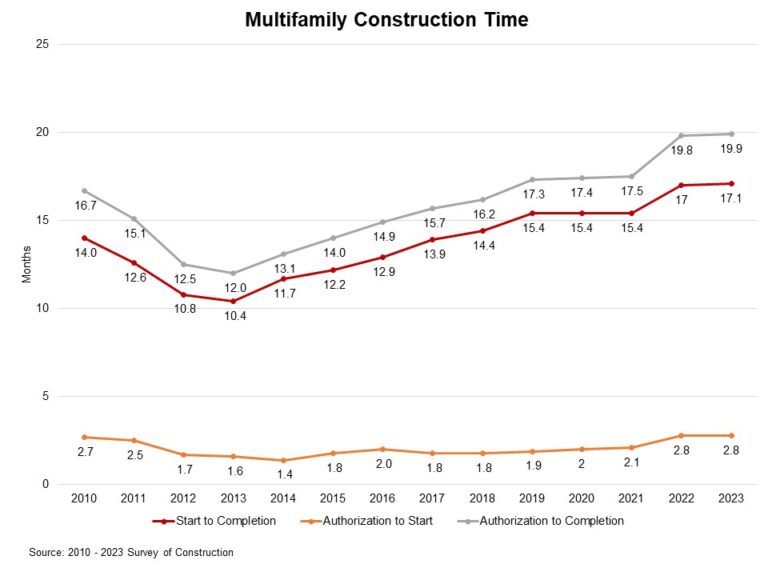

The average length of time to complete construction of a multifamily building after obtaining authorization was 19.9 months in 2023, according to the 2023 Survey of Construction (SOC) from the Census Bureau. The permit-to-completion time inched up 0.1 months in 2023, after an increase of 2.3 months in 2022, as the ongoing skilled labor shortage and supply chain issues were still challenging the industry.

The average time to build multifamily homes varies with the number of units in the building. The more units, the more time required to build. In 2023, buildings with 20 or more units took the longest time,22 months, to build after obtaining authorization. Properties with 10-to-19 units required 21.5 months. However, 2-to-4 unit buildings came in at 18.7 months, which took longer time than 5-to-9 unit buildings (16.9 months).

Compared to 2019, pre-pandemic, only buildings with 5 to 9 units took a similar time to complete. The construction process required 3.3 more months to complete multifamily buildings with 2-to-4 units, 2.8 months more for 10-to-19 unit buildings, and 3 months longer to finish for properties with 20 or more units.

The 2023 SOC data also shows a significant regional variation in the average construction duration of multifamily buildings. The West had the longest time from authorization to completion at 20.9 months, followed by the Northeast at 20.8 months, and then the South with 19.5 months. The shortest permit-to-completion period happened in the Midwest with 17.3 months.

Discover more from Eye On Housing

Subscribe to get the latest posts sent to your email.


This article was originally published by a eyeonhousing.org . Read the Original article here. .

The percentage of new apartment units that were absorbed within three months of completion rose from a decade low 42% to 53% in the first quarter of 2024, according to the Census Bureau’s latest release of the Survey of Market Absorption of New Multifamily Units (SOMA). The SOMA survey covers new units in multifamily residential buildings with five or more units. The absorption rate within three months for condominiums and cooperative units also rose over the quarter, up from 63% to 69%.

Apartments

The percentage of apartments absorbed within three months has fallen significantly from its peak of 75% in the third quarter of 2021, as shown in the graph above. Currently, the rate stands at 53% which is coupled with an uptick in completions, as SOMA estimates show a historically high level of completions at 99,120 units in the first quarter of 2024. This is well above the level of completions a year ago, which stood at 83,140. The pace of multifamily units being completed has picked up, as many units under construction over the past year are reaching the market. Since the first quarter of 2022, completions have been above 75,000 for eight consecutive quarters, as seen in the graph below.

Additionally, SOMA reports absorption rates within six-months, nine-months, and 12-months of completion. The absorption rates for all time periods follow similar downward trends as the number of apartments has ticked upwards over the past two years. For apartments completed in the 4th quarter of 2023, the absorption rate within six months of completion was 71%, down from a peak of 88% in the third quarter of 2021.

For the nine-month period, the absorption rate of apartments completed in the third quarter of 2023 fell to 84% down from the previous quarter’s completions of 88%. This rate also peaked at 96% in the same quarter as the other periods, the third quarter of 2021.

Finally, apartment units completed in the second quarter of 2023 were 94% absorbed within a year following completion. The trend remains the same for the 12-month period as the other time periods, as it peaked in the third quarter of 2021 at 98%.

Condominiums and Cooperative Units

The absorption rate for new condominiums and cooperative units rose to 69% for the quarter. However, this was 10 percentage points lower than absorption rate of the same quarter last year.

Total completions of new condominiums and cooperative units, according to SOMA, fell to the lowest level since the first quarter of 2022 marking 3,312 completed units. Quarterly completions of these units peaked in the second quarter of 2018, at 7,996 completions.

Discover more from Eye On Housing

Subscribe to get the latest posts sent to your email.


This article was originally published by a eyeonhousing.org . Read the Original article here. .
Pin It