This article was originally published by a www.houzz.com . Read the Original article here. .
Designer Tammy Battistessa of Ellaire Kitchen & Bath Design agrees. “Whenever possible, I include aging-in-place and universal design features in every project, as I believe many of these features benefit clients of all ages and abilities, in addition to allowing a client to safely remain in their home for a longer period of time,” she says.
Creating a home that can adapt also makes it more sustainable. “Aging in place is a key element to making legacy homes that can evolve over time,” architect Tim Barber says. With all that in mind, we asked more than 50 home design and construction professionals to share the aging-in-place features they always recommend. Here are the 10 that came up again and again.
This article was originally published by a www.houzz.com . Read the Original article here. .

Only 56% of professional remodelers undertake projects designed to allow homeowners to Age-in-Place (AIP), according to results from NAHB’s Q1 2025 Remodeling Market Index (RMI) survey. This is the lowest percentage recorded since NAHB began periodically asking AIP questions on its RMI survey in 2004. Economic uncertainty and high interest rates over the past year are the most likely explanations for this slight pullback in projects. Additionally, stock market volatility has dampened any potential wealth effects, especially since over 75% of all corporate equities and mutual fund holdings are held by those 55 or older.
The National Institute of Aging defines AIP as “staying in your own home as you get older.” This concept is becoming more relevant as the overall median age of the population continues to increase. Given the age of the existing housing stock, the need to update homes for AIP is a major demand-driver for the remodeling sector.
Age Groups
When asked about the age groups of homeowners who request AIP work, 73% of remodelers indicated that homeowners are 65 years or older, followed by 55 to 64 years at 61%. These two age groups have consistently been above 60% since the Q4 2010 survey.
Familiarity with Aging-in-Place
Ninety-six percent of remodelers indicated that most or some of their consumers are familiar with the AIP concept. That share has been at least 90% since the Q4 2018 survey.
Type of Aging-in-Place Projects
Grab bars remain the most common AIP project, with 87% of remodelers reporting this job in the last year, followed by curb-less shower (78%), installing higher toilets (71%), and widening doorways (52%). While their relative ranking has changed, these four have consistently been the AIP project types most often cited by remodelers.
Frequency of Aging-in-Place Requests
Seventy-three percent of remodelers indicated that requests for AIP features have significantly or somewhat increased over the past 5 years. This figure has not changed much since the inception of the series in 2004, ranging from 72% to 77%.
Reasons for Aging-in-Place Work
As for the reason why customers are undertaking AIP projects, 91% of remodelers stated that customers are planning ahead for future needs, followed by living with older parents (48%) and acute age-related disabilities (43%).
Who is Requesting Aging-in-Place Work?
Sixty-five percent of remodelers indicated that a majority of their AIP work was determined by the client, whereas the other 35% said it was mostly suggested by the contractor. The ‘determined by client’ option has consistently been above 50 percent.
Receptive to Aging-in-Place Modifications
When asked how receptive potential clients are to incorporating suggested AIP modifications, 48% indicated that their customers were very receptive and 51% were somewhat receptive, with only 2% stated that customers were not at all receptive to these modifications. The combined share of potential clients being receptive (‘very receptive’ + ‘somewhat receptive’) has consistently been above 95%.
Discover more from Eye On Housing
Subscribe to get the latest posts sent to your email.
This article was originally published by a eyeonhousing.org . Read the Original article here. .
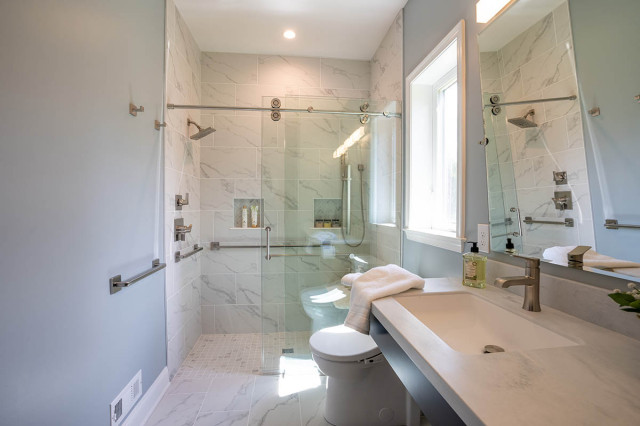
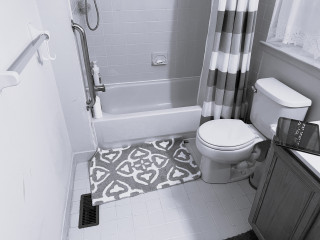
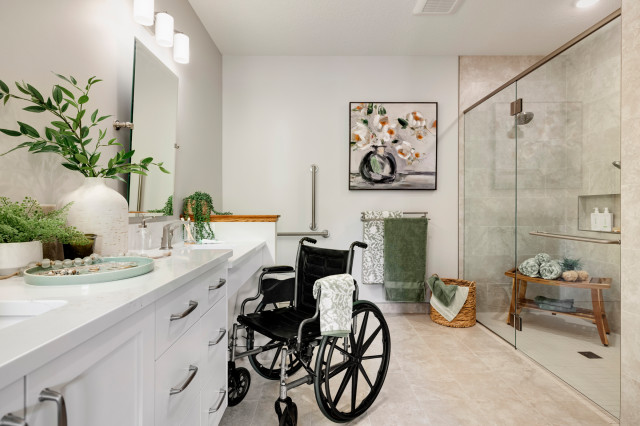
For help, they brought on designer Grace Arndt, who was helping them remodel their kitchen with similar principles. Arndt ditched a shower-tub combo in favor of a curbless shower that’s easy to enter for someone with mobility issues. A sliding glass door can easily be removed and replaced with a shower curtain that allows access for a wheelchair and a caregiver. A new double vanity has room under the sink to accommodate a wheelchair; tilted mirrors can be used by someone seated as well. Grab bars and rounded countertop corners also support aging in place. Meanwhile, light blue walls, a dark blue vanity and marble-look porcelain tiles in various sizes make the space as stylish as it is functional.
This article was originally published by a www.houzz.com . Read the Original article here. .
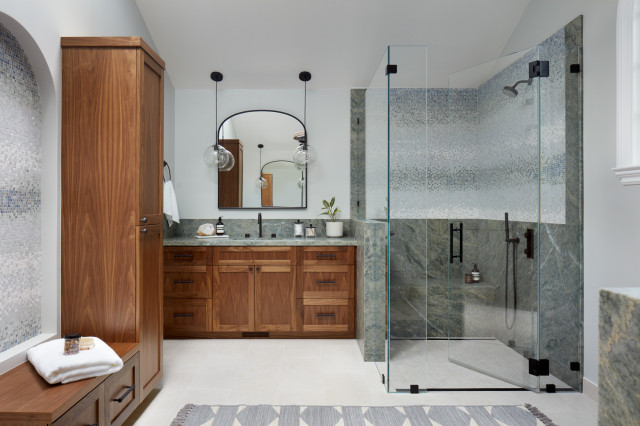
Davis removed the bathtub, walls around the water closet and pony walls around a portion of the shower to create an airier footprint with more room for maneuvering. A curbless shower with a wide ADA-compliant entry and grab bars inside (and beside the toilet) add future-proof features. Noticing that much of the home’s art was inspired by the ocean, Davis added a custom mural made from mosaic marble pieces that gives the impression of coastal fog wrapping the shower walls. A similar mosaic adorns an arched niche area that contains a walnut bench and storage cabinet. Soothing sea green granite slabs form the countertops and wrap the lower portion of the shower and pony walls. Walnut vanities add warmth visually, while heated flooring does it literally.
This article was originally published by a www.houzz.com . Read the Original article here. .
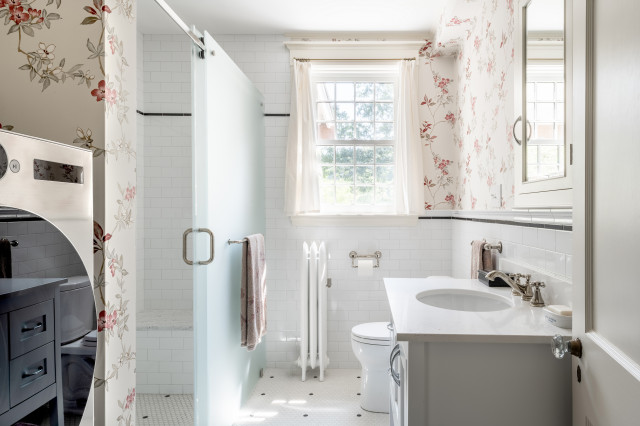
Everything about the new shower makes life easier. It’s zero-threshold, with no curb to step over, and the barn-style glass door glides smoothly on a track. “It also has a large handle that’s easy for arthritic hands to pull,” Greenberg says. A towel bar on the door keeps things within easy reach.
The wife selected a botanical wallpaper that ties into the nature-inspired motifs of the Craftsman era. The tile design also stays true to the period. “My clients wanted traditional 3-by-5-inch subway tile, but we had to look quite hard for just the right cap. This one isn’t too clunky and has a profile that they liked,” Greenberg says.
The floor features matte white hexagonal tiles for maximum traction. “All the original bathroom floors in the house are white hex with black accents and we continued that pattern here,” Greenberg says. A slim black pencil tile around the room ties it all together. The many grout lines add slip resistance — another thoughtful aging-in-place feature.
Keeping the bathroom warm through Massachusetts winters was a key priority. The team refinished the original radiator, giving it a fresh look while retaining its powerful heat output. “That radiator pumps out a lot of heat and they love it,” Greenberg says.
The bath also includes a ceiling-light-fan-heater combo, a feature the homeowners appreciated in the original room. To make the space more energy-efficient, Greenberg’s team padded out the exterior wall for extra insulation and replaced the old window with a historically appropriate reproduction.
Wallpaper: April Blossom, York Wallcoverings