Tag

Age

Browsing


The median age of construction workers is 42, one year older than a typical worker in the national labor force, according to NAHB analysis of the latest 2024 American Community Survey (ACS) data. At the same time, younger workers are becoming a growing part of the construction workforce. Despite some improvements since the peak of the skilled labor shortage in 2021, attracting and retaining skilled labor remains the primary long-term goal for the construction industry.

The median age of construction industry workers varies across states. The color coding in the map above tracks the median age of people working in the construction industry.  The state with the oldest median age (47 years old) is Rhode Island, followed by Connecticut, Illinois, New Hampshire and New Jersey, where the median age of construction workers is 44. Construction workers are younger on average in the central part of the nation. For example, half of all construction workers in Utah and Idaho are under 39.

The second data series mapped above is the difference between the median age of construction workers in each state and the median age of all industries. These estimates are reported as the numbers printed on each state. A positive number indicates that on average, construction workers are older than a typical worker in the state labor force. Rhode Island is the state where the median age of construction workers is 7 years higher than the overall median. On the other hand, a negative number indicates construction workers are, in general, younger than the state labor force.  In Vermont, the median age of construction workers is 4 years younger than the overall median.

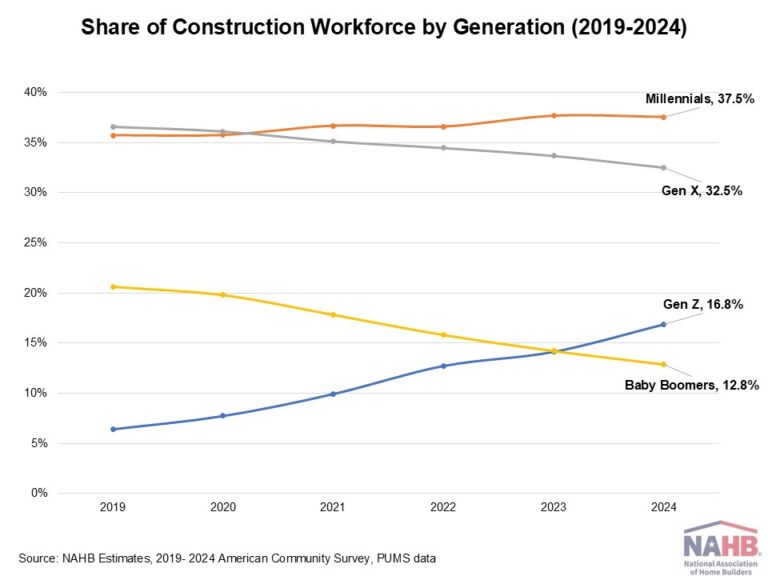
Generational shifts are reshaping the construction labor force. The share of Gen Z in construction workforce has grown rapidly, increasing from 6.4% in 2019 to 16.8% in 2024. This considerable increase over five years reflects a growing pipeline of younger workers. The Millennial generation share also rose from 35.7% to 37.5% over the same period. In contrast, the Gen X share declined from 36.6% to 32.5%, while the Baby Boomer’s share fell sharply from 20.6% to 12.8% as more retired. This shift suggests that Gen Z and Millennial workers are becoming an increasingly important part of the construction workforce. 

Compared with the workforce across all industries, construction has a relatively smaller share of younger workers, but a larger proportion of workers in their prime-working age. In 2024, only about 10.7% of construction workers were under age 25, compared with 13.7% of workers across all industries. Around 67.3% of the construction workforce were in the prime working years of 25-54, compared to 63.4% in the overall workforce.

Construction workers were especially concentrated in the 35 to 54 age group. Workers ages 35 to 44 accounted for 24.5% of the construction workforce, compared with 22.1% of workers across all industries; meanwhile, workers ages 45 to 54 represented 21.2% of construction workers, compared with 19.3% overall. At the same time, workers 55 and older made up 22% of the construction workforce. As these older workers approach retirement, attracting more skilled labor remains the primary long-term goal for the construction industry.


This article was originally published by a eyeonhousing.org . Read the Original article here. .

According to the latest data from the 2024 American Community Survey (ACS), the median age of owner-occupied homes has reached 42 years old. The age of the housing stock is an important remodeling market indicator. Older homes tend to be less energy-efficient than newly built homes and are more likely to require repairs, upgrades, and renovations in the future. At the same time, as people increasingly use their homes for multiple purposes and demand additional space, older housing represents an investment opportunity for homeowners.

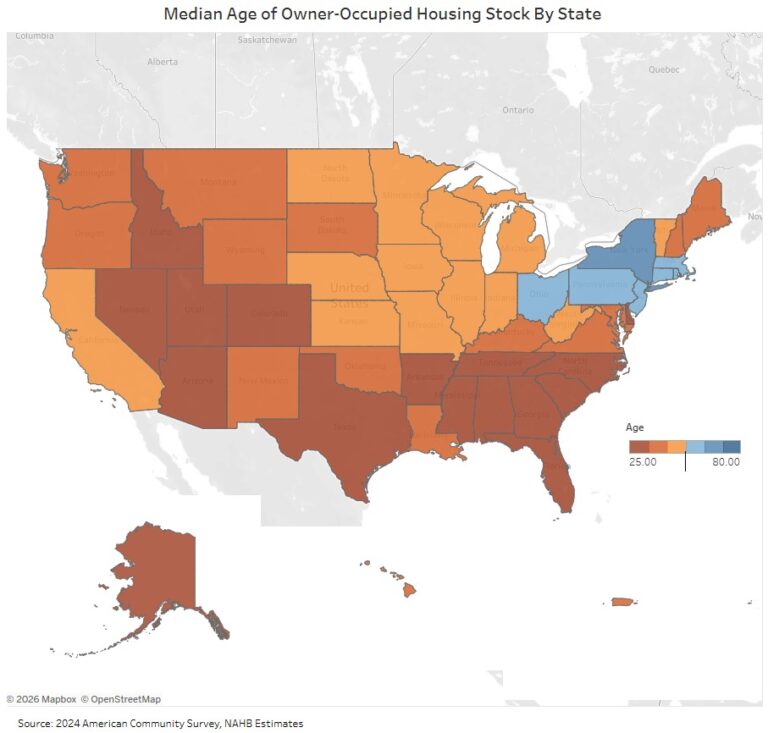
The age of the owner-occupied housing stock varies greatly across 50 states. New York has the oldest owner-occupied homes with a median age of 64 years, followed by Massachusetts (59), and Rhode Island (59). Half of all owner-occupied houses in the District of Columbia were built more than 80 years ago. However, D.C. is generally not a representative market, given its smaller size and highly urbanized environment.

In contrast, newer owner-occupied housing is particularly concentrated in the Sun Belt states where 14 out of 15 states, the exception being California (45), have a median owner-occupied housing stock age below the national median (42 years). The median age of owner-occupied homes in Nevada is only 25 years, followed by Texas at 28 years. South Carolina, Georgia and Arizona also rank among the states with the newer homes, where half of owner-occupied homes have been built within the past 29 years. 

The geographic distribution of owner-occupied housing stock age reflects underlying population changes. Population growth, including both natural growth and net migration, signals rising demands for housing and typically leads to more new construction. As a result, the rapid population growth states, like Idaho, Nevada, South Carolina, Texas Florida, tend to have newer owner-occupied housing stock.  However, states experiencing slower or even negative population growth tend to have older housing. In states such as Pennsylvania, Vermont, and New York, the owner-occupied housing stock is older than the national median.


This article was originally published by a eyeonhousing.org . Read the Original article here. .


With the end of 2024 approaching, NAHB’s Eye on Housing is reviewing the posts that attracted the most readers over the last year. In February, Na Zhao shared the latest data on ages of homeowners as well as when their homes were built. 

The median age of owner-occupied homes is 40 years old, according to the latest data from the 2022 American Community Survey[1]. The U.S. owner-occupied housing stock is aging rapidly especially after the Great Recession, as the residential construction continues to fall behind in the number of new homes built. New home construction faces headwinds such as rising material costs, labor shortage, and elevated interest rates nowadays.

With a lack of sufficient supply of new construction, the aging housing stock signals a growing remodeling market, as old structures need to add new amenities or repair/replace old components. Rising home prices also encourage homeowners to spend more on home improvement. Over the long run, the aging of the housing stock implies that remodeling may grow faster than new construction.

New construction added nearly 1.7 million units to the national stock from 2020  to 2022, accounting for only 2% of owner-occupied housing stock in 2022. Relatively newer owner-occupied homes built between 2010 and 2019 took up around 9%.  Owner-occupied homes constructed between 2000 and 2009 make up 15% of the housing stock. The majority, or around 60%, of the owner-occupied homes were built before 1980, with around 35% built before 1970.

Due to modest supply of housing construction, the share of new construction built within the past 12 years declined greatly, from 17% in 2012 to only 11% in 2022. Meanwhile, the share of housing stock that is at least 53 years old experienced a significant increase over the 10 years ago. The share in 2022 was 35% compared to 29% in 2012.

[1] : Census Bureau did not release the standard 2020 1-year American Community Survey (ACS) due to the data collection disruptions experienced during the COVID-19 pandemic. The data quality issues for some topics remain in the experimental estimates of the 2020 data. To be cautious, the 2020 experimental data is not included in the analysis.

Discover more from Eye On Housing

Subscribe to get the latest posts sent to your email.


This article was originally published by a eyeonhousing.org . Read the Original article here. .
Pin It