Profitability for residential remodelers reached its highest level in more than two decades in 2024. Industry-wide profit benchmarks are important because they allow companies to evaluate their financial performance in context with the industry. Doing so can guide resource allocation, budgeting, and target setting for costs and expense lines, leading to a more successful business strategy. This post summarizes the results from NAHB’s most recent edition of the Remodelers’ Cost of Doing Business Study.
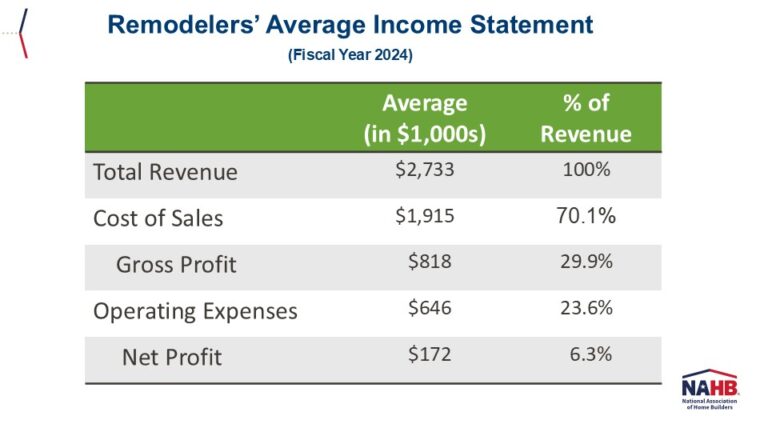
On average, residential remodelers reported $2.7 million in total revenue for fiscal year 2024. Of that, about $1.9 million (70.1%) was spent on cost of sales (i.e., labor, materials, contractors), which translates into an average gross profit margin of 29.9%. Operating expenses (i.e., indirect construction costs, finance, S&M, G&A, and owner’s compensation) cost remodelers an average of $646,000 (23.6% of revenue), leaving them with an average net profit margin of 6.3%.
Remodelers’ 29.9% average gross profit margin in 2024 was a solid five percentage points higher than in 2021, when the metric sank to a record low of 24.9%. The improvement was due in large part to a significant reduction in trade contractor costs, which dropped from 36% of revenue in 2021 to 30% in 2024. The average gross margin in 2024 (29.9%) marked a return to gross profitability levels at par with 2018 (30.1%).
Successfully reducing their costs of sales improved remodelers’ bottom line. In 2024, their average net profit margin (6.3%) was higher than in 2021 (4.7%) and 2018 (5.2%). It was also the highest net margin reported by remodelers since 1996 (6.8%).
The Cost of Doing Business Study also tracks residential remodelers’ balance sheets. On average, they reported $668,000 in total assets on their 2024 balance sheets. Of that, $331,000 (50%) was financed by liabilities (either short- or long-term) and the other $337,000 (50%) by equity builders held in their companies.
Historical data show remodelers’ balance sheets expanded significantly in 2024, with average total assets ($668,000) up 34% compared to 2021 ($497,000). But perhaps more important than fluctuations in the nominal size of their balance sheets, the data clearly point to remodelers deleveraging their businesses in the last decade. In 2015, 68% of remodelers’ assets were financed through debt. By 2021, that share was down to 49%, where it remained essentially unchanged in 2024 (50%). Logically, the latter means remodelers are using more of their own capital to run their companies, as illustrated by their equity share rising from 33% in 2015 to 50% in 2024.
More specific data about remodelers’ various cost of sales lines (e.g., the share of revenue spent on materials), operating expenses (e.g., how much owners were paid as compensation), or types of assets (e.g., cash) are available in the official publication of the 2026 Remodelers’ Cost of Doing Business Study.
This article was originally published by a eyeonhousing.org . Read the Original article here. .