Author

realtykast_fmyriy

Browsing


Over the past 125 years, women have played a crucial and multifaceted role in the labor force. Increasing women’s participation in the workforce is not only essential for individual and family well-being, but also contributes significantly to overall labor force participation rates and economic growth by adding more workers and enhancing overall productivity1.   

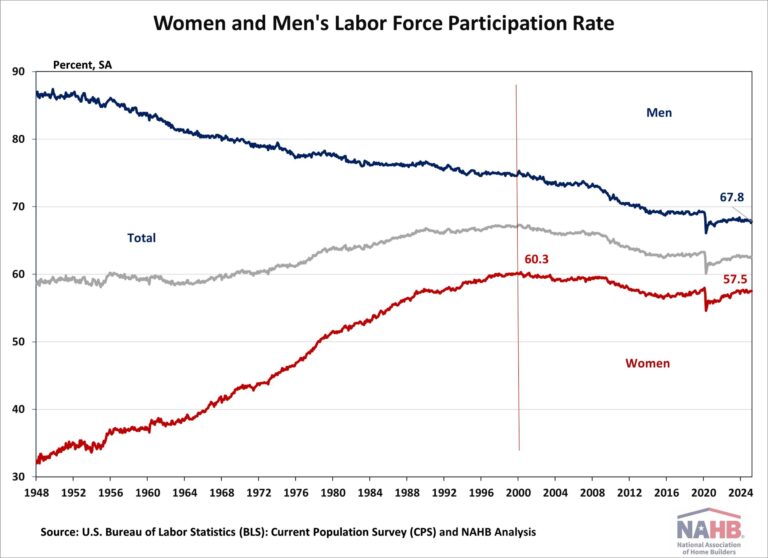
Historically, women’s labor force participation rate rose rapidly between 1948 and 2000, peaking around 60% in 1999. During the same period, men’s participation rates declined. However, since 2000, the growth in women’s labor force participation has flattened and then declined.

According to the March 2025 Employment Situation Summary reported by the Bureau of Labor Statistics (BLS), women’s labor force participation rate held steady at 57.5%, and women now represent nearly half (47%) of the total U.S. labor force.

Selected Categories

Prime-age women (ages 25-54) represent a significant and growing segment of the U.S. labor force. As of 2024, they accounted for nearly 30% of the civilian labor force, compared to 34% for prime-age men. According to the latest data from the Current Population Survey (CPS), prime-age women had a labor force participation rate of 78%, the highest among all female age groups. This rate has fully recovered from the COVID-19 pandemic, surpassing its previous peak recorded in February 2020.

As discussed in the previous blog, higher levels of educational attainment are strongly associated with higher labor force participation and lower unemployment. Women with a bachelor’s degree or higher have played a vital role in shaping the labor market. In 2024, about 70% of women with this level of educational attainment were active in the labor force, compared to only 34% of women who had not completed high school.

The CPS data also reveals notable differences in women’s labor force participation based on parental status.  Women with older children (ages 6 to 17) and no children under 6 years old had a higher labor force participation rate than those with younger children. Interestingly, women without children had a relatively lower labor force participation rate compared to those with children. Further research from the Brookings Institution and The Hamilton Project2 highlights a significant shift: women with young children (under 5 years), especially those who are highly educated, married, or foreign-born, are more likely to be in the labor force now than they were before the pandemic.

Women’s labor force participation also varies by race and ethnicity. Among women ages 16 and over, Black women had the highest participation rate at 61%, followed by Hispanic women (59%), Asian women (59%), and White women (57%).

The figure below reflects the diversity and complexity of women’s roles in the workforce.

Women in Industry

As more women enter the labor force, they are increasingly shaping a broad range of industries–from healthcare and education to leisure and hospitality, retail, technology, and construction.

In 1964, women were primarily employed in a narrower set of sectors. The top four industries employing the most women at that time were: manufacturing; trade, transportation, and utilities; local government; and education and health services3.

By 2024, however, women’s participation in the workforce has expanded significantly, both in scope and impact. According to the latest CPS data, women dominated the education and health services sector, where they hold approximately 27.6 million jobs. That means seven in every ten workers in this field are women. Moreover, women now make up more than half of the workforce in several other key industries, including other services, leisure and hospitality, and financial activities.

Despite their growing role in the workforce, they remain underrepresented in certain sectors, most notably, construction. Although women now make up a significant portion of the overall labor force, they account for just 11% of total employment in the construction industry. Of those, only 2.8% of women work in actual trade roles, while most women in the industry are employed in:

Office and administrative support

Management

Business

Financial operations

Gender Pay Gap by Occupation

While the gender pay gap in the U.S. has narrowed significantly over the past few decades, it remains a persistent issue in the labor market. According to a study4 by the Pew Research Center, women earned about 65 cents for every dollar earned by men in 1982. By 2023, that figure had risen to approximately 82 cents on the dollar—a clear sign of progress. However, the pace of change has slowed considerably in recent years.

In 2024, the CPS data shows that women working full time earned a median weekly wage of $1,043, compared to $1,261 for men. This means women earned 83 cents for every dollar earned by men—a 17% gender wage gap.

At the occupational level, women earn less than men across all major occupational groups, even ones dominated by women. The smallest gender pay gap was found in community and social services occupations. In contrast, occupations in legal, sales and related, protective services, and production display larger disparities in earnings between women and men.

The Future of Women in the Workforce

Looking ahead to 2033, the number of women in the labor force is expected to continue growing, driven primarily by the prime-age women (ages 25 to 54). BLS employment projections estimate that roughly 3.2 million prime-age women will join the workforce between 2023 and 2033. During this period, their participation rate is projected to increase slightly, reflecting continued momentum in women’s economic engagement.

Meanwhile, the U.S. labor market is experiencing a critical shortage of skilled workers, especially in fields like STEM (science, technology, engineering, and math) and skilled trades. As the NAHB Chief Economist stated, “The ultimate solution for the persistent, national labor shortage will be found…by recruiting, training and retaining skilled workers.” This applies equally to the women’s labor force.

Women’s participation is closely tied to their access to education and skills development. As more women pursue higher education and specialized training, their career opportunities expand, particularly in fields previously dominated by men. This progress can help narrow the gender pay gap over time.

However, women often shoulder disproportionate family and caregiving responsibilities, not only during their reproductive years, but throughout their lives. According to the American Time Use Survey (ATUS), on a typical weekday, prime-age working women spent about four hours on caregiving and household tasks, such as household activities, caring for and helping household members, and purchasing goods and services. This is nearly twice the time men spent on the same activities. Many women face a tough decision between career advancement and family caregiving responsibilities, often leading to reduced work hours or even complete withdrawal from the labor force.

To support and increase women’s labor force participation, it may be beneficial to consider a range of policies and workplace reforms. For example, promoting flexible work arrangements can help women better balance professional and personal responsibilities. Narrowing the gender pay gap would also play a critical role in ensuring fair compensation and financial security. Furthermore, expanding access to affordable and high-quality childcare could remove a major barrier for many working mothers. In addition, continued investment in education and training programs would enable women to advance in their careers and contribute to broader, long-term economic growth.

To conclude, empowering women to succeed in the workforce not only improves individual and family well-being, but also strengthens the entire economy.

Note:


This article was originally published by a eyeonhousing.org . Read the Original article here. .


2026 is finally here! And if you can still read this sentence without seeing double, you’ve made it!

But this year, things are going to be a little… different. We usually talk about the best places or strategies for buying rentals, but we’re going on a bit of a detour to start the year by discussing our real estate resolutions, all of which will actively help us retire early. Want to retire with rentals, too? This is the episode for you, and we’re sharing the strategies we’re using in 2026 to get there.

Kathy Fettke shares a new way she’s optimizing her real estate portfolio, with the goal to increase cash flow by 10% on her current portfolio (not buying more rentals!). Henry takes an opposite approach to most investors, opting not to scale his portfolio and instead doing something much safer. Dave details his “End Game”—the ultimate real estate portfolio for early retirement.

Dave:
Happy New Year, everyone. Welcome to the BiggerPockets Podcast. I’m Dave Meyer, head of real estate investing at BiggerPockets. I hope you all had a great holiday and are excited as I am to grow your portfolios this year. Today, we’re kicking off the year with New Year’s resolutions. And for that, I’m joined by my on- the-market co-host, Kathy Fettke and Henry Washington. We’re going to share our goals for the year, the strategies we’re planning to achieve those goals and the risks we’re avoiding in a changing market. A heads up that this show will also be published on the On the Market podcast feed over this New Year’s break, and make sure to tune in next week for my annual state of real estate investing show and a huge announcement for the BiggerPockets podcast you’re not going to want to miss. With that, let’s jump in. Kathy, Henry, how are you?
Happy New Year. Happy New Year to you.

Henry:
Happy New Year.

Dave:
I am not going to lie and pretend that we’re recording this in the new year. It’s not really the New Year, but proactively to everyone. We’re recording this in December, but happy New Year to all of you. Kathy, you have some great holiday plans. Tell everyone what you’re up to. You’re always somewhere fun.

Kathy:
Well, yes, I’m in Paris recording this from a cave.

Dave:
You literally look like you’re in a medieval wide seller right

Kathy:
Now. I’m pretty sure I am. I’m in the oldest part of Paris, but I am here for the Christmas markets and mainly because my daughter is getting married in France. So I had to come see the venue with her. Had

Dave:
To.

Kathy:
And then it’s also-

Dave:
You had to.

Kathy:
I had to, and it’s the last year of the northern lights being really intense. So we’re going to take a little trip up to the North Pole, to the North of Norway.

Dave:
Oh, that’s so great. Wow. What a fun trip. Henry, what were you up to in the holidays?

Henry:
Food.

Dave:
Enough set,

Henry:
Really. Absolutely. I mean, I have little kids, so I do get to enjoy the joy of Christmas still, so that’s fun, but mostly I’m eating my way through the holidays.

Dave:
Yeah. Good for you. All right. Well, let’s jump into today’s episode because I really want to just start looking forward. Last year was a interesting … I wouldn’t call it a great year. I was going to say it’s a great year. I would not have called 2025 a great year. That would’ve been a straight up lie. I am feeling optimistic going into 2026 and just about real estate in general. So let’s talk about this in terms of what our New Year’s resolutions are. We’ll start with real estate, but if you want to throw a non-real estate one in, I would love to hear them. But Kathy, what’s your real estate New Year’s resolution?

Kathy:
Well, I have a few, but one is to really dive into AI because
Rich actually bought a really expensive program and he’s finished it and I have not. I’m not even close. But I know it’s so powerful. I mean, one of the things that Rich did is he uploaded everything. Our bank statements, the cash flow, our system knows everything about us. And when we upload it, we could know which properties are performing well, which are not. I mean, we should be knowing that anyway, but I feel like sometimes it’s easy to get lazy or you’ve just owned properties for a while and haven’t really taken a look. Is this still a good performer? So using AI to optimize our portfolio is my goal for real estate.

Dave:
I like that a lot. I like this as a goal. It’s not like, oh, I have to buy this property by this date. This is more like a growth mindset kind of goal. How do you just evolve as an investor generally so that you can make better decisions going forward? Is that program, is that real estate specific?

Kathy:
No, no, it was just a bunch of business owners. But I mean, it’s like he’s got a business consultant now. All of our business financials are in there and we had every employee detail what they do, not in a dog kind of way, but I guess kind of like what do you do all day? And so AI knows each employee and knows how to optimize for them. It’s really been phenomenal.

Speaker 4:
Wow.

Kathy:
And we had one of the best months ever for our company last month. I don’t know if it has to do with that or not, but that’s strange, right? At a time when real estate has been so slow, sales have been slow, we had a really good

Dave:
Month. That’s awesome. So it sounds like you’re using AI not just to identify properties or deals, but work on and in your business as well.

Kathy:
Yeah. I mean, how many times do you really know what your insurance covers?

Dave:
Literally never.

Kathy:
So with, I’ll say Claude, for example, we can upload our entire insurance thing. There’s a word for it.

Henry:
Your insurance binder? Yeah.

Kathy:
Yeah, that thing, the binder. To just really know the details of your insurance policy and even ask it, “Hey, is this covering me for everything I need for this investment property in this particular state?” It’s really phenomenal with what’s available to us and it’s only going to get better, so why not be on the cutting edge of it?

Dave:
I love it. Henry, are you using AI regularly?

Henry:
The short answer is yes, but I’d be lying to you if I told you I was using it on a much deeper level than just the surface level asking for help with certain items. Now, I did try to build something similar to what Kathy was talking about about two months ago where I was uploading transaction data and information from my property manager because I wanted to see if AI could give me a sense of how well certain properties are performing. And I thought if I could upload the actual bank statements and marry that against the data from your property manager who’s actually going out to the properties, doing the actual repairs. And then I wanted to marry that against what I’m spending with contractors on certain properties to get just a bird’s eye view of my portfolio. And it was very challenging in ChatGPT. And so I’m wondering if I should try Claude or Gemini or one of those.

Kathy:
Claude is so good for business.

Dave:
Oh, really? I got to check that out because Henry and I were just in Seattle and people were raving about Gemini.

Kathy:
Yeah.

Dave:
I feel like it’s a horse race right now. One releases a new one and it gets a little bit better and then the other one gets a little bit better, but there’s not a clear winner. I just have to tell you guys, I got a little bit of a behind the scenes look at a big real estate company’s new AI tool. It’s not BiggerPockets, but there’s another one that’s going to release one soon. I got to do the beta. It is so freaking cool. It’s unbelievable how good the analysis and information about properties and markets. For a data analyst, this thing is so cool. I am super excited to start using these kinds of tools in my own analysis. But I have to ask you guys, maybe I’m just a complete control freak, but I use this for research, but I double check everything

Kathy:
That

Dave:
I do still, right? Okay,

Kathy:
Good. Because it still makes lots of errors. It’s not there yet, but it will be. It will be. So learning the things that we’re learning. And bottom line, the goal for me for doing all this is I want to see if I can … Wait, let me say that in a more powerful way. I’m going to increase cashflow by 10% by optimizing our portfolio, whether that means taking some older properties that aren’t really performing and 1031 exchanging them into better ones or just looking at things like we bought a lot 10 years ago because we were living at a house where someone was going to build this mega box property that block our view. And so we bought the lot and they wouldn’t do it and now we don’t live there anymore and we just kind of haven’t done anything with it. We tried to sell it.
Nobody wanted just a lot. So that’s one thing. It’s like, how do I optimize this piece of land that’s just been sitting there and we’re paying taxes on? And so I’ve been working with a manufactured housing company and we’re going to put manufactured housing on that lot. And so when I’m doing a whole new thing and it’s actually going to cash flow in CaliforniaCalifornia.
Yeah. And if my daughter ever decides she wants to move down the street from us, there’ll be a house there for her. Intent. But yeah, it’s kind of just stuff like that. Just kind of looking at what we have, the theme is more isn’t always better. Look at what you have and make it better.

Dave:
That’s great. Well, I think this is an awesome New Year’s resolution. I really like this idea of getting better at AI because I will admit, I am simultaneously excited by AI and very, very scared of it and terribly tired of it. And so sometimes I just choose to ignore it because I’ll see these deep fake videos online and I’m like, “AI is evil.” But then you talk about all these things that AI is amazing for. I just need to figure out the right way to use it for my business that makes sense and not be overwhelmed by the societal implications that might be coming with AI at the same time.

Kathy:
For sure. I mean, an example is just, I’ve been working a lot with Claude, that’s what I use and asking for LA County, what do I need to know about manufactured housing? Tell me this step-by-step process. And it’s not 100%, it’s not easy, but it helps it feel not as daunting.

Dave:
All right. Well, I love this. This is a great New Year’s resolution. Thanks for bringing this one, Kathy. We got to take a quick break, but we’ll be back with Henry’s New Year’s resolution right after this. Welcome back. I’m here with Kathy and Henry sharing our goals, New Year’s resolutions for 2026. We heard Kathy’s, which I love about getting better at using AI. Henry, what is your New Year’s resolution even though you don’t like them?

Henry:
No, I don’t like them. And I always feel awkward when people ask questions like this because of the kind of investor I am. I just do old, boring real estate, Dave. I buy distressed properties, I fix them up and then I rent them out or I sell them. And I think when people ask about resolutions, they expect to hear some super ambitious, creative thing that you’re doing. Like a big pivot,

Dave:
Like you’re making some change. Yeah. Yeah.

Henry:
And my goals are very similar each year because I just want to continue to do what works and what’s worked for generations, which is another iteration of the same thing. But now that I’ve placed that caveat, essentially I think of investing in three buckets where you’re either growing, you’re stabilizing or you’re protecting.
And we as investors operate in typically two of those buckets at a time, heavily weighted more so on one than the other. And so as I started in 2017, I’ve been a lot more focused on growth. So my goals each year were always around how many more assets do I need to acquire? How many more projects do I need to flip to give me the funding to acquire those assets? But now I’m in a place where I’m more focused on stabilization and protection. And to me, protection is paying off. And so my goals for 2026 or my resolution, if you want to call it that, is more focused around stabilization, optimization similar to Kathy, and paying off debt. So I have a stretch goal of paying off two properties in 2026. And I know two doesn’t sound like a lot, but we’re talking about completely clearing the debt on two assets, which I think is a big deal.
So I want to pay off two of my assets and there’s about four assets that I need to stabilize because I’m bleeding money in them right now.
Some of them my own fault, some of them, no fault of my own. One in particular, I bought a duplex, not in a flood zone, and we had a crazy flash flood and it tore through both units of the duplex. And then on top of that, a big mistake happened with one of the remediation companies where they did some work unauthorized to the tune of $40,000. So I have about a $40,000 bill that we’re fighting because they weren’t supposed to do the work. And I have about a $50,000 renovation I’m going to have to fund out of pocket. So these are big ticket items. They don’t just come very easy. So that property right now is a duplex that I pay monthly all the expenses on, but has no income. So stabilization is a big deal for me in 2026. I also have some multifamily assets I bought in 2023.
Again, no fault of my own. The city has come in and is requiring me to do some work that we didn’t plan on doing that where you can’t really fight. So there’s a lot that happens in a real estate portfolio that I think requires you to take a step back and evaluate. So 2026, stabilizing the assets that are bleeding money and paying off two properties. And so those lead me to my other goals, which is I need money to do those things. So that guides me to how many projects I need to take on throughout the year to generate the income I need to solve those problems, live my life. Make sense?

Dave:
It does make sense. I love the way of thinking backwards. A lot of people would be like, how many flips can I do, maximize, and then take that money and be like, what am I going to do with it? But I really like thinking about it like, what do I need to do? And then sort of backing into the minimum amount of work that you can do. That doesn’t mean you might not take on more deals if you find opportunity, but just having a good sense like, okay, I need to do two a quarter or one a year. I need to do that, make sure I’m hustling on that and then I’ll take everything else that comes from there.

Henry:
Yep. I average probably around like $45,000 net profit on a flip and I would estimate that I need to do about 15 projects to be able to pay off the properties that I’m looking to pay off and to be able to have the income necessary to continue to live and be able to stabilize the four assets I need to stabilize. So that’s my goals.

Dave:
I love it. I guess I understand maybe why you don’t love a New Year’s resolution because this sounds like it’s a multi-year project too. It’s not like this is something you do in 2026. This is a piece of a larger goal that you have been working for and will probably need to keep working towards beyond 2026.

Henry:
Yeah. My larger goal, ideally, this is … Now they say your goals are supposed to be big and scary, right? And in corporate world, they called them stretch goals. The big, scary stretch goal is to have a third of my portfolio paid off 10 years from now. I

Dave:
Like that.

Henry:
That’s a lot. It’s a lot of money. Yeah. Yeah. But I feel like if you don’t set a big scare … Shoot for the moon land on the stars, right? If I end up with half of that paid off, that’s still going to put me in an extremely strong financial position in 10 years. So the larger goal is that. And then what I do each year is tying into that. And then I have to adjust each year because yeah, I have a goal of two this year, but what if I only get one? So then I need to take what happens in 2026 in terms of the economic outlook and make new goals. Maybe 10 might be too far out. Maybe I need to change it. So I think I’m not afraid to reevaluate my goals based on what’s happening, but I try to make it all tie together.

Kathy:
I love that. It sounds like you’re also looking at the protection side of it because as you start paying off properties, oh, there’s such relief knowing that if anything goes wrong and you just can’t predict, you can’t predict things like 2020 coming along that turned out not to be bad for real estate at all. Ended up being a pretty good time for real estate bought, could have gone the other direction. And when you’ve got paid off properties, boy, all you have to do is sell a couple and it’ll help pay for the other ones that you’ve maybe over leveraged. And I know that you have way over leverage to get to where you are now and that has worked. But at some point you’re like, okay, it’s time to turn the ship and pay some of this off. That’s great.

Dave:
It’s interesting to hear both of you are focusing on optimization instead of growth. Is that a reflection of the market or just where you are in your personal investing journey?

Kathy:
That’s a good question. It was just the first thing that came to mind because it’s what I’ve been doing and excited about. Just taking a look at some of these properties that bought 10 or 15 years ago, I really haven’t paid any attention to them. For example, one, it just vacated and I talked to the property manager and she goes, “If you update this by about $20,000, you’ll get about 100,000 extra in equity.” I hadn’t even thought

Speaker 4:
About it. Easy.

Kathy:
So that’s exciting. And if I do that, then we can sell that or keep it, take the money out. And so it’s almost like an after the fact bur,

Speaker 4:
10

Kathy:
Years later down the road, bur.

Dave:
It’s a slow burn. A slow bur. It just doesn’t matter. Just keep optimizing things over the long run. This is the way to do it. It’s absolutely right. I love that.

Henry:
For me, Dave, it is more a function of where I am as an investor because I’m a deal junkie and I love the process of finding deals. I love buying a great deal and I love operating assets in great parts of the community. It all is so fun for me, but at some point I have to get to a place where I am protecting the assets I have so that I have paid off assets to pass on to my children. The overarching goal for my real estate business is for my children to be able to be the people they’re called to be and not the people they have to be for money. So if they need or want to do something that isn’t going to pay them a ton of money, at least I have these assets that will be paid off that can provide income for them.
And so to get there, I have to pay off properties. And so I have to draw a line in the sand somewhere and start paying down these assets. And so that’s why I have the 10-year goal trying to get some of these paid off so that I have those to pass. Now, when I get to that point, Dave, I may just start doing more deals again, but I will always have- You will. You will.
And I’ll probably still do deals that are like home run deals along the way. I’m not saying I’ll never buy another rental property between now and 10 years from now. I’m just saying I’m not in aggressive growth mode. So optimization is more important to me right now than growth was. And growth was more important to me when I first got started. It’s just a shift in where I am as an investor.

Dave:
All right. Well, these are great resolutions. Thank you. I really think these are, obviously they’re not just resolutions, but just goals and good perspective on where you both are in your investing journey. We are going to take a quick break, but we’ll come back with my New Year’s resolution right after this. The Cashflow Roadshow is back. Me, Henry, and other BiggerPockets personalities are coming to the Texas area from January 13th to 16th. We’re going to be in Dallas, we’re going to be in Austin, we’re going to Houston, and we have a whole slate of events. We’re definitely going to have meetups. We’re doing our first ever live podcast recording of the BiggerPockets Podcast, and we’re also doing our first ever one-day workshop where Henry and I and other experts are going to be giving you hands-on advice on your personalized strategy. So if you want to join us, which I hope you will, go to biggerpockets.com/texas.
You can get all the information and tickets there.
Welcome back. I am here with Henry and Kathy talking about our New Year’s resolution. Kathy shared that she’s looking to optimize her portfolio and learn more about AI. Henry is going to be trying to pay down some of his debt and stabilize some of his assets. My New Year’s resolution for 2026, and I’m with you on this, Henry, this is something I’ve been thinking about for at least six months and is going to take me 10 years. But my plan right now and the thing that I’m focusing on is enacting what I’m calling my end game.
Hopefully not going anywhere, but I’ve been investing for 15 years now and I feel like I’ve had these two different eras of my own investing. My first 10 years, I bought rental properties, I self-managed them, all of them locally in Denver. Those were the first 10 years. The last five years, then I moved abroad. I was living in Europe. I sold some rentals. I got pretty into passive investing. I got into lending. I do syndications. I still own rental properties, but I’ve kind of had this second era. And now I want to move. I’m back in the United States. I want to move into my third act as a real estate investor. And I call it my end game because I want to spend the next 10 to 15 years putting myself into retirement. I am in a fortunate position where I do feel like I have enough capital to do it, but I need to rearrange my portfolio into an optimized way so that 10, 15 years from now, I’m going to have a portfolio that is just rock solid.
It’s only assets that I really like. Ideally, they’re paid off or have very low debt on my overall portfolio. And I actually think it’s a good time to start acquiring rental properties right now. And so I’m seeing opportunities trade out of some of my more passive options or lending and start acquiring the assets that I want to own ideally for the rest of my life.That’s kind of what I’m starting to think about. And I’m even considering, Henry and I were just together in Seattle. We were talking about this, thinking about putting things on 15-year notes, for example, instead of going to the 30-year fix that I’ve always really used and just start thinking, I’m 38 years old. At 53, I probably still won’t retire, but I want the portfolio that I can retire off of and that I wouldn’t need to touch if I didn’t want to for the rest of my life to be in place.
That’s not going to happen in 2026. This is going to take me probably at least five years to reposition things, do some different projects, learn a little bit, but that’s my goal. That’s the thing I’m really working on.

Speaker 4:
Love it.

Henry:
Yeah, no, I think that that’s just smart financial planning. It’s similar to what I’m thinking about because I enjoy what I do now. I like chasing deals. I like flipping houses. It’s still fun and exciting. And is there annoying parts of it? Sure, but I enjoy it. But will I still enjoy it in 10 years? Will I just be tired of the chase? I’ve talked to a lot of seasoned investors in their 50s, 60s, and 70s, and the one theme across all of them is at some point they got tired of chasing deals. They got tired of churning houses and flipping houses. And so if I can get myself to a point where I don’t ever have to flip another house if I don’t want to, but I can still choose to, that’s ideal. And it sounds like that’s what you’re trying to get to.
How do I get to the point where if I just want to sit down and do nothing, I can. I’m taken care of, my family’s taken care of, my legacy’s taken care of, but if I want to go do some cockamamie crazy deal, I can also go do that. Definitely.
Getting yourself to retirement doesn’t mean you have to retire.

Dave:
First of all, I got tired of flipping houses before I even got started. So good for you. I did one. That’s all I needed. I’m at two right now and I’m tired. And I didn’t even do the GC. You

Henry:
Didn’t do the

Dave:
Hard part. I didn’t even do the hard part. I’m tired of it. No, I signed last night though and getting this thing done. So that’s great. No, that’s exactly right. For me, it’s not even the flipping. I’m always tinkering. I’m just like an optimizer. I’m always moving money from here to there. And I got to stop doing that too. I will do some of it. I will keep some of my money for fun because for me, that’s fun. Like you were talking about, Henry, you like looking at deals. For me, I like investing in passive deals. I like underwriting deals and figuring them out and looking for different opportunities, but I need to put the rock solid thing back in place because I had a lot of great rentals. I don’t regret selling any of them, but I have not rebuilt my active portfolio in the way I want to yet.
And so that’s really what I’m going to be focusing on. And like I said, there’s better and better deals. It’s not even that prices have gone down that much. It’s just the asset quality is so much better, in my opinion. And you’re seeing high quality properties come on the market. I think multifamily is looking more and more attractive right now. And so that’s the plan for 2026. My other resolution, just so you know, as always, is to go on as many vacations as humanly possible.
How do I travel all the time?

Henry:
Can we go on record, Dave, and set a stretch resolution? You and I?

Dave:
Uh-oh.

Henry:
Can we set a resolution that within five years we land an Anthony Bourdain style TV show where we travel around, eat food

Dave:
And

Henry:
Talk about real estate?

Dave:
This is our dream in life. Yes. We need a new vision board, you and I. All right. Well, this was a lot of fun. Thank you guys. I would love to hear your New Year’s resolutions, right? We want to hear them. Share them with us in the comments. We want to hear what your New Year’s resolutions are real estate-wise, fun-wise, lifestyle-wise, because at the end of the day in real estate, we’re doing this usually not because we just want to own or acquire assets for something, because it frees up something else in our lives, spending more times with our friends, family, traveling, eating disgusting amounts of food. This is why we’re actually here. So tell us what your resolutions are. Kathy, happy New Year. Thanks for being here.

Kathy:
Thank you. You too.

Dave:
Henry, happy new year. Excited for another year doing on the market with you both. And James, of course, when he decides to grace us with his present.

Kathy:
Yes. Absolutely. Thank

Dave:
You. Thanks everyone. We’ll see you next time.


Help us reach new listeners on iTunes by leaving us a rating and review! It takes just 30 seconds and instructions can be found here. Thanks! We really appreciate it!

Interested in learning more about today’s sponsors or becoming a BiggerPockets partner yourself? Email [email protected].


Source link


Forina Design & Co.Save Photo
4. Warm, Earthy Colors Everywhere

Terra cotta, sage, olive green, dusty blue, muted pastels, creamy beiges, browns, taupes and buttery yellows are taking over interiors. “The reign of all-white interiors and icy gray palettes has definitely come to an end,” says color specialist Jennifer Ott. “Homeowners are now craving warmth, richness and depth in their spaces. For those who still prefer lighter palettes, stark whites are giving way to warmer neutrals that are sun-warmed and tactile — think canvas, parchment or soft stone gray. These hues add subtle depth while maintaining a sense of calm and brightness.”

Kitchens feature terra-cotta-colored tile backsplashes and sage cabinetry, while living rooms lean into buttery yellows, warm taupes and olive accents layered with natural textures like linen, wool and rattan. Bedrooms and bathrooms are embracing muted blues and greens for a soothing, restorative feel, and even entryways and home offices are benefiting from warmer palettes that create inviting spaces rather than stark or clinical ones. “Clients have been increasingly drawn to warm, nature-inspired tones in their kitchen designs, particularly incorporating earthy hues like terra cotta, soft beige and sage green,” says designer Donna Rose. “This trend aligns with the broader shift toward biophilic, nature-inspired design.”

This New Jersey living room by Forina Design showcases the warmth of woodsy tones. Like many of the pros featured in this story, Forina Design subscribes to Houzz Pro. Moody green sofas, deep beige wallpaper, wood accents and touches of yellow, gold and blue create a layered, inviting space that feels both organic and vibrant.

9 Paint Colors Poised to Dominate in 2026


This article was originally published by a
www.houzz.com . Read the Original article here. .


Dave:
Will home prices go up or down in 2026? We have seen a historic run of home price appreciation with values rising year after year, even as mortgage rates have remained high. But will that continue next year or will we see prices flatten or even decrease in the year to come? Today, I’m giving you my 2026 home price forecast. Hey everyone. I’m Dave Meyer. Excited to have you here for what is simultaneously both my favorite and least favorite show of the year, predictions about the next year. I genuinely enjoy and love the data analysis and research that goes into making these predictions. And since I started doing this back in 2022, I’ve been pretty accurately in calling the direction of the housing market. But at the same time, it’s a little nerve-wracking and difficult to put these predictions out in public, especially this year when there’s less data available due to the recent government shutdown.
But despite those limitations, I choose to make these predictions for you every year because having an idea of where the market is heading, even if it’s not 100% accurate as no forecast is, this is still crucial as an investor because you invest differently in a rapidly appreciating market than you do in a flat or a correcting market. And don’t get me wrong, you can invest in any kind of market, but you do need to plan accordingly. And that’s what I’ll help you do today. By the end of this episode, you’ll know where the market is likely to go, what things to watch for in case things start to change and how to build your portfolio accordingly in 2026. Let’s do it. So making predictions about the housing market is difficult because the housing market is driven by so many different variables. On one side, you have all these things that impact demand.
How many people want to buy homes? These are things like demographics, immigration, cultural shifts, domestic migration, investor activity and so on. Then you have this whole other set of variables that impact the supply side, like the lock-in effect, construction trends, a longstanding shortage in homes in the United States and so on. But to me, and I’ve been on this trend for a while now, affordability is the number one variable driving the market these days. Now, why this variable among all the other ones out there? Well, we have hit an absolute wall in terms of affordability. We are near 40 year lows. And by the way, if you haven’t heard this term before, in context of the housing market, it just means how easily the average American can buy the average priced home. And that’s at 40 year lows. It hasn’t been since the early 1980s that has been this difficult for the average American to buy homes.
Now this is really crucial because what has not changed is that people do want to buy homes. There is still desire to buy homes. But when you look at demand, this economic term, demand, it’s not just desire, it’s desire and the ability to pay for it. We still have the desire side. The issue is that most Americans just cannot afford it. And in my view, if that doesn’t change, if affordability doesn’t move, not much is going to change in the housing market. But if affordability improves, so will the market. So affordability, this key thing is actually made up of three individual variables. We have home prices. How much do homes actually cost? That should make sense. We have mortgage rates because the majority of homes are purchased with a mortgage, and so this matters a lot. And we also have wages. How much are people earning?
So those are the three things, and we’re going to break each of them down one by one. So the first factor in affordability is mortgage rates. I did a whole episode about that, but the TLDR was that although I think they could come down a little on average, next year I don’t think they’re going to move that much. So I think it could modestly help affordability, but it’s probably not going to be the thing that really changes the housing market. The second one is wages and real wage growth can improve affordability. Real wages, if you haven’t heard this term, it’s basically just a question of are incomes rising faster than inflation? If the answer to that is yes, you have positive real wage growth. The answer to that is no, you have negative real wage growth. But luckily right now, one of the bright spots for the economy in recent years since 2022 or so is that we have had real wage growth.
Wages in America, incomes are growing faster than inflation, which means your purchasing power is going up. I hope that will stay up, but I think it’s going to slow in the next year. We’ve seen inflation up to about 3%. The job market is definitely weakening. That reduces leverage and salary negotiations. And I think wage growth will slow. But the thing about the housing market and how this relates to our strategy as investors is that even in the best times, wage growth takes time to really impact affordability. So although wage growth does really matter, it’s probably not a big factor in 26. So if rates aren’t going to change that much in my mind in our base case, and real wages are not going to impact affordability that much, does that mean that the housing market is doomed to have another year like we had this year where things are pretty slow and stuck?
Maybe, but we still have one more variable, which is housing prices, which is why my base case for next year is for home prices to be flat or maybe down just modestly. If you want some actual numbers, I like to predict a range and a direction because I think as real estate investors, it actually hurts us to obsess about is it up 1% or 2%? I think we actually should just say, “Hey, it’s up modestly. It’s down modestly. It’s flat this year. It’s going to go up a lot. There’s going to be a crash.” Those kinds of directional indicators I think are what’s really important. And what I see is that home prices in 2026 are going to be between negative 4% and positive 2%. You could call this flat if you want. I am personally leaning more towards the negative side right now. Again, we don’t have data from the last couple of months, but the way the trends are going, I think if I had to pick where we’ll be a year from now, I’d say negative one, negative 2% year over year growth.
So you might be surprised hearing me say this because all previous years I’ve said we’ve been flat or up because I genuinely believe that and that was what actually came to be. But this year I see that changing. And I just want to say having these kinds of declines, this isn’t crazy. Seeing modest declines in prices isn’t a crash. It’s not even unusual. It is a normal correction, and I should probably mention a buying opportunity. And that said, I am a little more pessimistic I think than other forecasters. I see Zillow at plus 1%, some others are near flat, but most of them are modestly positive. But we’re all still generally in the same range. Honestly, being plus 1%, minus 1%, it’s kind of flat. So that’s what most people are saying. And I think the takeaway here, whether you think it’s plus 1% or minus 2% is the same.
Appreciation is going to be slow at best. It might be negative. We can’t know right now with the little data that we have, but we have to not count on appreciation. I think that’s the main takeaway for us as real estate investors. Maybe we’ll get 1%. That would be great. Maybe it’ll be negative 1%. Honestly, whatever. If you’re counting for flat or you are not counting on appreciation when you’re underwriting your deals, you can still invest in this market, but that’s the main takeaway I want you all to have right now is that you should not assume you are going to get appreciation in 2026. So that’s my belief about what’s going on in terms of nominal prices. This is going to get a little wonky, but stay with me. Nominal prices means not inflation adjusted. This is the price that you see on paper.
This is the price that you see on Zillow. People are split on whether that’s going to be up a little bit, down a little bit, but what almost every forecast that I believe in that I think is reputable, all of them agree that real prices are going to be negative. And again, real in economic terms just means inflation adjusted. So every forecast I see believes that compared to inflation, home prices are going to go down. So even if prices on paper go up 1%, but inflation stays at 3%, then real home prices have declined 2%. Real prices are down. And even though I’m saying, I think the most likely scenarios that nominal prices are down next year, I feel much more confident that real prices will be down in 2026. That much seems pretty clear to me. So that’s my base case. It’s what I’ve called the great stall in recent months as you’ve listened to the podcast, and it’s still what I think is the highest probability of happening next year because affordability is too low.
Rates will come down a little bit, I think, but not that much. Wages aren’t really going to help us one way or another. And prices, if they flatten or modestly decline, that’s how we get into the stall period where affordability gradually gets restored to the housing market. That is the base case. But I should say that when I make these forecasts, I like to be honest about my confidence level. And I just want to say that this year it is lower than previous years. Last year, I felt really confident about what I said was going to happen. I was pretty accurate. This year, I think the great stall is probably a 50-ish, maybe 60% probability, which means that we have a 40 or 50% chance that something else could happen. And I’ll give you some alternative forecasts and predictions right after this break.
Before the break, I shared with you my base case. It’s what I think is the most likely scenario to happen next year, and that’s having pretty flat or maybe modestly declining nominal home prices next year. And I think pretty confident that real home prices are going to go down unless one of these other X factors happen, which is what we’re about to talk about. So what else could happen in the housing market? To me, it still all comes down to affordability. As you’ll remember, my base case is saying affordability not going to change that much. It’s just going to gradually improve. But what happens if it goes up a ton? What if affordability gets way better? What if it goes down and actually gets worse? Are there scenarios where affordability really does move more than my base case? Yes, absolutely. That is possible. I don’t think it’s the most likely thing to happen, but I want you to understand all of the different scenarios that could play out next year.
And to me, there is one really big X factor that I am going to be keeping a very close eye on next year because it could cause what is known as a meltup, basically a huge surge in home pricing. So when I’m asking, could affordability get much better and send prices up? Yes, there are a few routes to that, but to me, the most compelling one, the thing I’m going to watch most closely is something called quantitative easing. I went into this a lot in the episode predicting mortgage rates. So you can listen to that again, but if you missed it, it’s basically the Fed using one of its emergency tools to get mortgage rates down into the mid or low fives, maybe even lower. We don’t know. Quantitative easing, it’s basically they go out and frankly print money to create demand for mortgage-backed securities and bonds.
This pushes down yields, that pushes down mortgage rates, and that could increase the demand in the housing market a lot, which could potentially push up prices. Hopefully that makes sense, right? Because I don’t believe regardless of what happens, the Fed cuts rates a bunch of times. I still don’t think without quantitative easing, we are getting to the magic mortgage rate that we need in the United States to unlock the housing market. Research by Zillow, John Burns Real Estate, a couple different economics firms have all gone into this, and they say that the magic number you need to get to to get people off the sidelines to free up inventory, to restore transaction volume to the market is like somewhere between five and five and a half percent. I just don’t see that happening next year without quantitative easing. So the big question for 2026 in the housing market to me is, will there be quantitative easing?
And frankly, I think the chances of it happening are going up like every single week right now. The Trump administration has continued to prioritize affordability, particularly in the housing market. And as we’ve seen other parts of the economy start to falter and weaken like the labor market, I think the chance that the Fed dips into its toolbox to stimulate the economy continues to go up. Now, I don’t think this will happen right away in 2026. I think the earliest it will probably happen is in May because President Trump, he actually the other day said he already knows who he wants to name Fed chair, but he can’t do that until Jerome Powell’s term is up in May of 2026. So that’s when we would probably seriously start looking for this to happen. I don’t know if it’ll happen on day one, but it might happen sometime after May.
So if that does happen, and I call this the upside case, I know you have your base case, which is what you think is most likely. Is there a more positive case? That’s usually called an upside case. So my upside case for is we get quantitative easing, affordability improves, and then what? In that case, I think we see prices go up somewhere maybe between two and 6%, maybe up to seven if they really get rates down into the fives, maybe up to 7% if they get mortgage rates down in the fours, but that seems unlikely. And that’s what I see happening. Now, I know a lot of people are saying if there’s quantitative easing, if the Fed cuts rates, we’re going to see explosion in appreciation. They’re going to go up 10% again during COVID. I don’t buy that personally because we know that when rates went up, not only did it drive down demand, but it drove down supply as well, right?
That’s the lock in effect. That’s why prices haven’t fallen because low affordability doesn’t just impact demand, it impacts supply at the same time. Both of them are low right now. So in my opinion, if rates come down, yeah, it’s going to bring back demand, but it is also going to bring back supply, right? This will break the lock in effect. So more people will be listing their properties for sale, more people will be looking to move. And so in this quantitative easing scenario that we’re talking about, I think the real winner is going to be transaction volume. We are going to see more homes bought and sold. That will help. And there will likely be upward pressure on prices, but not like COVID. That is unusual. Seeing 10% appreciation might be a once in a lifetime thing that we don’t see again for generations. Of course, if they drop rates down to 2% or 3%, maybe that will happen, but I think that is not the case even if there’s quantitative easing.
So I would expect positive appreciation in this scenario, good appreciation, really good for investors, but nothing crazy like COVID. The other thing I should mention is that if this happens, it will probably happen amongst a backdrop of a slower economy. So people may not want to make huge economic decisions like buying a house when they’re fearful about their jobs. So we have to temper our expectations for what might happen if there is quantitative easing. Now, I told you my base case, I think that’s about a 50, 60% chance of happening. When we talk about the upside case is quantitative easing, I think it’s getting more likely. I actually think it’s about a 30% chance that this happens, and we’ll talk about how to account for that in your own investing in just a minute, but I also want to talk about downside because yes, there is a chance that affordability gets better.
There is also a chance that affordability gets worse, right? How does that happen? Well, it probably happens if inflation stays high. If inflation goes up, it’s been going up four months in a row. It is nowhere near where we were in 2021, 2022. So people overuse the word hyperinflation a lot in this country. 3% is not hyperinflation. Four months in a row of growth is not hyperinflation. We are nowhere near that. But if inflation continues to creep up and mortgage rates go back up, I think there is more downside. I’m not saying that’s going to be a full on crash, but I think there’s more downside below one to 2%, right? Could a crash happen and it really get bad? Sure. But on top of rates staying high, what we need to see is to force selling. We’ve talked about this on the show, but the thing that takes a correction to a crash is when homeowners are no longer able to afford their mortgages and they are forced to put their homes on the market to avoid foreclosure or as part of a foreclosure.
Now, right now, delinquencies, they’re up a little bit, but they’re still very low by historic standards. They’re below pre-pandemic levels. But what I am saying is that there is no evidence that a crash is likely at this point. If people’s predictions about AI just destroying the labor market come true and we see unemployment go up to 10%, yeah, there is a chance that there is a real estate crash, but that still remains unlikely. I think even in this scenario, maybe prices drop five to 10%. I have a really hard time, even in a downside case imagining more than a 10% drop in 2026. It seems just extremely unlikely to me, but the chance that we see 5% declines, 7% declines, low, but I’d say it’s maybe a 10% chance because we just don’t know. There could be some Black Swan event that we don’t see coming that negatively impacts the housing market.
We always have to remember, even though we can’t predict them, we have to remember that these things exist. That is part of being an investor. And we can’t just ignore them and pretend that they don’t happen, they are out there. So the question then is, what do you do? How do you use this information where I’ve just said, yeah, I have a base case, but it’s maybe 50, 60% likelihood. There’s a 40% chance that something totally different happens. How do you invest in that kind of market? I’ll tell you how right after this break.
So far, I’ve told you about my base case, which is the great stall, the potential for quantitative easing to bring us into an upside case and a scenario where the labor market really breaks and inflation stays high where maybe we have more downside. These are obviously three pretty different scenarios. So the question is, how do you invest in an era of uncertainty and low confidence? How do we invest when there are multiple likely outcomes? There’s no right answer to this, but I will tell you how I am doing it. I am first and foremost preparing for the great stall. I think that is the most likely scenario. And the whole idea of making forecast is to not get paralyzed by all the different outcomes, but to have a plan, but to remain somewhat flexible. So I’m going to plan for the great stall because I know this might seem counterintuitive, but I actually think it could be a great time to buy, right?
If we are in a scenario where prices are flat or going down on average, that means you can get great assets at a discount. Now, of course, in these kind of scenarios, there’s also the risk that you might buy a property and the value of that property goes down more once you buy it, but in the great stall, the downside risk of that is not so great. And if you use tactics like buying deep or value add investing, you can mitigate that risk. Now, seeing this opportunity and wanting to pursue that, at the same time, I’m protecting myself against those possible declines in values. Like I said, I am going to underwrite super conservatively. I am being very, very picky right now. I am being patient. I will only buy sure things, only buy excellent assets, things I would want to own even if prices went down for a year or two after I bought them.
Those things absolutely exist 100% and they will become easier to find and buy during the great stall. That is one of the benefits of this market is that more opportunity will exist. And by doing this, by pursuing great assets that I can get at a discount, but while simultaneously protecting myself against downside risk, I am also positioning myself to take advantage if that melt up happens, right? This is the way that you are actually planning for all three scenarios, right? You plan for flat, you protect against downside, but at the same time, you need to make sure that you are in the market in case the upside case happens to take advantage of the growth that could come from that. This, to me, covers all the bases and it’s entirely possible. So let’s talk a little bit more just specifics about what this looks like.
I am going to focus only on assets that I want to hold for a long time. I want to take a long-term mindset. When I look at a property right now, I’m thinking, do I want to own this five years from now? Do I want to own it 10 years from now? And if the answer to that is no, I’m not really interested in it. Even if I think it’s going to go up in the next couple years, maybe there’s something great happening in the neighborhood or you’re buying it below comps. For me, I only want to buy things that I’m going to hold onto for a long time. That’s like the number one thing. Number two, I want cashflow within a year to make sure I can hold onto it for five or 10 years. Now, we’ve done a bunch of episodes about this recently.
I really recommend you listen to them, but you need cashflow positive within the first year. One year is really not some magical number, but I basically mean at stabilization. A lot of times now when you go out and buy a property with current rents, the current condition of the property, it’s not going to cashflow. Well, if you’re going to do value add, if you’re going to upgrade them, if you’re going to big rents up to market rate, that’s when you need positive cashflow. If you can’t get to positive cash flow after stabililization, do not buy it. I know some people say appreciation’s more important. I don’t think so in this market. I just told you, I don’t think appreciation’s coming next year. So make sure you get cashflow so you can hold onto that property so that when appreciation does come, because it will come back.
When it comes back that you’re in the market, you’re already making cash flow, you’re getting those tax benefits, you’re getting that amortization, you’re in the market and you’re comfortably holding onto them. That’s what cashflow does for you. Next, I am adjusting my mindset to care less about short-term returns. Some people might disagree with this, that’s fine, but I am saying I still need cashflow. I still need the tax benefits. I still need amortization. So I’m not saying I’m getting no short-term returns. Those three things alone should probably beat the average of the S&P 500 by themselves without appreciation. So you can still get seven, 10, 12% without appreciation, not to mention value add. You should still be able to do that. But by expectation for appreciation, market appreciation where macroeconomic forces push up the price of housing, I have very low expectations for that for the next few years.
I have low expectations for rent growth over the next few years. I could be wrong about that, but I don’t want to account on that. I don’t want to assume that because no one knows. It’s super uncertain. I’m sorry. I know some people are going to say it’s going to go up. It’s coming back next year. We don’t know, and that’s okay. If you buy according to the way, I’m telling you, by being patient, by being picky, by having conservative estimates when you underwrite your deals, you can still find great deals, but you have to follow an approach similar to this. I’m not saying you have to do everything exactly the same as me, but having this kind of mindset will help you in this era of investing. This is the approach that I am going to pursue. Now, I understand that some people are thinking now, why not wait?
If there is this flat period that we’re going to be in, why not wait? I mean, you could, but what if that upside case happens and you miss out on it? That wouldn’t be good, right? The value of real estate is being in the market for a long time. So if there are good deals that produce cashflow that are going to produce a seven, eight, 10, 12% return as good as the average in the stock market in a bad year. If you’re going to get that in a bad year and you can buy properties that you want to own for 10 plus years, why would you not buy it now? You’ll still get cashflow. You’ll get amortization and tax benefits. You’ll be able to do value add and all of that, even if appreciation is slow. You’ll also start paying down your mortgage, which means that your benefits of amortization get better year after year after year and you’ll be learning and growing.
So to me, this approach gives you a little bit of everything. That’s how personally I am going to approach a year where there is frankly a lot of uncertainty. As I’ve shared with you, I think the most probable outcome is the great stall. That’s what I’m planning for, but I just want to be honest with you. I don’t want to pretend I know everything. I want to be honest that there’s probably a 40% chance that something else happens, that there is a melt up or 30% chance is my rough estimate of that or a more significant client. I think that’s really only about a 10% chance, but it is still absolutely there. Even with all of that uncertainty, there are very proven ways to invest in real estate and to continue moving yourself along the path towards financial freedom if you are willing to set your expectations appropriately, to be patient, to be conservative in your investing that will benefit you over the long run and even in the next year.
So that’s my approach, and hopefully this helps you as you start formulating your own strategy and tactics heading into 2026. That’s what we got for you guys today. I would love to hear your forecast. What do you think is most likely to happen in 2026? Please let me know in the comments. Thank you all so much for listening. We’ll see you next time.

Help us reach new listeners on iTunes by leaving us a rating and review! It takes just 30 seconds and instructions can be found here. Thanks! We really appreciate it!

Interested in learning more about today’s sponsors or becoming a BiggerPockets partner yourself? Email [email protected].


Source link


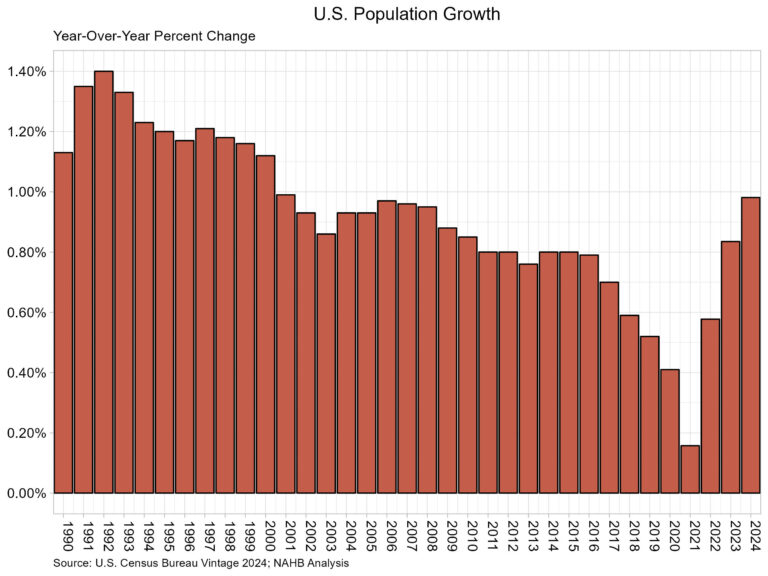
According to the U.S. Census Bureau’s latest estimates, the U.S. resident population grew by 3,304,757 to a total population of 340,110,988. The population grew at a rate of 0.98%, the highest rate since 0.99% in 2001. This also marked the third straight increase in the growth rate of the U.S. population. The vintage population estimates are released annually and represent the change in the U.S. population between July 1st of 2023 and 2024.

The Census Bureau reports that the primary source of population growth was net international migration (immigration), as international migration levels once again were higher than the previous year. The level of net international migration between 2023 and 2024 was 2,786,119. The second component of population growth is natural growth, which represents births minus deaths. Births totaled 3,605,563, down slightly from last year, while the number of deaths was reported at 3,086,925, also a decrease from last year. The natural growth, therefore, between 2023 and 2024 was 518,638.

Each region in the U.S. experienced population growth for the 2023-2024 period. The South led in population growth at 1.34% followed by the West at 0.85%. Meanwhile, the Midwest population grew 0.75%, while the Northeast grew the least at 0.59%.  

At the State level, 47 States and the District of Columbia had a population increase over the year. Of note, D.C. had the highest growth rate at 2.13%. Florida was second with population growth at 2.00% followed by Texas at 1.80%. Numerically, Texas experienced the largest population increase gaining 562,941. This was followed by Florida at 467,347 and California at 232,570.

Only three states lost population or remained level according to Census estimates. Vermont and West Virginia tied with a decline of 0.03%. Meanwhile Mississippi saw no population change.

California remained the most populous state by a healthy margin. California’s population was at 39,198,693, while the next most populous state was Texas at 31,290,831. To round out the top five States by total population the proceeding highest were Florida (23,372,215), New York (19,867,248), and Pennsylvania (13,078,751).


This article was originally published by a eyeonhousing.org . Read the Original article here. .


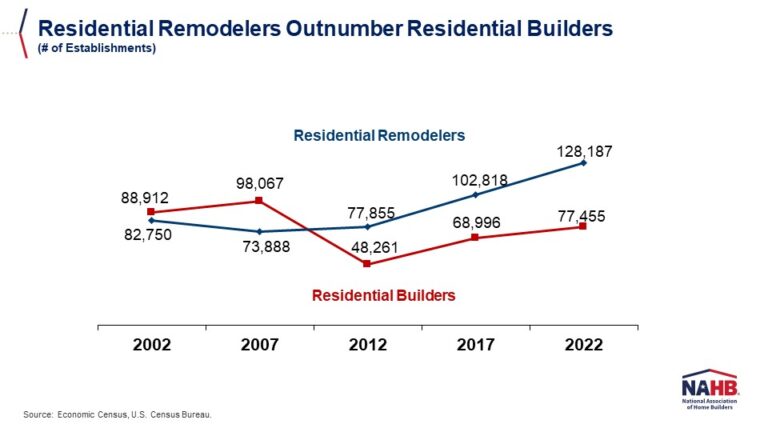
The number of residential remodelers in the U.S. has reached a record high of 128,187 establishments, 65% higher than the number of residential builders (single-family and multifamily), which stands at 77,455.  These official government counts were released by the U.S. Census Bureau as part of its 2022 Economic Census, which tallies American businesses every five years (in years ending in 2 and 7).

Growth in the number of remodelers significantly outpaced that of builders between 2017 and 2022. In that 5-year span, the remodeler count increased by 25% (102,818 to 128,187), while the number of builders grew at half that pace–by 12% (68,996 to 77,455).

A starker dichotomy emerges when comparing 2022 counts to those in 2007, prior to the financial crisis and the ensuing housing recession.  In that 15-year period, the official number of residential remodelers in the U.S. grew by 73% (73,888 to 128,187), while the official number of residential builders contracted by 21% (98,067 to 77,455).

Another way to analyze this data is by creating a combined universe of both builders and remodelers and then calculating each group’s share of the total. In 2022, for example, remodelers represented 62% of the total number of builders and remodelers in the U.S, while builders made up a minority share of 38%.  Remodelers have accounted for at least 60% of this total in the last three Economic Census (2012, 2017, and 2022). 

The last time builders comprised a majority share was in 2007, when they represented 57% of the combined total number of builders and remodelers in the country.


This article was originally published by a eyeonhousing.org . Read the Original article here. .


These rental property deals are making us richer, even with high housing prices and interest rates. Everyone thinks it’s impossible to find cash-flowing rental properties in today’s housing market, but this is NOT the truth. We’re going to show you three real rental property deals we’re buying. All of these are being purchased in 2025—these are NOT cheap deals from 2020 with 3% – 4% interest rates. Each one will build major equity, cash flow, or both.

Dave brought backup on this episode—the entire expert panel from the On the Market podcast—to share real deals they’re doing right now. We’ve got three to go through—a $55,000 heavy rehab rental property that will also serve as Henry’s own vacation home, a new build rental property at a super reasonable $214,000 price, and finally, a very creative (but somewhat costly) land-banking deal in Seattle, Washington.

Each of these deals ranges in expertise needed. Some of the heavier rehab projects may require a few years of renovation experience, while Kathy’s new build deal is a profitable rental ANYONE can buy right now. Regardless of your experience, you can copy these strategies and get richer with these rentals!

Dave:
Hey everyone. This is it, the last BiggerPockets podcast episode of 2025. We released 153 episodes this year and I hope you found them inspiring, educational and entertaining. I know I had a great time making each and every one of them. We will have a new episode Friday to kick off 2026. And then the following week, we’re going to do my state of real estate investing, which you’re going to want to listen to. And we have a very fun, very exciting announcement coming next week as well. To close out the year, we are republishing one of your favorite episodes of 2025. This is a conversation I had with Henry Washington, Kathy Fettke, and James Dainard back in April about properties that we had each recently purchased. It was a lot of fun, and I think it showed that you can make real estate investing work for you in almost any market at almost any price point.
So enjoy it. Have a happy new year, and thank you all for listening. Here’s my conversation with Henry, Kathy, and James.
Hey, everyone. I’m Dave Meyer, head of real estate investing at BiggerPockets, where we teach you how to achieve financial freedom through real estate. And today on the podcast, I am joined by three expert investors who are my co-hosts on the On The Market Podcast, James Daynerd, Kathy Fecke, and Henry Washington. James, Kathy and Henry are each going to tell us about an investment property that they’ve bought within the last few months with purchase prices ranging from 55 grand, so sort of at the low end of the spectrum, all the way up to 600 grand at the high end of the spectrum. Well, thank you guys for being here. Kathy, great to see you.

Kathy:
Great to see you. Can’t wait to hear what these guys are up to now.

Dave:
Are you nervous? I mean, not that this is a competition, but we always make it one.

Kathy:
It’s going to be a competition. It always is, even if it’s unsaid.

Dave:
Okay. Well, you usually hang pretty well in these competitions, so we’ll see. James, how are you doing? I’m good.

James:
And it doesn’t need to be said. It’s always a competition.

Dave:
Henry, good to see you, man.

Henry:
Hey, glad to be here. This is always a competition and I want to win this time.

Dave:
All right. Well, I’ll give you guys a little bit of a spoiler because I’ve read a little bit about the deals. We know that so far that Henry’s house that he’s bringing to trying to win apparently with a house full of spiders when he closed, but it will be a part-time vacation home for his family. Kathy found an incredible upside opportunity in one of the US largest and fastest growing cities, and James is getting super creative with a multi-part strategy to create profit other investors may have overlooked. So whether you’re a new investor, you’ve been in real estate for a long time, today’s show will have some great ideas to get the wheels turning on your own next property. Let’s get into it. All right, Henry, I’m going to pick on you. You have to go first and share the deal that you’re doing.

Henry:
Yeah, we’ve got a single family home that we purchased. It is coincidentally across the street from a lake and it’s arguably the second nastiest house I’ve ever bought. It was so riddled with brown recluse spiders and webs. You got me there. So first of all, when you walked in, you walk into a sunroom. The sunroom, literally three inches thick on the ground of just cigarette butts. Like this guy would just smoke his cigarettes and then throw his butts out in the sunroom. And then when you get into the house, I took one step in and I was like, nah, I’m good. So you had to get a stick of some kind and then you just had to wave it around in front of you from all the cobwebs.

Dave:
Oh, it’s like when they make cotton candy, they take that little thing and roll it around.

Henry:
Yeah. It was literally just like a thick stick of cotton candy except spiderwebs. And then the subfloors were so rotted away that we just had to put two by fours down so that we have something sturdy to walk on because I thought I was just going to fall through the floor.

James:
You know what though? I like that Henry said that this is the most realistic deal. Who wants to buy a house where you’re going to fall down and get killed by spiders within the first 30 seconds? It’s realistic though, Henry.

Henry:
It is realistic because our listeners can afford it. We haven’t talked to yours yet.

Dave:
What did you like about it? I’ve heard some things that would turn me off, but what was attractive about this

Henry:
Deal? I liked that it was across the street from the lake. I liked that I could buy it for $55,000, I think we paid for it.

Dave:
Oh yeah, that’s something to like.

Henry:
I mean, it needed more put into it than I paid for it. So we’re putting 90 grand into it, but the ARV on the house is 265 conservatively, probably closer to 275, 285. And if we want to long-term rent it, we could easily get $1,800 a month, mostly because as we bought it, it was a three bed, one and a half bath, but we were able to steal some room from a couple of closets and we made it a full three bed, two bath. So $1,800 a month long-term rent, but we’re going to actually short-term rent it because it’s across the street from the lake and I just want to be able to take my family there and do lake stuff. I don’t really know what lake stuff means because I’m not an outdoorsy person, but we’re going to figure it out.

Dave:
You will find out soon.

Henry:
Yeah.

Kathy:
I got to ask you about this lake though, because there’s different, there’s bougie lakes, there’s redneck lakes, and there’s lakes you don’t want to go near. What are we talking?

Henry:
I’m going to say one word and then you tell me what kind of lake it is. Arkansas. No, no. It is a pretty lake. There’s actually a deck and pier that you can walk up to and fish off of. They even have a fishing house. So when it’s cold outside, you can go inside the little house and fish down into the lake from the little house and there’s a boat dock and all kinds of stuff. So it’s actually, there’s really nice

Kathy:
Amazing

Henry:
Lakes in this community.

Kathy:
Oh, nice.

Henry:
And so I like the price point. I like that I have multiple exit strategies. I can sell this one if I wanted to and make a pretty decent profit because like I said, ARV is pretty high. I could long-term rent it for $1,800 a month and cashflow the property, or I can short-term rent it, which is what we’re going to do. And we’re estimating to make about $3,000 a month on the short-term rent. But the real reason I want to short-term rent it is because I haven’t been able to get my wife to agree to let me put a golf simulator in my personal home, but if it’s for a short-term rental and it’s going to bring us more income, I have gotten her agree to let me put it in the short-term rental, which is only like a 20-minute drive from my house. It’s basically like my own personal talk.
Is

Kathy:
Henry

Henry:
Working

Kathy:
On that house again?

Dave:
What could possibly be wrong

Kathy:
With it now?

Dave:
Wait, I have to ask you about this because I was going to put one in my short-term rental because I have this detached garage that I don’t use for anything right now, but I was worried that people are going to break it because it’s like you need a computer and a software. Are you worried about that at all?

Henry:
There’s cases that you can get for your launch monitor that can secure your launch monitor to the ground so that no one can take it. And then you can also lock your computer up in a case so that no one can take that, just a key to entry case. So yeah.

Dave:
Oh, maybe I have to come visit you in person and see how you created this just so I can replicate it.

Henry:
If you want to come and do some market research, or I can come out there and consult and tell you exactly how to set all this up. It’s a writeup. Yeah, easy

James:
Piece. But Henry, so you bought this house, it’s got no floors, it’s got lots of spiders.What does the permitting take? Because for us, if we have to wait nine months for a permit, it can be all the profit in the deal.

Henry:
Yeah, no, that’s a great question. Actually, the permitting process was really easy, actually. I just went to the permit office and told them what I was going to do and then they made me draw it out for them and I did. And then you pay for the permit and they issue it to you pretty much on the spot. As long as you’re not asking to do something that doesn’t conform to their normal standards. So I’m wanting to build a deck over the driveway of this property because the elevation is so steep that I don’t want anybody to park at the top of the driveway. And so I actually want to build a deck over the steepest part, but the rules in this community say that every house has to have either a carport or a garage. And so when I asked them to do that, they said I’d have to come to the meeting and present and get approval, and then they’d give me a permit.
So as long as what you’re asking for is within their normal standards, you can get a permit pretty quick. If it’s not, then you’ve got to go present.

Dave:
And how did you finance this, Henry? Because I imagine this deal you could not get a conventional loan on. So how’d you make this one work? No,

Henry:
This was similar to a hard money loan. I financed almost 100%. I think I had to put about $5,000 down at a mile money, but they financed the majority of the purchase and all of the renovation. And then once we finished the renovation, we will refinance it out into a 30-year fixed on a

Dave:
DSCR. So you financed your own golf simulator, just to be clear.

Henry:
Yeah. For business purposes, yes. Yes, of

Dave:
Course.

Henry:
Purely

Dave:
Business.

Henry:
I will get no personal joy out of this.

Dave:
And how long are you expecting this renovation to take? Sounds pretty serious.

Henry:
By the time we’re done, it’ll be about five months. Yeah,

Dave:
It seems pretty reasonable. So as you said, this is the most relatable deal. Is this a deal you think an average real estate investor could find and pull off?

Henry:
Absolutely. I think there are markets like this all over the country where you can buy houses for a reasonable price point and you can figure out a way to monetize them. I’m not saying it’s easy. I am saying it’s repeatable.

Dave:
Well, what’s hard about it? Tell me. It looks easy

Henry:
Because I just get to get on here and talk about the deal that I have. But what we don’t hear me talking about is how long or how much marketing I had to do in order to find an opportunity like this. There’s a level of consistently looking for opportunities and then when we find one, we’re able to capitalize on it. So it’s not like I just found this one property sitting out there, nobody wanted and bought it. It took a lot of legwork on the front end to find this opportunity. I mean,

James:
I love this deal. When the rehab’s bigger than the purchase price, it typically means- You’re making money. Yeah, you’re making some money on this thing. You

Kathy:
Better be making some money.

James:
But you still have to control those costs, right? And I think you have to be careful about buying the cheapest thing because the cost can’t explode. I mean, what do you think for somebody that was brand new, what’s their rehab number going to be?

Henry:
You could easily run this about 1125 to 150. It’s not just controlling your costs. It’s also not over renovating. But I have this contractor doing four jobs for me right now, and so he’s able to source materials all at the same time, and I’m able to get a discounted rate because we’re doing so many jobs with this one contractor.

Dave:
But even you said 125, right? So Henry, just as a reminder, he said his renovation cost him 90. So even if you went up to 125, which is like a 30, 35% increase over what Henry’s paying, you’re still into this deal for 180 and the ARV is 265. It’s still a good deal.

Henry:
It’s a stupid deal.

Dave:
Yeah, right.

Kathy:
You could mess it up left and right.

Dave:
Exactly. So yes, there are inevitably efficiencies that come with doing the volume of deals, Henry Doe, having a business for several years, being great at building these relationships, that definitely helps. But even if you’re starting, there’s so much cushion in a deal like this that it gives you a lot of flexibility and allows for some of those inefficiencies that just exist for anyone when they’re first getting started.

Henry:
Absolutely.

Dave:
All right. Well, that is Henry’s deal. We are going to take a quick break, but when we come back, we’re going to hear about Kathy’s new property and we’ll see if it’s as relatable as Henry’s deal that’s filled with spiders and has no floors. We’ll be right back. Running your real estate business doesn’t have to feel like juggling five different tools. With Reese Simply, you could pull motivated seller lists. You can skip trace them instantly for free and reach out with calls or texts all from one streamlined platform. And the real magic AI agents that answer inbound calls, they follow up with prospects and even grade your conversations so you know where you stand. That means less time on busy work and more time closing deals. Start your free trial and lock in 50% off your first month at resimply.com/biggerpockets. That’s R-E-S-I-M-P-L-I.com/biggerpockets. The Cashflow Roadshow is back.
Me, Henry, and other BiggerPockets personalities are coming to the Texas area from January 13th to 16th. We’re going to be in Dallas, we’re going to be in Austin, we’re going to Houston, and we have a whole slate of events. We’re definitely going to have meetups. We’re doing our first ever live podcast recording of the BiggerPockets Podcast, and we’re also doing our first ever one-day workshop where Henry and I and other experts are going to be giving you hands-on advice on your personalized strategy. So if you want to join us, which I hope you will, go to biggerpockets.com/texas. You can get all the information and tickets there. Welcome back to the BiggerPockets Podcast. I’m here with Kathy Becky, James Dadard, and Henry Washington talking about deals that we are all working on right now. We heard about Henry’s frightening deal with a lot of upside. Kathy, tell us about something you’re working on.

Kathy:
Well, this is a classic Kathy deal, and it is quite opposite from Henry’s and probably James as well. Shouldn’t be any spiders in this one, but actually it is me helping my daughter get her first investment property because first of all, I don’t know about my youngest yet, but my oldest, Karina, listens to me and she bought a house instead of a car right out of college. Because she didn’t get a car, her debt to income ratios were better. She was driving an old car. She didn’t need a new one, and that house helped her buy a house in Southern California. And just recently, the bank contacted her and said, “We can give you an equity line. All you have to do is just sign.” And she called me, she’s like, “Mom, what do I do? ” And I said, “Honey, you buy an investment property.
That’s what you do. ” And it’s a pretty substantial equity line that they’re giving her. So it’s scary. She’s very busy, busy professional. She’s got her own business and she lives in Southern California. So to find what Henry just described in her neighborhood would be about a million dollars for that. So I wanted to show her how I’ve been investing and how we’ve been teaching people invest who don’t live in areas where it makes more sense to do the types of things that Henry’s doing and James is doing. So how do you have a full-time job, two young kids, try to take care of your life, your home, all the things, and try to buy an old house and fix it up. It’s really hard. So an alternative is to buy a new house that doesn’t need any work and that still cash flows and is in a growth area where you today can negotiate to have the rate bought down.
So Dallas has been hitting the news a lot as an area where prices are going down or there’s just a lot of inventory, but they’re not really talking about the outskirts. And if you go to North Dallas, it’s a very different story, very low inventory versus higher inventory. Places like the McKinney area and even further north where you can still get tremendous deals and they still cash flow and it’s still in the path of progress. And it’s all the things I love for buy and hold investing for busy professionals who just aren’t in a situation to buy a spider house. It’s just not going to work for them. So this deal is in an area in North Dallas, kind of near McKinney. There’s so much development coming in in this area. The purchase price is $214,000 for brand new.

Henry:
That’s really good. Wow.

Kathy:
Crazy. The median price in that area is almost double that, 395,000. So getting it well under median price, I love that. It’s a three bedroom, two and a half bath. We’re negotiating the interest rate down. We’re trying to get it under 6% by negotiating with the builder. And the rent looks to be around $1,825. So again, not the numbers you’re going to see with Henry, but also that’s really hard to do when you live in Southern California. You’re not going to find
A $50,000 house and be able to put 100,000 into it, make it work. So again, this particular area has, days on market is 65, months of inventory, 3.9. So kind of normalizing, not what you hear in the news, which is a flood of inventory in Dallas. You have to know that with the Case Schiller Index and a lot of these areas where they mentioned cities, they’re not always talking about the metro area. And the metro area is very different than the city itself. Cities operate very differently than suburbs. So you’ve just got to know your suburb really well and know where the growth is headed because if we want something that cash flows, if we want something more affordable, so do businesses. Businesses want to get out of expensive areas and into more affordable areas where they can get the land for cheaper, where they can pay their employees a little bit less than they might have to in a city.
So you’ve got to always be looking at where our business is moving and where is housing needed as a result of that. So I’m super proud of her. She’s going to be able to pull this deal off. It’s her first investment, and I like it so much I’m going to get one too.

James:
Oh, wow.

Dave:
Just double dipping.

James:
I love that.

Kathy:
Yeah, you know

James:
It. You know what I love about this deal right now though? You’re catching the builders in the middle.
Right now, it’s a little bit harder to sell inventory, so they’re now selling to you at a discount. You’re able to negotiate the rate buy down, which is a benefit to you. I mean, essentially you’re getting the property for cheaper by getting that rate buy down. And also we have tariffs coming that supposedly is going to raise construction costs 10 to 15%, and you’re locking in on today’s bill cost where the builder is also working with you to get the inventory off. And that’s what we’re always chasing as investors is what’s in the middle no man’s land. And that’s how you can kind of crush that deal. When you can get that rate negotiated down and you’re buying below replacement costs, because if construction cost is up 10, 15% in 12 months, you’re buying below replacement cost. And that’s what I really do love about that deal.
It’s the right price, it’s the right affordability, and it should naturally go up in value just by the bill cost alone.

Henry:
There’s a couple of things I love about this deal. First of all, brand new construction home in an area of the country that is going to continue to grow. There’s a lot of landmass in Texas. They’re not just going to stop growing. So 214,000 for a purchase price for a brand new home-

Speaker 5:
Yeah,

Henry:
It’s crazy. The home’s not going to go down in value. Even in the short term, if it does, over the long term, this property’s going to appreciate. And I know there’s people listening to this and looking at the numbers and going, oh, 214,000, only 1,825 in rent. But you have to consider that this property is brand new construction, which means you are not going to have the maintenance expenses and the capital expenses maybe that I am going to have with my property that’s a much older property. And so that is going to help you with the cashflow in the short term. And in the long term, you’re going to have equity and appreciation plus the tax benefits on a property like this. This is almost a no-brainer if 214,018.25 rent in a market that’s going to appreciate. Sometimes where you find new construction at these price points, you’re probably not going to get the growth or the appreciation over time.
So I think being able to buy something like this at that price point near a metro area like Dallas is pretty amazing.

Kathy:
And then like you said, just not to get nickel and dimed. It’s like buying a new car versus an old car. You’re going to get a better deal on the old car, but you might have to … More fix it costs than a new car, hopefully.

Dave:
Yeah. And lower vacancy, right? I think when you go into these communities where it’s more family oriented, you might have longer term tenants too. I mean, this makes a lot of sense to me. Kathy, this might be a more relatable deal. It was. I think for an average investor who, especially who lives in a high price market, this is a good option. Henry, your deal has a lot of juice in it to borrow James’s term, but it’s a little bit more work and it’s going to be a little bit harder to do. So I think you might be competing here on relatability, Kathy.

Kathy:
All right.

Dave:
All right. Well, thank you for sharing with us, Kathy. Sounds like a really good deal. Good example of something that you can buy anywhere in the country if you have the capital to afford something like that. All right, we’re going to take a quick break, but we’ll be right back. Welcome back to the BiggerPockets Podcast. I’m here with James Danard, Kathy Fecke, Henry Washington, talking about deals everyone is working on right now. We’ve heard about Henry’s Spiderhost, Kathy’s new construction deal outside of Dallas. James, I’m guessing yours is probably worth more than both of theirs combined. What are we talking about here?

James:
Yeah, my earnest money was double Henry’s purchase price on this one.

Dave:
He’s like, “That’s pretty cute. 55 grand,

James:
214.” That’s great. No, and it doesn’t matter the size of the deal. You got to play with the cards you get dealt, right? And we’re in Seattle. It’s expensive. I would love to buy myself a $55,000 lake house. And Henry, I did just get a wakeboard boat, so maybe we head out that way. My deal though, for the market we’re in, we have to get pretty creative to come up with cashflow and build out your rental portfolio. Things are expensive. And the reason I love my deal is because they only make so much land and I’m getting the land for almost free-

Henry:
I love

James:
It. … on this one and how we’re setting up.

Henry:
Love that.

James:
What we have is I found a property, which is the equivalent to 55,000 in Arkansas. I found a two bedroom, one bath property in the Central District of Seattle. So this is an expensive neighborhood. It’s constantly growing on a 4,000 square foot lot, and we paid 600 grand for this property. And 600 grand in Seattle is cheap. So the reason I love this deal is there’s potential in the backyard. It sits on a two-sided street. There’s access on the back and the front house is on the front of the lot. We can renovate that house and put in about 1120,000, 125,000, and that house will be able to be sold for about 900,000. In addition to, this property is zoned LR3, low rise residential, to where we can build a row house in the back.
And I can build a 2100 to 2200 square foot house in the backyard and subdivide it off and sell that property for about $1.2 million. Wow. So the plan on this is we’re going to renovate the house, put 12,535,000 in. We’re going to sell it for 899,000, which is then going to give us the back lot on that property. There’s going to be about $35,000 in profit after we flip the house. So we’re going to get our backyard for $35,000 cash to us, and we’re able to build that house out at a cost of about 700 to 720,000 to build a house that’s worth 1.2 million. That property then has now created over 350 to $400,000 in equity, but it’s not going to pay for itself. I’m going to have to write a check to either pay for it or leave some money in. And so that’s why I love this deal.
It takes a long time to build these things out so I can start collecting rent, start putting renters in, and I can 1031 exchange this in one year. And so I’m going to flip off the front house, get the lot for essentially free in the back, build a house for 720,000, sell it for 1.2, create $300,000 in equity and profit, and then I’m going to take that 300,000 and I’m going to go buy a fourplex with no money out of my own pocket. And so the reason I do love this deal is you have to look at creative ways and expensive markets, whether you’re in LA, Chicago, Miami, New York. The numbers don’t pencil if you want to buy a rental.
And so for us, it’s a lot of work. This is going to take us about 12 to 15 months, but in two years, I’m going to be able to get into a fourplex with no money out of my own pocket. And that’s how you start creating the wealth. And that’s how we built out our whole portfolio. Again, I would much rather buy a deal like Henry. If I had those in my backyard, I would buy them. But in my neighborhood, I got to cut off my backyard to make any kind of money on the three.

Kathy:
This is how you do it in a high priced market. In California, you can do things like that with ADUs. There’s such a push. The California legislation is all about building these ADUs in the back and increasing value. And I love what you said. You can have income coming in while you’re working through the permitting process and so forth. You still can rent the main house and then be able to build and improve the back part. Love it. We’re always looking for deals like this.

Henry:
So you’re still able to sell these properties, one for 950 and another one for what, 1.2, even though they don’t have the yards anymore?

James:
Yeah. And so we’ve deducted that value down. So 899, if I build it in the back, if I actually don’t build anything in the back, the property could be worth up to 999. But that comes down to the plan. So as I was permitting and start working on permitting that back unit, you want to make sure that you’re not putting too many negative factors on that house. So things that we planned out is as we did our design, we made sure that this house still had a little bit of a backyard as a front yard, but we also got parking on it. And that was key to make the numbers work. If we couldn’t have got parking, that house could go down to about $799,000 in value. And so these deals, they get a little complex and you have to look at all the comps and what the impacts are.
And they take a little bit of time to work through. And that’s why it’s really important to work with the right professionals that can give you the right values because if we don’t have that parking stall, instead of making money on it, I’m actually going to be paying 100,000 to 150,000 for the deal. And so it’s all about that plan and how you lay it out. And just because you can build it in the back doesn’t mean you should either. And so you want to work with an architect, an engineer, a surveyor, and to figure out exactly what you can do. This is not guessing. This is all done in our feasibility when we bought the property. And the reason I love this deal is for some reason, if bill costs shoot up 30% because of tariffs in the next six to nine months and my numbers change, I can still pivot my deal and sell the house for in the 900s, high 900s, and still make a profit and just cancel it.
And the only risk I’m taking is the waste of plans.

Dave:
James, I’m curious, how many different ways did you look at making this deal work before you settled on this particular strategy?

James:
I looked at this deal five or six times. I said no the first three times. And then I just kept coming back to it because it was affordable. And I’m going, okay, I love a no man’s land deal when everyone doesn’t want it. It’s like, well, how can we make this work? And so I probably looked at this six different times over a 45-day period. And even when I locked it up, I was like, man, this might not work. And then finally after talking to my surveyor and architect, we came up with the right plan.

Dave:
Yeah. I mean, I think that shows getting creative in not just expensive markets, but just in the kind of housing market where we’re in where there’s not that much inventory. This is something that a lot of people probably had a chance to buy, but because you were disciplined about it and got creative with it, you were the one who figured out through that hard work that you did, how to make this what other people couldn’t make pencil into a really profitable deal for yourself.

James:
Yeah, it’s all about the plan that you’re putting on things. And if you look at a straight over tackle a lot of times, it won’t pencil because everybody’s looking at it straight over tackle, so they’re rushing in on that deal. I like the ones where it doesn’t make sense, straight over tackle, and you got to get a little creative, and that’s how you can create big pops. Even on this deal, I might keep it as a rental, but I still might tweak it at the end because I can 1031 that front house, and for some reason if bill costs go up, I know I can sell that lot in the back for 15 to 20% of value. So that tells me that lot’s worth 150 to 200 grand, and I can combine it and then 1030 want it out that way too. And so there’s multiple different options in where I’m not going to get stuck having to build the house if I don’t want to.

Dave:
Awesome. Well, this sounds like another great deal, James. Thank you so much. And I know the prices may seem out there, but a lot of the lessons that James is talking about on how to approach this kind of challenge, I think is applicable to really any market. So thanks so much for bringing it to us. All right. Well, thank you all so much for bringing these deals. Since we tend to always just make these things competitive for absolutely no reason, I think we often vote for one deal that we would do, you can’t vote for yourself. So James, what’s your vote?

James:
Well, even if I could vote for myself, I’d pick Henry’s deal all day long. I love a massive fixer, cheap, high equity growth, straight over tackle rental. I’m jealous. That is my kind of deal.

Dave:
I like it. All right, Kathy, what’s yours?

Kathy:
So I would pick James because I love opportunities like that where you have multiple exits. 600,000 might sound high to some people, but I know that is a good deal and then all the options that you could do with it. And then I would just want to borrow James and his team for just a year or so, and I’ll take that deal.

Dave:
Yes. Okay. So you’re not buying just the property, you’re buying the whole

Kathy:
Opportunity.

Dave:
Okay. I like that. All right. Henry, what’s yours?

Henry:
Well, even though Kathy’s hating on my deal, I would buy hers.

Dave:
Oh, okay. Oh, I have to be the tie breaker now, but tell us why, Henry.

Henry:
I just think those numbers are pretty amazing for a new construction. And we have to remember that real estate is a long-term wealth game. And the more that I am into this space and the more that I’m looking at my rental portfolio, I’m most excited when I look at the newer properties that I’ve bought in the past couple of years. I’ve bought a few new construction rental properties. Those are the legacy properties. Those are the ones that you’re going to be able to hand off to your kids and they’ll still be in pretty decent shape versus if I bought a 50-year-old property and then I’m handing that one off to my kids. There’s a lot of problems that could come with those. Here

Dave:
You deal with this.

Henry:
So the idea of being able to Buy something brand new at that low of a price point and knowing that appreciation’s going to go up, rents are going to go up over time. We didn’t talk about that with Kathy’s deal, but that’s another upside to hers. It’s 18.50 a month now. But if you’re going to get appreciation over time and rent growth over time, that gap of wealth just continues to get bigger. I think that’s a great option for people who probably have 15 to 20% sitting on the sidelines that they’d be willing to throw in a deal.

Dave:
Well, I get to be the tiebreaker now.This is fun. You all voted for each other. Oh boy. And normally, I think I would actually pick your deal, Kathy, because those are the type of more passive long-term deals I like. But Henry got me a golf simulator. You thrown a golf signature on Andy deal. I’m taking it, so I’m picking Henry. All right. Well, thank you guys so much. This was a lot of fun, Henry, James, Kathy. We appreciate you being here and hopefully we’ll have you guys back on again soon. And thank you all so much for listening to this episode of the BiggerPocketsPodcast. We’ll see you next time.


Help us reach new listeners on iTunes by leaving us a rating and review! It takes just 30 seconds and instructions can be found here. Thanks! We really appreciate it!

Interested in learning more about today’s sponsors or becoming a BiggerPockets partner yourself? Email [email protected].


Source link


Tired of spending your money on rent or stashing it in a traditional savings account? You could make your money work harder for you and get on the path to financial freedom with real estate investing. Today, we’re going to show you exactly how to buy your first rental property in 2026, step by step!

In this episode, Ashley and Tony are going to show you seven steps that will get you off the sidelines and into the game! First, we’ll help you lay a foundation for investing. You’ll not only need to get your financial house in order but also set clear investing goals, determine your purchasing power, and choose your investing strategy.

You’ll also learn how to do things like find a lender, choose your market, and assemble your investing team. Then, we’ll start looking at deals! We’ll share how to build your buy box, analyze properties, and negotiate with sellers. Most importantly, we’ll teach you the right way to build your business so that you succeed today AND as you scale your real estate portfolio!

Ashley:
Hey rookies, are you tired of watching your money sit stagnant and low yield savings accounts or giving your money away in rent every month? In 2025, real estate investing could be your path to financial freedom.

Tony:
And in today’s episode, we’ll break down the current market landscape and give you a step-by-step roadmap to help you start your real estate investing journey.

Ashley:
We will give you the knowledge and confidence to get started in real estate. I’m Ashley Kehr.

Tony:
And I’m Tony J. Robinson, and welcome to the Real Estate Rookie Podcast.

Ashley:
Okay, Tony, before we actually jump into the action steps you need to take to get your first deal or even your next deal, let’s talk about why you should invest in real estate right now. Tony, are you seeing any market indicators or economic indicators as to why someone should invest right now in real estate?

Tony:
Yeah, I mean, I think the biggest thing that we’re seeing is that even with all of the kind of fluctuations in real estate, we’re still seeing that over the long term, property values are continuing to go up and people are still building wealth. And as we continue to see, I think the supply of housing be constrained. That’s been a big talk for quite some time now is that there just isn’t enough housing to absorb all the demand. For the people that hold that limited supply, it typically is going to put you in a really good position, especially if you look out over a longer time horizon of five years, 10 years, 20 years, because you’re going to get a lot of appreciation on top of the cash flow that you’re continuing to generate. So I think just the fact that there’s this big imbalance between supply and demand is going to play in our favor.
And then irrespective of your kind of political beliefs, I think having a president in office who’s a real estate investor, there’ll probably be some good things that come our way as well. I saw a clip, I don’t know where he was speaking at, but he said that, hey, bringing back 100% bonus depreciation, very much something that he wants to do and all of us as real estate investors benefit from that. So I think there’s a lot of things kind of working in the favor of real estate investors today. What about you, Ash? What are you seeing?

Ashley:
Yeah, I think right now that if you’re going to start investing in real estate, it should be a long-term play. This isn’t going to be a get rich, quick scheme. You’re not in most cases going to see amazing cash flow because you’re getting a property at such a low interest rate, your mortgage payment is lower, rents are super high, so you have that cashflow buffer that maybe you got a couple years ago. That’s definitely going to be harder to find now. But I think if you are putting in long-term goals for real estate to actually build wealth, then I think definitely now is still a great time to invest in real estate.

Tony:
I think the other thing too, Ashley, to add to that is that we’re in this kind of weird spot and we’ve been here for a little while now and we’ll probably be here at least through a good portion of this year. But I think we’re in this weird spot where the demand, the number of people who are looking to purchase properties is nowhere near what it was in 2021 and 2022. So there’s fewer people looking for properties. Now, supply is also lighter than it was because there are a lot of people locked into these lower interest rates, 4% and below that don’t necessarily want to sell. But for the properties that are listed, I think we’re in a really unique opportunity right now because since there is less competition, it means that you as a buyer have slightly more leverage. And it means that if a property’s on the market and it’s been sitting for 30, 60, 90 days, you’ve got the ability to go there and go in there and start negotiating on things like price, negotiating on things like credits, negotiating on things like whatever other terms are important to you.
So if you are a rookie who’s sitting on the sideline and you don’t want to have to get in when rates are back to 5% and maybe you’re … It was crazy buying real estate at one point. It was so hard. And if you want to avoid that kind of bloodbath of so many people fighting over the same deal, this might be a great time where you as a buyer have a little bit more leverage.

Ashley:
Now, if you’re considering your first deal or maybe even moving on to your next deal, another consideration besides just the timing right now is also your own personal financial foundation. Are you actually ready and prepared financially to invest in real estate? So we did a YouTube video. You can head over to Real Estate Rookie on YouTube, unless you’re already here watching right now. And it was released on March 4th, and it’s a video about how to financially prepare yourself to invest in real estate. So go ahead and go check out that video. Let’s get into step one. So besides getting your personal finances in order, there’s some other things you need to do to kind of lay the foundation for your first investment. One of those things is figuring out what your goal is and what your priority is. So why do you even want to invest?
What do you want to get out of it?

Tony:
Yeahs, I think a lot of people get into … They get so excited about investing in real estate that they don’t really take a moment to pause and understand why they’re doing this and what their actual priorities are. There’s different reasons people invest. You have cash flow, you have the appreciation, you have tax benefits. If you’re doing something like short-term rental, you have maybe owning cool vacation properties in places you like to go. But with those motivations, oftentimes you won’t be able to equally satisfy all of them with one property. You probably won’t get a property that’s going to give you amazing cashflow, amazing appreciation, and amazing tax benefits, and oh, it’s a place that I love to go vacation. So more often than not, you’ll have to choose which one is most important. And I think that’s where most rookies kind of make a mistake is that they don’t make that decision, and then they’ve just got this kind of shotgun approach on strategy and market.

Ashley:
So the next thing you should be figuring out when you’ve set your financials is going to get pre-approved or figure out how you’re going to fund this deal. How are you going to pay for it? Is it going to be cash that you have? Is it going to be a mix of cash and bank financing? Will it be a line of credit on your primary residence? But you need to figure out what your purchasing power is. If you don’t know how much you are able to spend, you are going to be wasting so much time analyzing all these deals, looking in all these markets, looking at all these properties without even knowing what you can actually buy. How annoying is it? Have you guys ever gone to one of those wholesale stores where they dump everything off the truck that was overstocked from Target and all these different places and you go and there’s just stuff piled everywhere and you walk through and there’s no prices on anything.
You have to find someone, you have to barter with them. How do you walk through there and know what you can actually buy without knowing the prices? It’s so frustrating. So same with knowing your purchasing power for your property as to what can you afford? What can you be looking for?

Tony:
I think the last thing that Ricky’s want to do is start investing a ton of energy and time into a city, into a market or into a property, only to realize that it’s not even within their budget. Because who cares if you found the perfect city that checks all the boxes, if you can’t actually afford to buy there because you either don’t have A, the cash for down payment and closing costs, or B, the ability to get approved for the debt to buy in that market, then you just wasted a bunch of time. So that’s why Ash and I are saying, starting with understanding your purchasing power, your cash on hand and your loan approval amount is one of those most important first steps.

Ashley:
And then you’ll also need to know what exact strategy you’re going after because your buy box is going to be tailored based upon what strategy you’re going after. So say Tony and I are both looking to invest in the same market, but he’s going for a short-term rental and I’m going for a long-term rental. He may be looking for a property with a pool because it will increase his daily rate where myself, I don’t want a pool because it’s going to drive up my costs of insurance having long-term rentals in there and a pool. So making sure you know your strategy, you’ve defined your buy box and what you’re actually going to be looking to buy.

Tony:
And just one additional point on top of that is, I guess there is a bit of a distinction between strategy and asset class and having some understanding about those things I think is important as well. For example, with quote unquote short-term rentals, you can have a single family short-term rental, which is the asset class. Short-term rentals are the strategy, single family is the asset class. You could have a “short-term rental with a small motel.” You could have short-term rentals with a large hotel. Same thing for long-term. I can buy a single family property, so long-term is a strategy, single family is the asset class, or I could do long-term as a strategy and focus on small multifamily. Four to 10 units, 20 units. I could do large multifamily, 100 units and up, still long-term rentals, but it’s different assets. So understanding not only the strategy that you want to go after, but also the asset class is important to make sure that you’re putting all of the other pieces in place correctly.

Ashley:
We are going to take a quick break, but we’ll be right back after this with more on how to get your first property.

Tony:
All right guys, we’re back. So we talked about the foundational stuff. Now let’s get into the good stuff here.What’s the actual roadmap? So one of the most important questions you’re going to have to ask yourself is, how am I actually going to fund this purchase? So our second step is to get you to talk to a lender. Your lender’s going to be one of your best friends as you look to scale up your real estate portfolio. And I think Ashley and I both would encourage you to do a couple of things when it comes to lending. Number one is talking to multiple people. I think we’ve seen enough folks who come on and they only go to one lender. That lender gives them an answer and they take that as the gospel. But I think there’s challenges in doing that or you kind of make it more difficult for yourself because every lender has something that’s slightly different that they can offer to

Ashley:
You. Yeah. And I think too, we’re going to get into market selection, but even if you don’t have your market selected, there are nationwide lenders where you could at least get an idea of what you would be approved for. So if you need help finding a lender to get your preapproval, you can head over to biggerpockets.com/lenderfinder. And this is where you can find a lender that works with investors and can help you get that first investment.

Tony:
One other thing too that I just want to call it on the lending side, and we’ve talked about this a lot on the Rookie Podcast also is that there is a tremendous amount of value in going and working with small, local, regional banks. If you’ve got a good relationship with your local Chase, your local B of A, sure, go talk to them as well. But as you start to build your real estate portfolio, the small local banks are the ones that are going to have the most flexibility. And Ashley and I both, as we built our portfolio, have built relationships with these small local banks that have given us loan products that we no way, in no way, shape, or form would’ve gotten if we would’ve walked into Bank of America. My very first deal, my bank funded 100% of my purchase and my rehab.
I could not walk into Bank of America and say, “Hey guys, I got a killer deal for you. Check this out. ” There’s no way they would’ve said yes to that, but small local banks have the flexibility to do so. So whatever market you’re in, look up credit unions, look up regional banks and just go start talking to folks, see what they can offer you.

Ashley:
The next question kind of ties into this. You need to know what market you’re going to invest in, because if you are going to use a small local bank, you’re going to want to use the small local bank that’s in the market that you’re buying the property. So one of the banks that I use now, it is such a small area that they will actually lend in. If I was going to get a property in the city of Buffalo, which is 25 to 30 minutes from where these bank locations are, they would not lend there. They want to stay nice in their little rural surrounding towns and only lend on those properties, but they have great flexibility and they know their market, they know their area and they stick to it because they can tell when they’re looking at a property, what is actually going to be a good investment for the bank to lend onto.
So when you’re looking for your market, the best place to go to actually find it is to go to the BiggerPockets Forums, go to the Real Estate Ricky Facebook group, read, read the forums, read through the post, or ask the question, “Where should I invest? Where are you investing and why are you investing there?” Make a comment or make a post that shows your buy box, what strategy you’re looking for and that you need a market that fits that strategy. This is such an easy lift to do. Even if you get no one that responds, which is very unlikely in these two groups, it took what, five minutes for you to type up that post and to post it. You will get so much information. Then go to the BiggerPockets forums and create a keyword. So you can create keywords. So I have it set.
If anyone mentions Buffalo, even if they’re talking about the Animal Buffalo instead of Buffalo, New York, I will get, and I have gotten, there was a post about that where I got an alert and you have the alert set up right to your email and it says, “This person’s talking about Buffalo.” So if there is markets you’re interested in, start making keyword tags for them so that you’re getting updated information about them. Then you can go to the biggerpockets.com/resources and there’s a whole bunch of market analysis tools there. So the first things you need to know is your budget. So what markets can you actually afford to invest in? If you know you can only buy your purchasing powers only 200,000, you’re not going to waste your time looking in San Francisco for a property. Your strategy. If your strategy is long-term buy and hold, you most likely are not going to go and purchase in a destination area like Joshua Tree or maybe even the Smoky Mountains.
Sure, there probably are deals out there, but those aren’t probably going to be your highest cash flow. You would make more money turning those into short-term rentals probably. So knowing your strategy and your purchasing power can help you narrow down what market you actually want to invest in.

Tony:
Yeah. We actually did an episode recently, Ashley and I, and Dave Meyer from the real estate podcast on the market. It was episode 452 where we broke down market research for Ricky’s and each one of us picked a different market. We explained why. So if you want some more support on choosing your market as a Ricky investor, episode 452 is a great place to go. Once you’ve chosen your market, our next step is in building out your investment team. And David Green, who wrote several books of BiggerPockets, he’s oftentimes referenced this as your core four, but it’s the people that you’ll need around you as you look to build out your real estate investing empire. And I think for most rookies, the kind of core folks that you’ll need, your lender, which we already talked about, you’ll need a real estate agent, you’ll need an insurance broker, you’ll need potentially a property manager if you choose to self-manage or not, and usually you’ll need some sort of handyman contractor, someone that’s going to do that kind of work for you.
And as you put those pieces together, that’s how you start building the confidence that you can actually do this thing, whether it is in your backyard or whether it’s long distance.

Ashley:
Yeah. And I think it starts with finding one of those people and then using referrals, word of mouth, recommendations to actually build the rest of the team. So if you’re looking for deals, I would say an agent is a great place to start. Or if you know somebody that lives in the area that can be your boots on the ground, that can tell you like, no, I would not invest on that street. Turn the corner, then I would buy a property there that’s a way better area. So having somebody who has knowledge of the property, I think is super valuable too. Even if they’re not an agent, they’re not a lender, anything like that, but they can be your eyes and your ears for the property, I think is very valuable too.

Tony:
My very first deal, it was my agent that was kind of like, actually it was my lender. My lender and my agent kind of concurrently, they were like the lunch pin for me, but my lender introduced me to my agent, and then they both introduced me to my contractor, to my property manager, and a good agent who’s well connected and who does a lot of volume in a certain city typically has a lot of people in their Rolodex. So for all of our Ricky’s that are listening, if you want to find some of the best investor-friendly agents on the planet, head over to biggerpoxes.com/agentfinder, biggerpockets.com/agentfinder, super quick, super easy, fill out a quick form and you’ll get all the top rated agents in whatever market it is that you’re searching in.

Ashley:
Yeah. To give it a real life example of this, I’ve used the same real estate agent. I’ve used a couple others, but she’s been the consistent one for a while now. And I bought a pocket listing from her last year and I was flipping the property and an issue came up with the sump pump and it was delaying our closing. So she knew somebody that knew the building inspector, that knew who did the plumbing inspections and just because of how well connected she was just from doing deals in this area, this property was the farthest away from my house that I’ve ever done. I didn’t know anybody in the area. I have a great contractor who worked out there and hired his subs and took care of everything. I barely ever had to go there, but during this issue, it wasn’t a contractor connection. It was like working with the town and she was so well connected because she had done so many deals in that area that it wasn’t … It was one of her clients that used to work with somebody in there, but just having those connections can be so valuable to make your deal go through.
And I think that is a huge benefit to working with an agent who is investor friendly and has experienced doing a lot of deals because of those connections they have.

Tony:
Yeah. Ash, great example of the power of avenue good agent. So again, if you guys, Ricky’s biggerpockets.com/agentfinder best place to go. Once you’ve got your team built out, the next step, I think we’re on step number five now, so set number five is building out your buy box and then actually analyzing your numbers. So I guess before we even get into the nitty gritty here, just to quickly define what your buy box is, your buy box is the specific type of property and location of property that you’re searching for to help you achieve the goals that you’ve set out to become a real estate investor. So I’ll give you guys a quick example. When we made the decision to buy our first hotel, we made the buy box of we want a property that’s between the purchase price of one million to $3 million, value add opportunity, meaning we needed an opportunity to go in there, rehab and increase the value.
We only wanted to focus on either vacation markets or urban markets. We didn’t want suburban or rule, and we wanted something that offered seller financing. That was our tight buy box. And then it became so much easier to filter through all the different opportunities we were seeing to say, does it match or does it not match? Because then we didn’t waste our time with the stuff that wasn’t within our buybox. And we got really, really good at underwriting things that were within our buybox. And then taking it even back to the beginning of my journey, my buy box, when I very, very first started, I wanted a single family home and the 71105 or 71104 zip codes in Shreveport, Louisiana, single story. And I think I wanted it built like 1950s or later, nothing before 1950s with a value add opportunity. And my very first deal was at the three bedroom, single story home, value add 1954 build and the 71105 zip code.
So the better you get it defined on your buybox, the easier it becomes to really scale up the property identification and the property analysis. So I don’t know, what are your buy boxes looking like or how have they maybe evolved? What would it look like for you?

Ashley:
Well, actually I created a buy box worksheet. You can go to biggerpockets.com/Rickyresource and it’s a template and it basically asks you questions as to everything you should be looking at when building out your buybox. Do you want a pool? Do you want a garage? Do you want an HOA? Do you want how many bedrooms? How many bath? What type of building material do you want the property to be constructed of? Things like that. And I know you guys are probably so sick of us mentioning different links you can go to on BiggerPockets, but all of this stuff is free. All of this is free that you’re mentioning. We’re not trying to sell anything, but that’s another link is biggerpockets.com/rookieresource. And it’s a buy box template and you can go ahead and just click on it, download it, and then fill out that information to help guide you.
So for me, my BobBox right now is the next property I’m going to do is I’m going to do another flip and it’s going to be a starter home is basically my buy box. So I have three little towns that I’m searching in and it has to have a minimum of three bedrooms and a max of five bedrooms. So not super big wiggle room there, at least two bathrooms, two full bathrooms. And it has to be on an acre, at least an acre for these towns that I’m investing in, that’s where true value add is having that little bit of acreage. So those are a couple different things that you should be looking at. I don’t want anything with a pool. I don’t want to have to make sure the pool’s working. I don’t want to have to do updates and repairs to a pool.
So different things like that. The more detailed you get, the slimmer your funnel will get to be. And yes, you’ll have less deals to analyze, but at least you’ll only be analyzing the deals that you really, really want.

Tony:
And for all the Rickies that are listening, you might be asking, “Well, how do I know what my buy box should be? ” And a lot of it is you asking the questions or maybe answering the questions that we’ve kind of been talking about. Like as you said, what scope of project are you willing to take on? How comfortable are you going out of your own backyard? How much capital do you have to actually buy something? And as you start to answer these questions, your BuyPod kind of naturally starts to fill itself in. But that’s like the first piece of this equation or at least the first piece of this fifth step. But once you have your buy box, the second piece is to then start finding properties that fit within your buy box and running the numbers on those deals. I think the analysis piece is one step where a lot of rookies make mistakes, both on they don’t analyze enough and they just see a property that looks nice and a nice area and they assume, “Okay, well, if it looks nice and it’s a great area, it must be a great deal.” That is not how you analyze a property.
You want to make sure that you have as much cold, hard facts about the potential revenue on that property, the potential expenses on that property, and the potential profits on that property to see, does this actually align with whatever return expectations I have for my real estate business? So making sure that you’re going through the process of correctly analyzing the deal. Now, the flip side of that is true as well, where we’ve seen some rookies who maybe go too far to the extreme and they overanalyze and they get suck in analysis paralysis and they never buy anything because they feel like they don’t have enough data. So you got to find your sweet spot on that spectrum of not analyzing at all and being frozen in analysis paralysis to be able to find the deals that you’re confident enough in to actually move forward. And I just think the last thing I’ll add on the analysis part is that, because there’s always risk in real estate investing.
There is no real estate deal that it’s going to give you a guaranteed return. If you want a guaranteed return, you have to go buy a government bond, which I don’t know what bonds you’re paying these days, but a couple of percentages, percentage points. So just know there’s always risk. The goal isn’t to eliminate the risk in real estate investing. The goal is to build your confidence as high as you can. And once you feel confident in the deal, that’s when you know it’s time to pull the trigger.

Ashley:
Okay, you guys, welcome back. If you haven’t already, make sure you are subscribed to the Real Estate Rookie YouTube channel. Okay. So next we’re going to be going over making an offer and what to do once you’re under contract. So there’s so many different ways to make an offer. If you’re using a real estate agent, they will definitely help you guide you through this process. But once you get under contract, there’s different things that you need to do as soon as they’re under contract. But Tony, let’s go over making an offer. What are some of the things as an investor that we need to consider when making an offer? We’ve done our deal analysis, we know what we can make the deal work for at what purchase price. What are the next steps from there to actually submit your offer?

Tony:
Yeah, I think first, and this is just mindset, is that the asking price, the listed price of a property is simply a suggestion. And we have no idea what is going on in the mind of the seller, and maybe they’re much more willing to accept a number that’s lower than what they’ve initially listed for. I feel like most people, when they go to sell a property, understand there’s some form of negotiation in that. So typically they’re not just going to list it at their rock bottom price, right? They usually have a little bit of wiggle room there. So I see a lot of rookies who kind of get caught up because they’re like, “Oh, well, they’re asking this and the deal just kind of doesn’t make sense there.” But the question isn’t what did they list it at? It’s like, “Hey, what number makes the most sense for you?

Ashley:
Yeah, I’m honestly one of those people right now. I’m trying to sell this property that I had bought, kind of held onto it and now just want to unload it, not doing anything with it anymore. And I would take a lower offer than what it’s sitting at right now too. So you never know.

Tony:
You find the right seller at the right time. When we bought our hotel in Utah, I don’t recall how long the property had been listed, but enlisted for a while well over, I think they had an initial list for like close to two million and we bought it for just under a million bucks. Same property, but it just sat long enough. The pain was strong enough for the sellers. They said, “Okay, cool. Hey, we just want to get this off our hands.” So just from a mindset perspective, actually, I think there’s a lot of value in treating the listing price as a suggestion and always basing your numbers off of, how does this deal make sense for me?

Ashley:
And then too, when you’re making your offer, you don’t have to make just one offer. I like to submit multiple offers so the seller is getting the decision, which when people get to make a decision, they feel happy. That makes them, instead of getting something and like, “Oh, well, you’re offering this, I’m going to counter this so that I’m getting what I want. ” That weird mindset thing of somebody wanting to have control of the situation, you give them two, you give them three offers, let them select it in their hands. They’re getting to choose. So one could be conventional financing, one could be seller financing, and one could be an all cash offer. So my all cash is going to be the lowest offer. I’m going to give you $80,000. Do loan financing, I’m going to give you $100,000. You do seller financing, I’ll give you $115,000 as the purchase price, okay?
And you can tailor up these different contracts, these different offers as to what your terms are going to be for each, but you could still have the same purchase price, but maybe change the contingency. I’m willing to pay this amount and on this one, I’m willing to close on the property in this state, but I want seller credits. So I’ll close sooner, but I want $10,000 in seller credits. Then your other one could just be, well, close whenever or whatever it may be and you don’t have to pay me any seller credits. So there’s different things that you can negotiate rather than just the purchase price of the property too, to make it more appealing.

Tony:
We did an episode recently with J. Scott, episode 525, where we talked about negotiating tips and tactics for real estate. So again, if you guys want a full deep dive on real estate negotiating, episode 525 with Jay Scott, but I guess just one more thing to add to what you said, Ashley. I think when we think about negotiating real estate, there’s a few things and you touched on a few of them, but just to kind of clearly articulate it for the listeners, you have the purchase price, which is what I think most people think about when it comes to negotiating real estate, but that’s just one lever you can pull. In addition to your listing price, there are things like if you’re doing a traditional real estate transaction, it’s like, “Hey, what contingencies am I going to add?” And maybe you can make your offer more competitive by reducing the number of contingencies.
Some of the common ones are you have a due diligence period, like an inspection contingency, you have a financing can Contingency, those are true of the most common ones. Sometimes if you’re in certain markets, you might have a sword type plumbing type thing, whatever it may be. But what contingencies are you including and which ones can you maybe not include to make your offer more competitive? We’ve heard some interesting stories from folks in the Rookie Podcast as well, like people who are like, “Hey, all I need is help moving. If you can help me move, I’ll give you a really good deal.” And that’s something that’s so out of the box that you would never think would impact the ability to get the deal done, but the more you know about the seller’s motivations, the easier it becomes for you to solve that problem. So just the point here is that there are more things to negotiate than just a listing price.
And the more questions you ask, the better job you can do at providing the best offer to the seller.

Ashley:
So now that you’re under contract of the property, say you did your inspection, you went past through all the contingencies. And just a little side note is that I highly recommend if you don’t know anything about construction or rehabbing a property and this is a property that needs work, or maybe it doesn’t, maybe it is being sold as turnkey and in perfect condition, but you don’t know things to look for, I would highly, highly suggest getting the inspection done. Don’t skip that because there could be issues that you don’t even know. And when you’re vetting an inspector, make sure there’s certain things that they are going to do for you. I used an inspector for a long time and I didn’t even realize that there was way more capabilities until I went to a different market and used a different inspector. And I was like, oh my gosh, taking a tool to the wall to make sure every wall was insulated.
My other inspector had never done that before. So little different things like that is to make sure when you’re interviewing inspectors, what is their full scope? What are they actually going to give you? So once you’re under contract on the property, there’s other things that you need to do. You need to get your insurance in place. You need to switch the utilities into your name for your closing date. If this is a rental property for especially short-term rental or long-term rental, and I guess even midterm rental is setting up your systems of processes for the day that you close. So are there already tenants in place? If it’s a short-term rental, are there already bookings in place? Do you need to set up your bookings? Do you need to order furnishings? Do you need to hire a property manager? So start thinking about, it gets so exciting when your offer is accepted and you’re under contract, but the work doesn’t stop there.
That’s where the real work begins. And then you close on the property and it’s like, yay, I closed. But now you have to put all those processes in place that you worked on while you were under contract. And that’s when starts to take off for you and is exciting when you have that first deal in place. But you need to really focus on building out what is your business for this property and how are you going to asset manage it? How are you going to operate this property?

Tony:
You hit on so many good things, Ashley, that I think a lot of rookies don’t realize go into being a successful real estate investor. But I think that the main takeaway from what you said is that we have to approach even our first real estate investment as a business. And I think if we can kind of just take off the hat of over just real estate investors to putting on the hat of we are entrepreneurs and business owners who just happen to be in the business of real estate, it gives you a slightly different perspective on how to approach even that very first deal because Ash and I have both gone through the growing pains of scaling a portfolio ineffectively to then having to go back and kind of rebuild it from the ground up. And it’s so much easier if you just take the time to do it the right way.
So everything you actually said about having the systems, the processes, everything from making sure you turn on the utilities and turning them off, those are the things that’ll save your headache as your portfolio continues to scale. I think the only other thing that I’d add to this is the goal is to get the first deal done, and hopefully you’ve done that, but also think about how you can leverage that first deal to get to your next deal. And I’ll give a really quick example, but let’s say that you’re able to save 500 bucks a month from your day job. That’s 6,000 bucks a year. And so you’ve got a starting pile of cash of about 50,000 bucks. So you’ve got 50,000 to start with, $6,000 per year that you’re able to save. You take that 50,000, go out and buy a property and say you’re able to get, you’re doing rent by the room and you get a 30% return.
What is that? 15,000 bucks a year that you’ll get back on top of the $6,000 per month or $6,000 per year that you’re saving, like two and a half years, you got another 50 grand. Now you’ve got two properties kicking off 15,000 bucks per month. So you can see how it starts to snowball. So one property gets you a lot further when you recycle those profits back into the business, you can go from one property to two properties to five in a relatively short period of time.

Ashley:
Well, thank you guys so much for joining us for this episode of The Ultimate Guide to Investing in 2025. I’m Ashley and he’s Tony. And if you guys aren’t already following our new Instagram account, make sure to go check it out at BiggerPocketsRookie. You’re watching on YouTube, make sure you let us know in the comments what you want to learn for investing in 2025. Thanks so much for joining us. We’ll see you guys next time.


Help us reach new listeners on iTunes by leaving us a rating and review! It takes just 30 seconds and instructions can be found here. Thanks! We really appreciate it!

Interested in learning more about today’s sponsors or becoming a BiggerPockets partner yourself? Email [email protected].


Source link


“After” photos by Spacecrafting

Kitchen at a Glance
Who lives here: A couple with a blended family that includes six young adult kids
Location: Shakopee, Minnesota
Size: 238 square feet (22 square meters)
Designers-builders: Steve McDonald and Angela Barnhart of White Birch Design

Before: The kitchen’s short cherry cabinets, beige walls and brown granite countertops made the space feel drab and dated. “They just wanted to add cabinets that go to the ceiling and add an island and paint everything, but that wasn’t solving problems for the kitchen itself,” Barnhart says.

The awkward angled peninsula with the sink cut the kitchen off from the family room. “You had to go all the way around the peninsula to get in and out of the kitchen,” Barnhart says. “When you entertain and have a bunch of people there, it becomes very difficult.”

A large stainless steel refrigerator jutted past the cabinetry, and a pair of wall ovens with a TV above them crowded the space even further. The homeowners liked the maple floor but not its dark stain, and they wanted to keep the charm of glass-front cabinets above the range wall in the updated design.


This article was originally published by a www.houzz.com . Read the Original article here. .


Wage growth in construction continued to decelerate in April on a national basis, but the differences across regional markets remain stark. Nationally, average hourly earnings (AHE) in construction increased 3.6% year-over-year and crossed the $39.3 mark when averaged across all payroll employees (non-seasonally adjusted, NSA). Meanwhile, average earnings in construction in Alaska and Massachusetts exceeded $50 per hour (NSA). Across states, the annual growth rate in AHE ranged from 10.6% in Nevada to a decline of 3% in Oklahoma. This is according to the latest Current Employment Statistics (CES) report from the Bureau of Labor Statistics (BLS).   

Average hourly earnings (AHE) in construction vary greatly across 43 states that report these data. Alaska, states along the Pacific coast, Illinois, Minnesota, and the majority of states in Northeast record the highest AHE. As of April 2025, fourteen states report average earnings (NSA) exceeding $40 per hour.

At the other end of the spectrum, nine states report NSA average hourly earnings in construction under $34. The states with the lowest AHE are mostly in the South, with Arkansas reporting the lowest rate of $29.3 per hour.

While differences in regional hourly rates reflect variation in the cost of living across states among other things, the faster growing wages are more likely to indicate specific labor markets that are particularly tight. Year-over-year, Nevada, Mississippi, Alaska, Colorado, Texas, Florida, South Carolina, and Montana reported fastest growing hourly wages in construction, more than doubling the national average growth of 3.6%. Nevada reported the largest annual increase of 10.6%, while the growth rate in Mississippi and Alaska was just under 10%.

In sharp contrast, Oklahoma registered a decline in hourly wages of 3%. Five other states reported modestly declining hourly rates in construction, compared to a year ago – Louisiana, Missouri, Rhode Island, California, and Wisconsin.


This article was originally published by a eyeonhousing.org . Read the Original article here. .

Pin It