Author

realtykast_fmyriy

Browsing


Foreclosure markets move in stages. First come early filings. Then come the auctions. And when auction volume rises, it signals one thing clearly: Distress is maturing, and opportunities for investors may be expanding.

November’s foreclosure data tells an important story. While Foreclosure Starts cooled across much of the country, Notices of Sale surged 27.93% year over year, signaling that a large wave of properties is now entering the auction phase of the foreclosure pipeline.

For investors who buy at trustee sales, courthouse auctions, or pre-auction negotiations, the Notice of Sale stage is one of the most decisive points in the process. It compresses timelines, accelerates decision-making, and often reveals where future REO inventory will appear if properties fail to sell on courthouse steps.

This month, the numbers—especially county-level shifts—highlight where auctions are heating up, where they’re cooling, and what that means for investors entering the end of 2025.

National Auctions Push Higher While States Diverge

In November 2025, the U.S. recorded 17,402 Notices of Sale, up 2.38% month over month and 27.93% year over year.

This upward movement is meaningful. Even though October saw a temporary decline, November’s increase reinforces a broader trend: 2025 is ending with more auctions and more properties moving deeper into foreclosure compared to 2024. But the national averages mask big differences across states.

State-Level Auction Performance: Five Key Markets

1. Florida

  • 800 Notices of Sale
  • ?41.63% MoM
  • Still +17.30% YoY

Florida recorded the steepest MoM decline of all major states. But the YoY increase keeps it above 2024 levels. Auctions slowed dramatically—likely due to October’s backlog.

2. California

  • 1,130 Notices of Sale
  • ?10.09% MoM
  • +7.93% YoY

California’s auction activity cooled slightly compared to October, but remains higher than last year.

3. Ohio

  • 490 Notices of Sale
  • ?2.45% MoM
  • +25% YoY

Ohio continues its steady upward march, consistent with its long-term trend of ongoing pipeline normalization.

4. North Carolina

  • 534 Notices of Sale
  • +35.39% MoM
  • +92.09% YoY


This is the auction story of the month. North Carolina saw massive increases both monthly and annually.

5. Texas

  • 2,612 Notices of Sale
  • ?18.03% MoM
  • +2.75% YoY

Texas dipped month over month, but remains one of the highest-volume foreclosure auction states in the country.

Why Notices of Sale Matter So Much

For investors, the Notice of Sale stage provides visibility into both timing and opportunity.

1. Auction timing becomes predictable

Once a Notice of Sale is issued, the property is typically scheduled for auction within three to six weeks, depending on state law. This creates a clear runway for:

  • Due diligence.
  • Funding decisions.
  • Bidding strategy.
  • Partner alignment.
  • IRA or Solo 401(k) preparation for non-recourse financing.

2. Properties become more actionable

Unlike early-stage filings, which may cure or be resolved through modification, auction-stage properties are far more likely to change hands—either at the sale or shortly after as an REO.

3. Investors get first access to distressed assets

Buying at auction often means:

  • Lower acquisition prices.
  • Less competition than retail listings.
  • More margin for BRRRR, flip, or long-term rental strategies.

4. Auctions signal future REO supply

When auction numbers spike, REO inventory typically grows 60 to 120 days later. Tracking NOS activity helps investors anticipate supply before it hits the MLS.

County-Level Insights: Where Auctions Are Heating Up or Cooling Down

Under Option C, we focus only on the most meaningful and statistically significant county-level moves—the ones that help investors understand where the action is happening.

Florida: Big auction pullbacks in the counties that matter

The statewide decline was driven by:

  • Miami-Dade County: One of the steepest MoM drops in auction volume
  • Broward County: Notable decline tied to October’s spike
  • Lee County (Fort Myers): Also posted a sharp auction slowdown

But in contrast:

  • Orange County (Orlando) saw a moderate increase in Notice of Sale filings, suggesting localized pressure.

Investor insight

Florida’s auction volume cooled dramatically, but key Central Florida ZIP codes still show rising pre-auction activity.

California: Slower auctions, but Inland Empire holds firm

Notable county-level shifts include:

  • Los Angeles County: Meaningful MoM slowdown in auction postings
  • Riverside County: Remained elevated despite the state’s decline
  • San Bernardino County: Stable-to-rising NOS activity in several investor-heavy neighborhoods

Investor insight

California’s cooling is uneven; some Inland Empire markets are still quietly accelerating toward auction.

Ohio: Columbus leads the way

The most important county-level movement was in:

  • Franklin County (Columbus): One of the strongest MoM increases in Notices of Sale
  • Cuyahoga County (Cleveland): Posted a surprising slowdown despite historically high volume
  • Hamilton County (Cincinnati): Stable, not signaling distress acceleration

Investor insight

Columbus continues to emerge as Ohio’s top pre-auction opportunity zone in Q4.

North Carolina: Massive auction injection

The state’s 35.39% MoM surge came primarily from:

  • Mecklenburg County (Charlotte): One of the largest increases statewide
  • Wake County (Raleigh): Rapid growth in trustee-sale scheduling
  • Guilford County (Greensboro): Strong contribution to the YoY surge

Investor insight

North Carolina is moving through foreclosures faster than any other major state this month. This is a prime state for auction-focused investors.

Texas: Drop in volume, but one jaw-dropping spike

Despite a statewide decline, Texas still delivered one of the most dramatic county-level movements of the month:

  • Harris County (Houston): Strong MoM drop in Notices of Sale
  • Dallas & Tarrant Counties (DFW): Noticeable declines
  • BUT: Bexar County (San Antonio): Posted one of the few MoM increases

Investor insight

Texas remains the fastest foreclosure pipeline in the country. Even during slow months, cases move quickly toward sale.

How Investors Can Use Notice of Sale Data

Auction-stage data is one of the most actionable foreclosure metrics. Here’s how investors can use it:

1. Build a county-level auction watch list

Identify counties where NOS filings accelerated this month:

  • Charlotte
  • Raleigh
  • Columbus
  • California Inland Empire ZIP codes
  • Parts of Central Florida

These counties offer greater odds of finding auction inventory in the next 30 to 120 days.

2. Evaluate non-recourse loan timing (for IRA/401(k) investors)

Because auction dates are fixed, investors using self-directed retirement accounts can:

  • Prequalify for non-recourse financing
  • Prepare capital within tax-advantaged plans
  • Structure cash offers in advance

3. Predict REO supply before it appears

Auctions that fail to produce a winning bid often become bank-owned. Rising Notices of Sale = rising future REOs.

4. Accelerate local market due diligence

Auction-rich markets require:

  • Contractor availability.
  • Property manager relationships.
  • Title research efficiency.
  • Local legal familiarity.

Tracking NOS data helps investors front-load their preparation.

Take Control of Your Investment Strategy

Auctions represent one of the most dynamic moments in the foreclosure process. They compress timelines, sharpen investor strategy, and reveal where motivated sellers—and lenders—are active.

If you want to deepen your understanding of foreclosure opportunities and explore how to use a Self-Directed IRA or Solo 401(k) to invest in real estate, learn more at: www.TrustETC.com/RealEstate

Equity Trust Company is a directed custodian and does not provide tax, legal, or investment advice. Any information communicated by Equity Trust is for educational purposes only, and should not be construed as tax, legal, or investment advice. Whenever making an investment decision, please consult with your tax attorney or financial professional.

BiggerPockets/PassivePockets is not affiliated in any way with Equity Trust Company or any of Equity’s family of companies. Opinions or ideas expressed by BiggerPockets/PassivePockets are not necessarily those of Equity Trust Company, nor do they reflect their views or endorsement. The information provided by Equity Trust Company is for educational purposes only. Equity Trust Company and their affiliates, representatives, and officers do not provide legal or tax advice. Investing involves risk, including possible loss of principal. Please consult your tax and legal advisors before making investment decisions. Equity Trust and BiggerPockets/PassivePockets may receive referral fees for any services performed as a result of being referred opportunities.


Source link


In the ever-changing world of home design and remodeling, the ability to quickly and effectively identify your customers’ needs has become a real competitive advantage. Whether you’re a contractor, an interior designer or a tradesperson, the key to success often lies in your ability to understand and anticipate your clients’ desires, sometimes even unconsciously. But how can you do this systematically and effectively? That’s where the art of questioning comes into play, a skill that’s often overlooked, yet crucial.

Imagine yourself in front of a potential new customer, with just one hour to gain their trust and demonstrate your expertise. In this short space of time, every question asked becomes a strategic tool, every answer a mine of valuable information. This balancing act requires precision and open-mindedness, technical skill and empathy, leadership and attentive listening.

This presentation of essential questions will guide you not only toward quickly identifying your clients’ needs, but also toward creating an authentic connection. Because behind every remodeling project lies a unique personal story, aspirations to be realized and sometimes emotional challenges to be overcome.


This article was originally published by a www.houzz.com . Read the Original article here. .


Dave:
2026 is finally here. I hope you all had great holiday and New Year’s. With the New Year upon us, this is a great time to start looking forward into 2026, talk about our goals and our New Year’s resolutions. I’m Dave Meyer, joined by Kathy Fettke and Henry Washington today. And we’re going to be laying out what we want to be more disciplined about this year, the strategies we think are going to pay off best for us, and the goals we want to have checked off by 2027. From how we buy and manage deals to how we think about risk and opportunity, we’re putting our plans on the record. This is On The Market. Let’s jump in. Kathy, Henry, how are you? Happy New Year. Happy New Year to you.

Henry:
Happy New Year.

Dave:
I am not going to lie and pretend that we’re recording this in the new year. It’s not really the New Year, but proactively to everyone. We’re recording this in December, but happy New Year to all of you. Kathy, you have some great holiday plans. Tell everyone what you’re up to. You’re always somewhere fun.

Kathy:
Well, yes, I’m in Paris recording this from a cave.

Dave:
You literally look like you’re in a medieval wide seller right

Kathy:
Now. I’m pretty sure I am. I’m in the oldest part of Paris, but I am here for the Christmas markets and mainly because my daughter is getting married in France. So I had to come see the venue with her. Had to. And then it’s also-

Dave:
Wow, you had to.

Kathy:
I had to, and it’s the last year of the Northern Lights being really intense. So we’re going to take a little trip up to the North Pole, to the North of Norway.

Dave:
Oh, that’s so great. Wow. What a fun trip. Henry, what were you up to in the holidays?

Henry:
Food.

Dave:
Enough set,

Henry:
Really. Absolutely. I mean, I have little kids, so I do get to enjoy the joy of Christmas still, so that’s fun, but mostly I’m eating my way through the holidays.

Dave:
Yeah, good for you. All right. Well, let’s jump into today’s episode because I really want to just start looking forward. Last year was a interesting … I wouldn’t call it a great year. I was going to say it’s a great year. I would not have called 2025 a great year. That would’ve been a straight up lie. I am feeling optimistic going into 2026 and just about real estate in general. So let’s talk about this in terms of what our New Year’s resolutions are. We’ll start with real estate, but if you want to throw a non-real estate one in, I would love to hear them. But Kathy, what’s your real estate New Year’s resolution?

Kathy:
Well, I have a few, but one is to really dive into AI because Rich actually bought a really expensive program and he’s finished it and I have not. I’m not even close. But I know it’s so powerful. I mean, one of the things that Rich did is he uploaded everything, our bank statements, the cash flow. Our system knows everything about us. And when we upload it, we could know which properties are performing well, which are not. I mean, we should be knowing that anyway, but I feel like sometimes it’s easy to get lazy or you’ve just owned properties for a while and haven’t really taken a look. Is this still a good performer? So using AI to optimize our portfolio is my goal for real estate.

Dave:
I like that a lot. I like this as a goal. It’s not like, oh, I have to buy this property by this data. This is more like a growth mindset kind of goal. How do you just evolve as an investor generally so that you can make better decisions going forward? Is that program, is that real estate specific?

Kathy:
No, no. It was just a bunch of business owners. But I mean, it’s like he’s got a business consultant now. All of our business financials are in there and we had every employee detail what they do, not in a dog kind of way, but I guess kind of like what do you do all day? And so AI knows each employee and knows how to optimize for them. It’s really been phenomenal. Wow. And we had one of the best months ever for our company last month. I don’t know if it has to do with that or not, but that’s strange, right? At a time when real estate has been so slow, sales have been slow, we had a really good

Dave:
Month. That’s awesome. So it sounds like you’re using AI not just to identify properties or deals, but work on and in your business as well.

Kathy:
Yeah. I mean, how many times do you really know what your insurance covers?

Dave:
Literally never.

Kathy:
So with, I’ll say Claude, for example, we can upload our entire insurance thing. There’s a word for it.

Henry:
Your insurance binder? Yeah.

Kathy:
Yeah, that thing, the binder. To just really know the details of your insurance policy and even ask it, “Hey, is this covering me for everything I need for this investment property in this particular state?” It’s really phenomenal with what’s available to us and it’s only going to get better, so why not be on the cutting edge of it?

Dave:
I love it. Henry, are you using AI regularly?

Henry:
The short answer is yes, but I’d be lying to you if I told you I was using it on a much deeper level than just the surface level asking for help with certain items. Now, I did try to build something similar to what Kathy was talking about about two months ago where I was uploading transaction data and information from my property manager because I wanted to see if AI could give me a sense of how well certain properties are performing. And I thought if I could upload the actual bank statements and marry that against the data from your property manager who’s actually going out to the properties, doing the actual repairs. And then I wanted to marry that against what I’m spending with contractors on certain properties to get just a bird’s eye view of my portfolio. And it was very challenging in ChatGPT. And so I’m wondering if I should try Claude or Gemini or one of those.

Kathy:
Claude is so good for business.

Dave:
Oh, really? I got to check that out because Henry and I were just in Seattle and people were raving about Gemini.

Kathy:
Yeah.

Dave:
I feel like it’s a horse race right now. One releases a new one and it gets a little bit better and then the other one gets a little bit better, but there’s not a clear winner. I just have to tell you guys, I got a little bit of a behind the scenes look at a big real estate company’s new AI tool. It’s not BiggerPockets, but there’s another one that’s going to release one soon. I got to do the beta. It is so freaking cool. It’s unbelievable how good the analysis and information about properties and markets. For a data analyst, this thing is so cool. I am super excited to start using these kinds of tools in my own analysis. But I have to ask you guys, maybe I’m just a complete control freak, but I use this for research, but I double check everything

Kathy:
That

Dave:
I do still, right? Okay,

Kathy:
Good. Because it still makes lots of errors. It’s not there yet, but it will be. It will be. So learning the things that we’re learning. And bottom line, the goal for me for doing all this is I want to see if I can … Wait, let me say that in a more powerful way. I’m going to increase cashflow by 10% by optimizing our portfolio, whether that means taking some older properties that aren’t really performing and 1031 exchanging them into better ones or just looking at things like we bought a lot 10 years ago because we were living at a house where someone was going to build this mega box property that block our view. And so we bought the lot so they wouldn’t do it and now we don’t live there anymore and we just kind of haven’t done anything with it. We tried to sell it.
Nobody wanted just a lot. So that’s one thing. It’s like, how do I optimize this piece of land that’s just been sitting there and we’re paying taxes on? And so I’ve been working with a manufactured housing company and we’re going to put manufactured housing on that lot. And so when I’m doing a whole new thing and it’s actually going to cash flow in California

James:
California.

Kathy:
Yeah. And if my daughter ever decides she wants to move down the street from us, there’ll be a house there for her. Intent. But yeah, it’s kind of just stuff like that. Just kind of looking at what we have, the theme is more isn’t always better. Look at what you have and make it better.

Dave:
That’s great. Well, I think this is an awesome New Year’s resolution. I really like this idea of getting better at AI because I will admit, I am simultaneously excited by AI and very, very scared of it and terribly side of it. And so sometimes I just choose to ignore it because I’ll see these deep fake videos online and I’m like, “AI is evil.” But then you talk about all these things that AI is amazing for. I just need to figure out the right way to use it for my business that makes sense and not be overwhelmed by the societal implications that might be coming with AI at the same time.

Kathy:
For sure. I mean, an example is just I’ve been working a lot with Claude, that’s what I use. And asking for LA County, what do I need to know about manufactured housing? Tell me this step-by-step process. And it’s not 100%, it’s not easy, but it helps it feel not as daunting.

Dave:
All right. Well, I love this. This is a great New Year’s resolution. Thanks for bringing this one, Kathy. We got to take a quick break, but we’ll be back with Henry’s New Year’s resolution right after this. Welcome back to On the Market. I’m here with Kathy and Henry sharing our goals, New Year’s resolutions for 2026. We heard Kathy’s, which I love about getting better at using AI. Henry, what is your New Year’s resolution even though you don’t like them?

Henry:
No, I don’t like them. And I always feel awkward when people ask questions like this because of the kind of investor I am. I just do old, boring real estate, Dave. I buy distressed properties, I fix them up and then I rent them out or I sell them. And I think when people ask about resolutions, they expect to hear some super ambitious, creative thing that you’re doing. Like a big pivot,

Dave:
Like you’re making some change. Yeah.

Henry:
Yeah. And my goals are very similar each year because I just want to continue to do what works and what’s worked for generations, which is another iteration of the same thing. But now that I’ve placed that caveat, essentially I think of investing in three buckets where you’re either growing, you’re stabilizing or you’re protecting.
And we as investors operate in typically two of those buckets at a time, heavily weighted more so on one than the other. And so as I started in 2017, I’ve been a lot more focused on growth. So my goals each year were always around how many more assets do I need to acquire? How many more projects do I need to flip to give me the funding to acquire those assets? But now I’m in a place where I’m more focused on stabilization and protection. And to me, protection is paying off. And so my goals for 2026 or my resolution, if you want to call it that, is more focused around stabilization, optimization similar to Kathy and paying off debt. So I have a stretch goal of paying off two properties in 2026. And I know two doesn’t sound like a lot, but we’re talking about completely clearing the debt on two assets, which I think is a big deal.
So I want to pay off two of my assets and there’s about four assets that I need to stabilize because I’m bleeding money in them right now.
Some of them my own fault, some of them, no fault of my own. One in particular, I bought a duplex, not in a flood zone, and we had a crazy flash flood and it tore through both units of the duplex. And then on top of that, a big mistake happened with one of the remediation companies where they did some work unauthorized to the tune of $40,000. So I have about a $40,000 bill that we’re fighting because they weren’t supposed to do the work and I have about a $50,000 renovation I’m going to have to fund out of pocket. So these are big ticket items. They don’t just come very easy. So that property right now is a duplex that I pay monthly all the expenses on, but has no income. So stabilization is a big deal for me in 2026. I also have some multifamily assets I bought in 2023.
Again, no fault of my own. The city has come in and is requiring me to do some work that we didn’t plan on doing that where you can’t really fight. So there’s a lot that happens in a real estate portfolio that I just, I think requires you to take a step back and evaluate. So 2026, stabilizing the assets that are bleeding money and paying off two properties. And so those lead me to my other goals, which is I need money to do those things. So that guides me to how many projects I need to take on throughout the year to generate the income I need to solve those problems, live my life. Make sense?

Dave:
It does make sense. I love the way of thinking backwards. A lot of people would be like, how many flips can I do, maximize, and then take that money and be like, what am I going to do with it? But I really like thinking about it like, what do I need to do? And then sort of backing into the minimum amount of work that you can do. That doesn’t mean you might not take on more deals if you find opportunity, but just having a good sense like, okay, I need to do two a quarter or one a year. I need to do that, make sure I’m hustling on that, and then I’ll take everything else that comes from there.

Henry:
Yep. I average probably around like $45,000 net profit on a flip, and I would estimate that I need to do about 15 projects to be able to pay off the properties that I’m looking to pay off and to be able to have the income necessary to continue to live and be able to stabilize the four assets I need to stabilize. So that’s my goals.

Dave:
I love it. I guess I understand maybe why you don’t love a New Year’s resolution because this sounds like it’s a multi-year project too. It’s not like this is something you do in 2026. This is a piece of a larger goal that you have been working for and will probably need to keep working towards beyond 2026.

Henry:
Yeah. My larger goal, ideally, now they say your goals are supposed to be big and scary, right? In corporate world, they call them stretch goals. The big scary stretch goal is to have a third of my portfolio paid off 10 years from now.

Dave:
I like that.

Henry:
That’s a lot.
It’s a lot of money. But I feel like if you don’t set a big scale … Shoot for the moon land on the stars. If I end up with half of that paid off, that’s still going to put me in an extremely strong financial position in 10 years. So the larger goal is that. And then what I do each year is tying into that. And then I have to adjust each year because yeah, I have a goal of two this year, but what if I only get one? So then I need to take what happens in 2026 in terms of the economic outlook and make new goals. Maybe 10 might be too far out. Maybe I need to change it. So I think I’m not afraid to reevaluate my goals based on what’s happening, but I try to make it all tie together.

Kathy:
I love that. It sounds like you’re also looking at the protection side of it because as you start paying off properties, oh, there’s such relief knowing that if there’s anything goes wrong and you just can’t predict, you can’t predict things like 2020 coming along that turned out not to be bad for real estate at all. Ended up being a pretty good time for real estate, but could have gone the other direction. And when you’ve got paid off properties, boy, all you have to do is sell a couple and it’ll help pay for the other ones that you’ve maybe over-leveraged. And I know that you have way over-leveraged to get to where you are now and that has worked, but at some point you’re like, okay, it’s time to turn the ship and pay some of this off. That’s great.

Dave:
It’s interesting to hear both of you are focusing on optimization instead of growth. Is that a reflection of the market or just where you are in your personal investing journey?

Kathy:
That’s a good question. It was just the first thing that came to mind because it’s what I’ve been doing and excited about. Just taking a look at some of these properties that I bought 10 or 15 years ago and really haven’t paid any attention to them. For example, one, it just vacated and I talked to the property manager and she goes, “If you update this by about $20,000, you’ll get about 100,000 extra in equity.” I hadn’t even thought

James:
About

Kathy:
It. Easy. So that’s exciting. And if I do that, then we can sell that or keep it, take the money out. And so it’s almost like an after the fact bur,

James:
10

Kathy:
Years later down the road, bur.

Dave:
A slow bur. It just doesn’t matter. Just keep optimizing things over the long run. This is the way to do it. It’s absolutely right. I love that.

Henry:
For me, Dave, it is more a function of where I am as an investor because I’m a deal junkie and I love the process of finding deals. I love buying a great deal and I love operating assets in great parts of the community. It all is so fun for me, but at some point I have to get to a place where I am protecting the assets I have so that I have paid off assets to pass on to my children. The overarching goal for my real estate business is for my children to be able to be the people they’re called to be and not the people they have to be for money. So if they need or want to do something that isn’t going to pay them a ton of money, at least I have these assets that will be paid off that can provide income for them.
And so to get there, I have to pay off properties. And so I have to draw a line in the sand somewhere and start paying down these assets. And so that’s why I have the 10-year goal trying to get some of these paid off so that I have those to pass. Now, when I get to that point, Dave, I may just start doing more deals again, but I will always have- You will. You will. You’re right. And I’ll probably still do deals that are home run deals along the way. I’m not saying I’ll never buy another rental property between now and 10 years from now. I’m just saying I’m not in aggressive growth mode. So optimization is more important to me right now than growth was. And growth was more important to me when I first got started. It’s just a shift in where I am as an investor.

Dave:
All right. Well, these are great resolutions. Thank you. I really think these are, obviously they’re not just resolutions, but just goals and good perspective on where you both are in your investing journey. We are going to take a quick break, but we’ll come back with my New Year’s resolution right after this. The Cashflow Roadshow is back. Me, Henry, and other BiggerPockets personalities are coming to the Texas area from January 13th to 16th. We’re going to be in Dallas, we’re going to be in Austin, we’re going to Houston, and we have a whole slate of events. We’re definitely going to have meetups. We’re doing our first ever live podcast recording of the BiggerPockets Podcast, and we’re also doing our first ever one-day workshop where Henry and I and other experts are going to be giving you hands-on advice on your personalized strategy. So if you want to join us, which I hope you will, go to biggerpockets.com/texas.
You can get all the information and tickets there.
Welcome back to On the Market. I am here with Henry and Kathy talking about our New Year’s resolution. Kathy shared that she’s looking to optimize her portfolio and learn more about AI. Henry is going to be trying to pay down some of his debt and stabilize some of his assets. My New Year’s resolution for 2026, and I’m with you on this, Henry. This is something I’ve been thinking about for at least six months and is going to take me 10 years. But my plan right now and the thing that I’m focusing on is enacting what I’m calling my end game.
Hopefully not going anywhere, but I’ve been investing for 15 years now and I feel like I’ve had these two different eras of my own investing. My first 10 years, I bought rental properties, I self-managed them, all of them locally in Denver. Those were the first 10 years. The last five years, then I moved abroad. I was living in Europe. I sold some rentals. I got pretty into passive investing. I got into lending. I do syndications. I still own rental properties, but I’ve kind of had this second era. And now I want to move. I’m back in the United States. I want to move into my third act as a real estate investor. And I call it my end game because I want to spend the next 10 to 15 years putting myself into retirement. I am in a fortunate position where I do feel like I have enough capital to do it, but I need to rearrange my portfolio into an optimized way so that 10, 15 years from now, I’m going to have a portfolio that is just rock solid.
It’s only assets that I really like. Ideally, they’re paid off or have very low debt on my overall portfolio. And I actually think it’s a good time to start acquiring rental properties right now. And so I’m seeing opportunities trade out of some of my more passive options or lending and start acquiring the assets that I want to own ideally for the rest of my life.That’s kind of what I’m starting to think about. And I’m even considering … Henry and I were just together in Seattle. We were talking about this, thinking about putting things on 15-year notes, for example, instead of going to the 30-year fix that I’ve always really used and just start thinking, I’m 38 years old. At 53, I probably still won’t retire, but I want the portfolio that I can retire off of and that I wouldn’t need to touch if I didn’t want to for the rest of my life to be in place.
That’s not going to happen in 2026. This is going to take me probably at least five years to reposition things, do some different projects, learn a little bit, but that’s my goal. That’s the thing I’m really working on.

James:
Love it.

Henry:
Yeah, no, I think that that’s just smart financial planning. It’s similar to what I’m thinking about because I enjoy what I do now. I like chasing deals. I like flipping houses. It’s still fun and exciting. And is there annoying parts of it? Sure, but I enjoy it. But will I still enjoy it in 10 years? Will I just be tired of the chase? I’ve talked to a lot of seasoned investors in their 50s, 60s, and 70s, and the one theme across all of them is at some point they got tired of chasing deals. They got tired of churning houses and flipping houses. And so if I can get myself to a point where I don’t ever have to flip another house if I don’t want to, but I can still choose to, that’s ideal. And it sounds like that’s what you’re trying to get to.
How do I get to the point where if I just want to sit down and do nothing, I can. I’m taken care of, my family’s taken care of, my legacy’s taken care of. But if I want to go do some cockamamie crazy deal, I can also go do that. Definitely.
Getting yourself to retirement doesn’t mean you have to retire.

Dave:
First of all, I got tired of flipping houses before I even got started. So good for you. I did one, that’s all I needed. I’m at two right now and I’m tired. And I didn’t even do the GC. You

Henry:
Didn’t do the hard part.

Dave:
I didn’t even do the hard part. I’m tired of it. No, I signed last night though and getting this thing done. So that’s great. No, that’s exactly right. For me, it’s not even the flipping. I’m always tinkering. I’m just like an optimizer. I’m always moving money from here to there. And I got to stop doing that too. I will do some of it. I will keep some of my money for fun because for me, that’s fun. Like you were talking about, Henry, you like looking at deals. For me, I like investing in passive deals. I like underwriting deals and figuring them out and looking for different opportunities, but I need to put the rock solid thing back in place because I had a lot of great rentals. I don’t regret selling any of them, but I have not rebuilt my active portfolio in the way I want to yet.
And so that’s really what I’m going to be focusing on. And like I said, there’s better and better deals. It’s not even that prices have gone down that much. It’s just the asset quality is so much better, in my opinion. And you’re seeing high quality properties come on the market. I think multifamily is looking more and more attractive right now. And so that’s the plan for 2026. My other resolution, just so you know, as always, is to go on as many vacations as humanly possible.
How do I travel all the time?

Henry:
Can we go on record, Dave, and set a stretch resolution? You and I? Uh-oh. Can we set a resolution that within five years we land an Anthony Bourdain style TV show where we travel around, eat food and talk about real estate?

Dave:
This is our dream in life. Yes. We need a new vision board, you and I. Yes. All right. Well, this was a lot of fun. Thank you guys. I would love to hear your New Year’s resolutions, right? We want to hear them. Share them with us in the comments. We want to hear what your New Year’s resolutions are real estate-wise, fun-wise, lifestyle-wise, because at the end of the day in real estate, we’re doing this usually not because we just want to own or acquire assets for something, because it frees up something else in our lives, spending more times with our friends, family, traveling, eating disgusting amounts of food. This is why we’re actually here. So tell us what your resolutions are. Kathy, happy new year. Thanks for being here.

Kathy:
Thank you. You too.

Dave:
Henry, happy new year. Excited for another year doing on the market with you both. And James, of course, when he decides to grace us with his present. Yes.

Kathy:
Absolutely. Thank

Dave:
You. Thanks everyone. We’ll see you next time.

Help us reach new listeners on iTunes by leaving us a rating and review! It takes just 30 seconds and instructions can be found here. Thanks! We really appreciate it!

Interested in learning more about today’s sponsors or becoming a BiggerPockets partner yourself? Email [email protected].


Source link


This article is presented by NREIG.

Winter has a way of exposing every weakness in a rental property. 

The first deep freeze can turn a hairline pipe crack into a flooded basement. One unshoveled walkway can become a slip and fall dispute. A furnace that worked “just fine” in October can suddenly fail the moment temperatures drop into the teens. And when these issues hit, you’re looking at liability exposure, frustrated tenants, and preventable property damage. 

That’s why smart landlords treat winter like the high-stakes season it is. The risks are predictable. The solutions are straightforward. But clarity is everything. When you assign winter responsibilities clearly, before the first snowflake, you drastically reduce emergencies, misunderstandings, and costly claims.

Winter is one of the top seasons for insurance claims. Partners like National Real Estate Insurance Group (NREIG) help landlords stay protected when the unexpected happens, even when you’ve done everything right.

Let’s break down the biggest cold-weather threats to your property, why these risks spiral when lease language is unclear, and how to structure winter responsibilities so you and your tenants stay aligned from day one. 

Winter may be unavoidable, but winter damage doesn’t have to be. Let’s get ahead of it.

The Biggest Winter Risks Landlords Face

Winter exposes weaknesses in a rental property faster than any other season. Even well-maintained homes can experience failures when temperatures swing, snow loads increase, and moisture builds in hidden places. Understanding these risks in detail is the first step to preventing midwinter emergencies, insurance claims, and tenant disputes.

Frozen and burst pipes

When temperatures plummet, water inside pipes can freeze and expand, causing cracks or catastrophic ruptures. A single burst pipe can release hundreds of gallons of water in minutes, damaging drywall, flooring, electrical systems, and tenant belongings. 

These events often trace back to simple oversights like a tenant turning the thermostat too low, a drafty crawlspace left uninsulated, or an outdoor spigot not winterized properly.

Frozen pipes also tend to trigger disputes about responsibility. Tenants may blame the property, while landlords suspect improper thermostat settings or failure to drip faucets. Without clear winter expectations in the lease, determining fault becomes messy, fast.

Ice dams and roof damage

Ice dams form when heat from the home melts roof snow unevenly. The meltwater refreezes at the edges, trapping water behind it. That water can then seep under shingles, causing leaks, ceiling stains, mold, and insulation damage. Landlords often don’t realize there’s a problem until tenants report water spots, and by then, repairs can be extensive.

Roofs also bear extra weight in winter. Heavy snow accumulation can strain older structures, loosen shingles, damage gutters, and set the stage for leaks during the thaw.

Slick walkways, stairs, and driveways

Slip-and-fall incidents spike during winter. Even a thin layer of ice can send someone to the ER. Landlords risk liability if walkways, stairs, and driveways aren’t addressed promptly, and tenants may assume the owner is responsible unless the lease explicitly states otherwise.

Regular clearing of snow and ice is critical, but problems arise when expectations aren’t communicated clearly, or when a tenant believes “minor ice” isn’t worth reporting.

Heating system failures

A broken furnace in winter is both inconvenient and a habitability issue that can force tenants into hotels, damage your property, and trigger rent credits or claims. Heating systems work harder in extreme cold, so worn parts, dirty filters, or overdue maintenance can lead to sudden failure.

Inconsistent heating also increases pipe-freeze risk and pushes tenants toward unsafe temporary solutions like ovens or portable heaters.

Space heater fire risks

Space heaters cause thousands of residential fires each year, many of them in rentals. Tenants often place them too close to bedding or curtains, plug them into overloaded power strips, or leave them running unattended. Without clear rules and education, landlords may face fire, smoke, and liability fallout.

Outdoor fixtures and drainage

Unwinterized hoses and spigots can freeze and burst. Clogged gutters and downspouts create ice dams. Poor drainage causes meltwater to pool near foundations, leading to seepage or basement leaks.

Each issue is predictable and preventable when both landlords and tenants know exactly what to do and when. That’s why the next section digs into why clarity in the lease is the most powerful winter-proofing tool you have.

Why Winter Responsibilities Must Be Crystal Clear in the Lease

Winter issues can cause property damage and create confusion when the lease isn’t specific about winterization responsibility. When a pipe freezes, a walkway ices over, or a furnace stops working, tenants and landlords often have completely different assumptions about who should have prevented the problem, and who must fix it now. And that confusion turns into dollars lost—fast.

At its core, unclear winter responsibilities open the door to three major risks: disputes, liability exposure, and preventable losses.

Clear responsibilities prevent costly losses

Winter property damage is expensive, but most common issues are preventable with the right actions: dripping faucets, clearing gutters, insulating exposed pipes, and reporting heating issues immediately. The problem is that tenants don’t automatically know they’re supposed to do these things.

When the lease clearly outlines winter expectations and those expectations are communicated early, problems are resolved quickly, before they turn into emergencies. A well-written lease protects both landlords and tenants, so keep winter specifics in mind when drafting your lease. 

What Winter Responsibilities Should Actually Look Like

Once you understand why winter duties must be clearly defined, the next step is translating those expectations into practical, actionable responsibilities. The goal is to eliminate any guesswork about who is responsible for what and when.

Tenant Responsibilities: Daily and Weekly Winter Tasks

Tenants play a key role in preventing winter damage, but they can only do so effectively when their responsibilities are spelled out in the lease.

Snow and ice removal

Tenants should be responsible for clearing snow and applying ice melt on walkways, steps, driveways, porches, and any areas they use regularly. This reduces slip-and-fall risk and keeps access points safe.

Thermostat minimums

A clear minimum temperature, often 55 to 60 degrees, prevents pipes from freezing. Tenants must understand that turning the heat off to “save money” can lead to thousands in damage.

Dripping faucets and cabinet access

During extreme cold, tenants may be required to drip faucets and open cabinet doors to allow warm air around pipes. These small steps can prevent major plumbing failures.

Prompt reporting of issues

Tenants should immediately report:

  • No heat or inconsistent heating
  • Slow drains or signs of pipe freezing
  • Roof leaks or ceiling spots
  • Ice buildup around gutters or walkways

A simple delay in reporting can magnify losses dramatically.

Safe use of space heaters

If space heaters are allowed, tenants should follow strict rules: Keep them away from flammable materials, avoid power strips, and never leave them unattended.

Landlord Responsibilities: Structural and Seasonal Preparation

Landlords must handle the tasks that protect the property’s infrastructure, especially the systems tenants cannot safely access or maintain. Fireplace maintenance?

System maintenance and inspections

Seasonal furnace inspections, filter changes, and identifying weak points in the HVAC system help prevent midwinter failures.

Insulating vulnerable areas

This includes crawlspaces, attics, basements, exterior walls, and any exposed piping.

Gutter and downspout clearing

Removing fall debris reduces the risk of ice dams and roof leaks during freeze-thaw cycles.

Winterizing outdoor fixtures

Disconnect hoses, shut off exterior spigots, cover exposed fixtures, and ensure proper drainage away from the foundation.

How to Document These Tasks Clearly

A strong lease spells out responsibilities in plain language. Create a winter addendum or dedicated section that includes:

  • Exact temperature requirements
  • Snow and ice removal details
  • Clear timelines for reporting problems
  • Specific safety expectations (space heaters, plumbing steps, etc.)

Communication is key

Even with a solid lease, reminders matter. Sending tenants a winter checklist or early-season email reinforces expectations and helps keep everyone aligned. With responsibilities clearly divided and documented, both landlord and tenant are equipped to keep winter from becoming a season of emergencies. 

How to Conduct Mid-Season Inspections

A mid-season inspection is your next best tool for catching winter-related issues before they escalate. By the time January or February arrives, your property has already endured weeks of freezing temperatures, fluctuating weather patterns, and increased system strain. A quick check-in can uncover small issues before they evolve into expensive emergencies.

Additionally, a quick check-in also reinforces accountability. When tenants see that you’re monitoring the property’s condition, they’re more likely to report issues promptly and follow winter responsibilities outlined in the lease.

What to look for during the inspection

A thorough mid-season walkthrough should include:

  • Heating performance: Is the furnace cycling normally? Are there cold spots or signs it’s struggling? Insulation still in place?
  • Frozen pipe indicators: Check under sinks, in basements, and in crawlspaces for condensation, frost, or slowed water flow.
  • Roof and gutter areas: Look for ice buildup, icicles, blocked downspouts, or ceiling discoloration inside.
  • Drainage concerns: This includes meltwater pooling near the foundation or improperly directed downspouts.
  • Exterior walkways and stairs: Ongoing slick spots or areas that tenants aren’t maintaining.

How to communicate findings

After the inspection, send tenants a short, friendly summary, outlining:

  • Any issues observed
  • What you will be addressing
  • What the tenant needs to handle
  • A follow-up timeline

This keeps everyone aligned and shows tenants you’re actively protecting the property, and their comfort, from mid-season risks.

How to Protect Yourself This Winter

Even with clear winter responsibilities, diligent tenants, and proactive inspections, winter still has its surprises. Landlords who take winter seriously don’t just rely on good communication and strong lease language—they also make sure they have the right insurance partner in place. Because when something goes wrong in January, the cost of recovery can escalate fast.

This is where National Real Estate Insurance Group (NREIG) becomes such a critical part of your winter strategy. NREIG specializes in protecting real estate investors from exactly the kinds of risks winter brings. Their coverage is built around real-world property challenges like frozen pipe damage, roof leaks from ice dams, slip-and-fall liability, heating system failures, and even tenant-caused issues.

NREIG’s programs also include investor-focused protections like:

  • Liability coverage tailored for rental properties
  • Property coverage for sudden winter damage events
  • Loss of rents support when units become temporarily uninhabitable
  • The Tenant Protector Plan®, which adds another layer of protection when tenant negligence contributes to a covered winter loss

Having an insurance partner who understands these seasonal risks means you’re not navigating winter alone or left fighting through claims with a carrier unfamiliar with rental operations.

Winter may always bring uncertainty, but your financial exposure doesn’t have to. The strongest defense is a combination of clear winter responsibilities, proactive maintenance, and investor-focused insurance that steps in when the unexpected happens.

If you want to ensure your rental portfolio is protected against frozen pipes, slip-and-fall claims, fire-related damages, and other cold-weather surprises, now is the time to strengthen your coverage. Take the next step: Review your current policy and get a tailored, investor-focused quote from National Real Estate Insurance Group (NREIG). Their team understands the unique winter risks landlords face, and can help you close coverage gaps before the next storm hits.

Protect your investment with confidence. Start your quote HERE.


Source link


This article is presented by LegalZoom.

A frequently asked question in online real estate investing threads is, “Should I form an LLC for my rental property?” 

It may seem like setting up an LLC is one more thing to do on a list that can seem so long to a new investor that it’s overwhelming. There’s insurance to research and sort out; there’s the property management company, the rental payments, the accounting…is setting up an LLC really worth it if you’re investing on a small scale, say, into a single unit, at this point? Isn’t it enough to just purchase good insurance?

As a matter of fact, you really, really should set up an LLC for your rental. New investors often don’t realize that buying rental property in their personal name exposes them to lawsuits, tenant claims, and debt collection. An LLC separates personal and business assets, creating a liability firewall. 

Let’s consider all the implications in a bit more detail.

What a Lawsuit Could Mean If the Property Is in Your Name

From a legal perspective, becoming a real estate investor is a higher risk, for the simple reason that you will be dealing with a lot of people and situations that can lead to a lawsuit. The most obvious risk comes from tenants, who could sue you for anything from slipping and falling on an icy driveway (which is your responsibility to maintain) to mold in the bathroom. 

But risks don’t stop with the tenants. The neighbors could sue you for accidental damage to their property (say, a fence) during repair or renovation work on your property. They might even sue you if a new fence (or tree) accidentally crosses the property boundary onto theirs. 

A lawsuit, if it does happen, is always a headache, but if the rental property is in your own name and not under an LLC, you could be looking at a true nightmare. 

The biggest risk of not forming an LLC for your rental investment is exposing your personal assets to claims. If you personally are being sued, you could lose your personal savings and even your own home. Depending on the size of your personal assets, your landlord liability insurance policy may not cover all of it.

Even more unpleasantly, if you happen to go through a divorce, if your real estate property is in your own personal name, it’s considered your personal property and can become part of the divorce settlement, just like the house you share with a spouse.

How LLCs Isolate Rental Risk

These are just some of the potential scenarios in which an investor can suffer because of their failure to separate their business and personal assets. Setting up an LLC does just that: In the eyes of the law, it creates a clear separation between business and personal assets. It’s a metaphorical wall between your personal life and business life. 

If a court determines that you must pay damages, only your business assets would be at stake. Legally, claimants and/or creditors cannot go after your personal assets. 

Say a tenant decided to sue for an accident in your rental unit. If the rental is registered as an LLC, the maximum they could sue you for are the assets held in the LLC (worst-case scenario, that includes the value of the rental property). But they cannot then also go after your personal savings, car, etc. The liability is limited by the size of your business.

This, of course, doesn’t mean that setting up an LLC protects you from the possibility of lawsuits—the meaning of “Limited Liability” is sometimes misunderstood in this way. All it means is that your liability stops at your business assets; the business can still be sued, and, if the claimant has a case, they can win. 

Common Mistakes First-Timers Make

If you have already bought your first investment property (the traditional route with a mortgage, not cash buyer) and are now reading this and thinking, “great! Now I’ll form an LLC!” you need to tread very carefully. 

Forming an LLC after closing on a property technically triggers what’s called the “Due on Sale” clause, where the mortgage lender can demand full loan repayment due on the transfer of ownership. Your lender may not do this, but they certainly can. You should always form an LLC before you close and sign the deeds on the rental property. 

Having said that, there still are ways to incorporate the property into an LLC, but it will need to go through a land trust first. If you already own property and want it to become part of an LLC, you’ll need legal advice first. 

Newbie investors often dislike the administrative work (especially come tax filing time!) of running a separate LLC, so they sometimes incorporate multiple properties into one LLC. This can seem like an efficient way of running things, but it is a mistake from a legal standpoint. If a lawsuit does happen and all your properties are part of the same LLCs, they are now all on the line. You should always isolate the liabilities for multiple properties, incorporating each into its own LLC.

Another common mistake first-timers make with LLCs is that they don’t keep personal and business finances separate. This is known as “piercing the corporate veil” and essentially negates any protection offered by the LLC. If, for example, during a lawsuit, it’s discovered that you were using your LLC bank account for personal expenses, the court can determine that you can still be held personally responsible. 

Finally, holding rental property in an LLC can place restrictions on financing future properties. Fannie Mac and Freddie Mac, for example, will not lend to LLCs, so if you want to finance an investment property through them, you’ll have to do it in your own name. 

Final Thoughts

LLCs are not a panacea, but for most investors, they do offer very real asset protections and are well worth the extra time, paperwork, and small fees involved. 

If you want to make sure your rental investment LLC is set up correctly from the get-go, get in touch with us at LegalZoom. We can help with everything from timing the formation of your LLC to paperwork and any individual complexities of your real estate business.


Source link


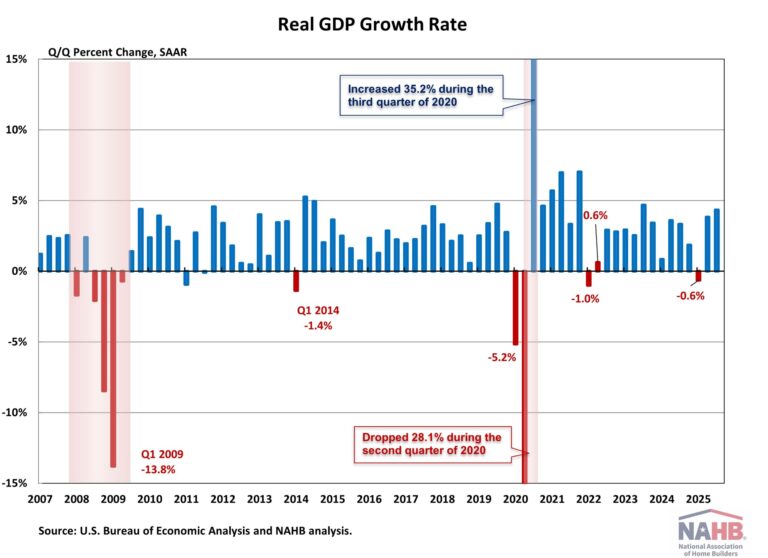
A belated GDP report shows that the U.S. economy expanded at a strong pace in the third quarter–July through September–before signs of cooling appeared in the labor market and consumer confidence weakened.

According to the “advance” estimate released by the Bureau of Economic Analysis (BEA), real gross domestic product (GDP) expanded at an annual rate of 4.3% in the third quarter of 2025, accelerating from a 3.5% increase in the second quarter. This marks the strongest pace of annual economic growth in the past two years. This growth rate was above the NAHB forecast for the quarter as well.

Furthermore, the latest data from the GDP report indicates that inflationary pressures intensified over the quarter. The GDP price index rose 3.8% for the third quarter, up from a 2.1% increase in the second quarter of 2025. The Personal Consumption Expenditures Price (PCE) Index, which measures inflation (or deflation) across various consumer expenses and reflects changes in consumer behavior, increased 2.8% during the quarter. This is higher than a 2.1% rise in the previous quarter.

This quarter’s increase in real GDP primarily reflected stronger consumer spending, exports, and government spending, which were partially offset by a decrease in investment. Imports, which are a subtraction in the calculation of GDP, decreased during the quarter as tariffs had measurable effects.

Consumer spending, the backbone of the U.S. economy, rose at an annual rate of 3.5% in the third quarter, its strongest rate since the fourth quarter of 2024. Both goods and services contributed to the gain, with spending on goods rising at a 3.1% annual rate and spending on services increasing 3.7%.

Government spending also added to economic growth, reflecting increases in both state and local government spending (led by higher consumption expenditures) as well as increased federal government spending, driven by defense consumption expenditures. 

Nonresidential fixed investment increased 2.8% in the third quarter. The increases in equipment (+5.4%) and intellectual property products (+5.4%) offset the decrease in structures (-6.3%). Meanwhile, residential fixed investment (RFI) continued to contract, declining 5.1% for the second consecutive quarter. Within the residential category, single-family structures fell 8.9% at an annual rate, multifamily structures declined 2.9%, and spending on home improvements dropped 7.6%.

For the common BEA terms and definitions, please access bea.gov/Help/Glossary.


This article was originally published by a eyeonhousing.org . Read the Original article here. .


This article is presented by Steadily.

If you’re like most landlords, you probably assume that once you pick a policy and pay your premium, you’re covered. Simple, right? 

Unfortunately, that assumption is exactly how landlords end up blindsided by denied claims, unexpected exclusions, and thousands of dollars in out-of-pocket losses.

Your landlord insurance policy is one of the most important business contracts you’ll ever sign. It determines what’s protected, what isn’t, and how much financial risk you’re actually carrying—long before anything ever goes wrong. 

But these forms are long, technical, and packed with fine print that’s easy to skim past when you’re trying to close on a property or onboard a new rental. According to the insurance experts over at Steadily, many of the most painful surprises come from misunderstandings that could have been caught before signing. 

Think about the most common losses landlords experience: water damage, liability claims, aging roofs, tenant-caused damage, and weather events. Many of these issues are coveredbut many others are covered only under certain conditions, or not covered at all. The difference comes down to understanding what’s in your policy before you commit.

Let’s walk through the eight things every landlord should check before signing a policy, so you can avoid costly gaps, spot red flags early, and make smarter decisions for your portfolio.

While every insurer structures things a bit differently, investor-focused providers like Steadily make this process much easier by using clear, landlord-specific language and coverage options built for real-world rental risks.

1. Understand What’s Actually in Your Policy

The first thing you need to understand before signing your policy is what’s actually inside it. This sounds obvious, but most landlords never read past the declarations page, and that’s where costly mistakes begin.

Steadily’s general guidance is that there are seven core components you’ll see in nearly every insurance contract. Knowing how to read each one gives you a massive advantage when comparing quotes or evaluating exclusions.

Declarations page

This is the snapshot of your policy. It lists:

  • The property address
  • Named insureds (who’s covered)
  • Policy period
  • Coverage limits
  • Deductibles
  • Key endorsements

Most landlords stop reading here, but this page only tells you what you think you have, not what you truly have.

Insuring agreement

Think of this as the “promise” section. It outlines:

  • What the insurer agrees to cover
  • Under what circumstances they’ll pay
  • The basic framework for how your protection works

If the declarations page is the summary, the insuring agreement is the foundation.

Definitions

Insurance policies use industry-specific language, and the definitions page is where those terms are spelled out. This matters because:

  • A single definition can change the outcome of a claim.
  • Terms like “water damage,” “residence premises,” or “vandalism” may not mean what you assume.

These definitions matter, and you need to make sure your definition aligns with those in the contract.

Coverages

This section specifies exactly what losses are covered and under what limits. It’s where you’ll find:

  • Dwelling coverage
  • Other structures
  • Loss of rent
  • Personal property (if applicable)

It’s important to read this section carefully so you understand the true scope of your protection.

Exclusions

This is where insurers outline what is not covered. Common exclusions include:

  • Floods
  • Earthquakes
  • Neglect
  • Wear and tear
  • Sewer backup (unless endorsed)

Many landlords are shocked when something they assumed was covered appears here, making it essential to read before signing.

Conditions

Conditions are the rules you must follow for coverage to apply. Examples include:

  • Maintenance requirements
  • Timelines for reporting claims
  • Steps you must take after a loss

Missing a condition, even accidentally, can jeopardize a payout.

Endorsements

Endorsements modify the policy. They can:

  • Add coverage
  • Limit coverage
  • Clarify terms

For landlords, endorsements are often where essential protections live, such as:

  • Ordinance or law coverage
  • Sewer backup protection
  • Short-term rental endorsements

Before you sign anything, go through these seven sections with a fine-tooth comb. This is where the most important coverage details and the biggest potential pitfalls live.

2. Confirm Whether You Have Named Peril or Open Peril Coverage

One of the quickest ways to misunderstand your insurance protection and end up with an unexpected denial is not knowing whether your policy uses named peril or open peril coverage. The difference is simple, but the financial impact can be huge.

Steadily’s policy guide highlights this as one of the first questions landlords should ask, because everything else in your policy flows from this choice.

Named peril coverage: Only what’s listed is covered

A named peril policy protects you only against the specific events listed in the contract. If it’s not named, it’s not covered, period.

There are two types:

1. Basic named perils covers a limited set of events, such as:

  • Fire
  • Lightning
  • Windstorms or hail
  • Explosions
  • Smoke
  • Vandalism
  • Riots
  • Damage from vehicles or aircraft
  • Sinkhole collapse
  • Sprinkler leakage
  • Volcanic activity

2. Broad named perils include everything in the basic list, plus additional protections like:

  • Burglary
  • Falling objects
  • Ice or snow weight
  • Frozen plumbing
  • Accidental water discharge
  • Electrical issues

Named peril policies can work well, but only if you fully understand which events are included and which aren’t.

Open peril coverage: Everything is covered unless excluded

An open peril policy flips the script. Instead of listing what is covered, it lists what isn’t. If the cause of loss is not specifically excluded, it’s covered.

This typically provides:

  • Broader protection
  • Fewer gray areas during claims
  • Greater peace of mind for landlords

But open peril policies are also more expensive, and not all exclusions are obvious at first glance.

Why this choice matters for landlords

Knowing whether you have named or open peril coverage affects:

  • How you evaluate risk
  • What supplemental endorsements you may need
  • How claims are handled
  • Whether certain losses will be denied outright

For example, a basic named-peril policy might deny a claim for ice dam damage, while an open-peril policy might cover the same event unless ice dams are explicitly excluded.

Before signing your policy, read the definitions and coverages pages carefully. Notice whether the perils are listed individually or not

Check your exclusion. Even open-peril policies can have exclusions you wouldn’t expect. Ask your insurer or broker directly about what type of peril is listed. 

And compare your options. Open peril often delivers better long-term value for landlords, but don’t just assume this is the best decision without thoroughly reviewing the policy.

3. Verify Replacement Cost Value vs. Actual Cash Value

Now that you know what your policy covers, it’s time to understand how your insurer will calculate what they owe you after a loss. This is where many landlords get blindsided, because two policies with the same coverage limits can produce very different payouts depending on whether they use Replacement Cost Value (RCV) or Actual Cash Value (ACV).

Steadily’s guide emphasizes this distinction as one of the most important details to check before signing.

Let’s break it down in landlord-friendly terms.

Replacement Cost Value (RCV): The higher, safer payout

With RCV coverage, your insurer pays what it costs to replace or repair the damaged item with a new one of similar kind and quality, without deducting for depreciation. In other words, if your 15-year-old roof is destroyed in a storm, the insurer covers the cost of a new roof, not the depreciated value of the old one.

RCV benefits:

  • Larger payouts
  • Better long-term protection
  • Fewer surprises during claims

Actual Cash Value (ACV): Depreciation hits your wallet

With ACV, the insurer subtracts depreciation from the payout. Using the same roof example: If the roof originally cost $12,000 and depreciation brings its value down to $4,000, then $4,000 is what you get, even if replacement costs $12,000+ today.

ACV benefits:

  • Cheaper premiums
  • However, significantly lower claim payouts

Why this matters so much for landlords

Landlords deal with:

  • Wear and tear
  • Aging systems
  • Tenant-caused damage
  • Weather exposure

That means most items in a rental property have already depreciated. If your policy uses ACV, a major claim could cost you tens of thousands out of pocket.

Even worse, ACV may apply differently to your dwelling versus your personal property, so confirm how each section of your policy is handled

Questions to ask before signing

  • Is my dwelling covered at RCV or ACV?
  • What about other structures?
  • Is personal property covered at RCV or ACV?
  • Are there age-related stipulations (for roofs, HVAC, plumbing, etc.)?

The smart move

If your budget allows it, choosing RCV for both dwelling and personal property coverage typically provides the strongest protection for landlords, especially during catastrophic losses.

4. Understand What Kind of Water Damage Your Policy Covers

Water damage is one of the most common, and most expensive, insurance claims landlords face. Not all water damage is treated the same, and what you consider water damage may not match what your insurer considers water damage.

Steadily’s policy guide highlights just how nuanced this category is and why landlords must understand the distinctions before signing a policy. 

What’s typically covered

Most landlord insurance policies cover sudden and accidental water damage, such as:

  • Water damage after a fire: If the fire department or sprinklers drench your property, resulting water damage is generally covered.
  • Accidental appliance or plumbing leaks: This includes leaks from dishwashers, washing machines, refrigerators, and faulty plumbing.
  • Burst pipes: Especially those caused by freezing weather, as long as you maintained adequate heat and weren’t negligent.
  • Roof leaks from storm damage: If a storm tears off shingles or a fallen tree causes a breach, interior water damage is usually covered.
  • Ice dams: This is when ice builds up on the roof and forces water inside. But, similar to burst pipes, claims may be denied if poor maintenance contributed.

What’s usually not covered

  • Flooding: Standard landlord insurance almost never covers flood damage, including rising groundwater, storm surges, river overflow, and heavy rain accumulation. If your property is in a flood-prone area, you’ll need separate flood insurance.
  • Sewer or drain backup: Unless you’ve added an endorsement, backup from drains, toilets, or sump pumps is typically excluded.
  • Appliance replacement: If your washer leaks, the water damage is covered, but the washer itself usually isn’t.
  • Neglect-related damage: Slow leaks, ignored repairs, or deferred maintenance often lead to claim denials.
  • Earthquake-related water damage: If an earthquake causes a pipe to break and flood a room, the water damage is excluded unless you carry earthquake coverage.

Why water damage is such a high-risk blind spot

Water damage can lead to mold growth, structural damage, tenant displacement, loss of rental income, and major out-of-pocket expenses. Lots of water-related scenarios fall into a gray area of coverage, so landlords should read this section with extreme care. You can ask these questions before signing:

  • What types of water damage are explicitly covered?
  • Is sewer or drain backup included or available as an endorsement?
  • Are there maintenance conditions tied to water-related claims?
  • Do I need separate flood or earthquake coverage?
  • How does the policy define “neglect” or “seepage”?

Understanding these distinctions could be the difference between a fully paid claim and a five-figure personal expense.

5. Check How Your Policy Handles Roof Coverage

Roof coverage is one of the most misunderstood parts of a landlord insurance policy, and one of the most common sources of claim disputes. Roofs age, storms hit, shingles wear down, and insurers treat all these situations differently depending on the carrier and the state.

Steadily’s guide notes that many insurers reduce roof coverage once the roof reaches a certain age, switching from Replacement Cost Value (RCV) to Actual Cash Value (ACV). This means a much smaller payout if your roof is damaged. 

Here’s what landlords need to watch for before signing.

Age-based roof restrictions

Some insurers automatically downgrade older roofs to ACV once they pass an age threshold, often 10, 15, or 20 years. That means you get reimbursed for the roof’s depreciated value, not the cost to replace it. In states with severe weather risks, this downgrade is even more common.

Location matters

Certain states impose stricter rules on roof coverage due to climate risks. For example, Steadily’s guide highlights that Texas insurers are particularly strict about older roofs because of the state’s frequent hailstorms and intense thunderstorms. That means a roof that qualifies for RCV in one state may only qualify for ACV in another.

Cosmetic damage is often excluded

Even if hail or wind damages your shingles cosmetically, many insurers exclude minor denting, surface impacts, and aesthetic-only damage. If the roof still functions, it may not be covered.

Your roof is a first line of defense against water intrusion, mold, structural damage, tenant complaints, and habitability issues. If a storm compromises the roof, you could face multiple layers of costly problems. 


To protect yourself ahead of time, you can ask these questions before signing your policy:

  • Is my roof covered at RCV or ACV?
  • Does the policy change coverage at a specific roof age?
  • What documentation is required to prove roof condition?
  • Are cosmetic damages excluded?
  • Is there a separate wind or hail deductible?

Getting clear answers now can save you from a painful surprise when a storm hits.

6. Clarify Liability & Defense Cost Limits

Liability coverage is a critical part of your landlord insurance policy. It’s also one of the least understood. Many landlords assume that if they’re sued, their policy will handle everything. Unfortunately, that’s not how liability protection always works.

Steadily highlights a key distinction that can dramatically change your financial exposure: whether your defense costs are inside or outside the liability limit.

Liability coverage: What it actually protects

Liability coverage is designed to protect you if:

  • A tenant or guest is injured on your property.
  • Someone sues you for negligence.
  • You’re pulled into a legal dispute over conditions at the property.

This coverage typically pays for medical bills, legal defense, and settlements or judgments. The payout structure varies, depending on how your policy treats defense costs.

If defense costs are inside the limit, your legal expenses count toward your total liability limit. For example, let’s say you carry $300,000 of liability coverage. If your legal defense costs $85,000, your remaining coverage for the settlement is now $215,000. This can leave landlords dangerously exposed, especially with today’s legal costs.

If defense costs are outside the liability limit, legal fees do not reduce your coverage, and you retain the full liability limit for settlements. This is the preferred structure for landlords. This provides a more predictable, comprehensive protection.


Why this matters for landlords

Legal defense costs can escalate quickly due to tenant injuries, habitability claims, premises liability lawsuits, and disputes surrounding mold, water intrusion, or structural issues. If these costs erode your liability limit, you could be responsible for paying substantial amounts out of pocket.

Here are some questions to ask before signing your policy:

  • Are defense costs inside or outside my liability limit?
  • What is my base liability limit?
  • Are there sublimits for specific types of liability claims?
  • Are medical payments included separately?
  • Does the policy offer higher liability options (e.g., $500,000, $1 million)?

Defense cost structure can completely change how protected you are during a lawsuit. It’s one of the most important details landlords should confirm before committing to a policy.

7. Look for Location-Specific Exclusions

Even the strongest landlord insurance policy has limits, and many of those are directly tied to where your rental property is located. Geographic risk is one of the biggest factors insurers evaluate, and depending on your region, certain hazards may be excluded from standard coverage.

This is one of the most common blind spots for landlords, because exclusions aren’t always obvious until a claim is filed.

Flood exclusions (almost always excluded)

Standard landlord insurance does not cover flood damage. This includes flooding caused by storm surges, heavy rainfall, overflowing rivers or lakes, and rising groundwater. If your property sits in or near a FEMA flood zone, you’ll need a separate flood insurance policy, either through the NFIP or private flood carriers.

Earthquake exclusions

Earthquake damage is also typically excluded, unless you purchase an endorsement or a stand-alone policy. This matters even if you’re not in California. States like Utah, Washington, Oregon, Oklahoma, and South Carolina all experience seismic activity that can cause structural damage, cracked foundations, and, importantly, water damage from burst pipes. Without earthquake coverage, those losses are not covered.

Named storm or wind/hail restrictions

Certain states have special deductibles or exclusions for hurricanes, windstorms, and hail damage. For example, Gulf Coast and Atlantic states often have named storm deductibles, while Midwest states may have separate wind/hail deductibles due to severe storms. These deductibles can be based on a flat dollar amount, or a percentage of the property’s insured value (often 1% to 5%). 

Wildfire exclusions or underwriting restrictions

In high-risk areas—especially parts of California, Colorado, Arizona, and the Pacific Northwest—some insurers exclude wildfire, require defensible space inspections, or offer limited or restricted coverage. If you invest in these states, wildfire-related underwriting deserves special attention.

Why these exclusions matter

Location-specific exclusions can dramatically change your risk exposure. A policy that looks affordable at first glance may leave you unprotected against the very hazards most common in your region. 


Here are some questions you can ask before signing your policy:

  • Are floods excluded? If so, do I need separate coverage?
  • Are earthquakes excluded? Is an endorsement available?
  • Are there special deductibles for wind, hail, or named storms?
  • Are wildfires covered or restricted?
  • Are any geographic limitations mentioned in the exclusions or conditions section?

8. Bonus Checks Landlords Often Miss

Even if you’ve reviewed the big-ticket items like perils, water damage, roof coverage, and liability limits, there are still several smaller—but equally important—details buried in your policy that can make or break a future claim. These are the kinds of conditions most landlords overlook until it’s too late.

Vacancy clauses

Most landlord policies change coverage the moment your property becomes vacant. Common restrictions include:

  • Reduced protection after 30 or 60 days of vacancy
  • Exclusions for vandalism, theft, or water damage
  • Special inspections or maintenance requirements
  •  

If you invest in value-add properties or have extended turnover periods, vacancy rules matter.

Tenant-caused damage limitations

Many landlords assume that if a tenant causes damage, insurance will cover it. This is not always the case. Some policies exclude:

  • Tenant negligence
  • Intentional damage
  • Pet-related damage
  • Smoke damage from careless behavior

Review this section closely, especially if you allow pets or rent to higher-turnover tenants.

Maintenance obligations

Insurance policies often include conditions requiring you to:

  • Keep heat on during freezing weather
  • Maintain plumbing and HVAC systems
  • Monitor and repair roof leaks
  • Manage mold proactively

Failure to meet these obligations can void a claim, even if the damage would otherwise be covered.

Loss of rents coverage details

If a covered loss makes your rental uninhabitable, loss of rent coverage replaces your income. But pay attention to:

  • Time limits (often capped at 12 months)
  • Payout caps
  • Exclusions tied to specific hazards

This coverage is crucial for protecting cash flow, especially during lengthy repairs.

Policy sublimits

Even if your main coverage is strong, sublimits can quietly restrict certain types of claims. Common sublimits include:

  • Mold remediation
  • Debris removal
  • Tree damage
  • Ordinance or law upgrades
  • Theft of landlord-owned property

These can drastically reduce payouts if you don’t expect them.

Required documentation processes

Before signing, understand what documentation your insurer requires during a claim, including:

  • Photos or videos of damage
  • Receipts for repairs
  • Proof of maintenance history
  • Tenant communication logs

Policies often specify these requirements in the “Conditions” section.

These smaller details might not seem urgent during onboarding, but they can become major problems in a crisis. Completing these bonus checks ensures your policy performs exactly how you expect when it matters most.

Why Having an Investor?Focused Insurer Matters

By now, you’ve seen just how many moving parts go into a landlord insurance policy. From exclusions to roof age restrictions to water damage nuances, there’s a lot for investors to keep track of. And the truth is, most landlords don’t have the time nor desire to become insurance experts.

That’s why working with an insurer built specifically for real estate investors can make all the difference. 

Steadily specializes in landlord?first coverage, meaning they design every policy, workflow, and support system around the realities you deal with every day. Here’s what that means for you.

Clear, transparent policies (no hidden surprises)

Steadily’s focus on rental properties means their policies are built for the exact scenarios covered here. Instead of ambiguous terms buried in dense documents, they use clear language and investor?friendly structures so you understand what is and isn’t covered, why certain exclusions exist, and how to avoid preventable claim issues. It’s insurance written for landlords, not repurposed for them.

Fast, digital?first quotes when you’re under contract

If you invest regularly, you already know that insurance can be one of the most painful bottlenecks when closing. Calls, back?and?forth emails, and slow approvals can all waste time. When you’re trying to hit a contract deadline or bind coverage for a new rental, speed matters.

Steadily removes that friction by giving landlords instant online quotes, rapid underwriting turnarounds, and a modern dashboard for managing all your properties. 

Coverage designed for real?world landlord risks

Because Steadily works exclusively with landlords, their policies automatically account for:

  • Vacancy?related exposures
  • Short?term rental needs
  • Tenant?caused damage
  • Loss of rent
  • Liability concerns specific to rental properties

You don’t have to piece together coverage or guess which endorsements you need. Steadily helps you get it right from the start.

Support from people who understand rentals

Whether you’re dealing with a claim, asking about coverage, or insuring a full portfolio, Steadily’s team understands landlord concerns like habitability rules, state?specific risks, renovations and value?add projects, and cash flow protection needs. That context matters when you need fast, accurate answers.

With so many complex details hidden in a landlord insurance policy, partnering with an insurer that specializes in rental properties makes your life dramatically easier. Steadily helps eliminate blind spots, reduce risk, and protect your cash flow with confidence.

Get a quote in minutes

Steadily’s digital-first process lets you:

  • Compare landlord-ready coverage options quickly
  • Avoid confusing paperwork and endless back-and-forth emails
  • Bind a policy fast when you’re under contract

Whether you own a single rental or a growing portfolio, the right coverage is your safety net.

Protect your investments with confidence. Get a fast, landlord-specific quote from Steadily today.

The best time to close your coverage gaps is before something goes wrong. Steadily helps you do exactly that.




Source link


This article is presented by WDSuite.

For new and experienced multifamily investors alike, choosing the right market is often the most important decision you’ll make. You can buy a beautifully renovated apartment building, secure great financing, and even underwrite the deal conservatively. But if the neighborhood lacks stability, demand, or the right tenant base, your investment will struggle.

What separates the pros from everyone else is knowing how to assess a market beyond surface-level trends. Rent growth and job numbers matter, but they don’t tell the full story. That’s especially true in multifamily investing, where you’re dealing with dozens of tenants, longer hold periods, and more exposure to economic shifts in the surrounding area.

If your 2026 goal is to buy smarter and scale with less risk, the first step is learning how to evaluate a market the right way—not just with your gut, but with data that tells you what’s really going on in the neighborhood.

1. Median Credit Score

One of the strongest signals of a stable rental market is the median credit score of residents. A higher median credit score often points to a more financially responsible tenant pool, fewer payment issues, and reduced turnover. For multifamily investors, this can mean more predictable rent rolls and fewer evictions.

Strong market

The median credit score here is above 675, indicating higher financial responsibility and lower default risk

In neighborhoods with higher credit scores, residents tend to have stronger financial habits, which translates into consistent rent payments and less wear and tear on units. These markets also tend to attract more stable employers, better school systems, and lower crime rates—all of which support long-term property value and resident retention.

Weak market

This is indicated by a median credit score below 600, especially when combined with other risk indicators like high vacancy or stagnant income growth

A significantly low median credit score may be a red flag. It can indicate economic distress, frequent job instability, or an area where rent collection could become more hands-on. That doesn’t mean the deal is bad, but it does mean your property management approach may need to shift, and risk mitigation becomes even more important.

How to use WDSuite to analyze median credit score

With WDSuite, multifamily investors can view the median credit score by neighborhood directly from their personalized dashboard. The data drills down to specific properties and submarkets, giving you a far more nuanced view than looking at citywide data. You can compare the credit score of a target asset’s area to local, state, and national benchmarks, helping you assess the risk profile at a glance.

By monitoring this data over time, you can also detect trends that point to a neighborhood improving or declining. These insights are crucial when planning long-term holds or value-add projects.

2. Safety Score

Multifamily properties are community-based by nature. Unlike single-family rentals, where tenants may tolerate less-than-ideal neighborhoods because they’re more isolated, multifamily tenants rely on shared spaces. Parking lots, hallways, laundry rooms, and playgrounds are common areas that mean the perceived safety of a neighborhood plays a much bigger role.

For multifamily investors, safety is not only a tenant concern but a performance metric as well. A property’s location directly influences occupancy rates, tenant turnover, and the type of renters your property attracts. If a tenant doesn’t feel safe, they will either leave early or never sign a lease at all. In contrast, a well-rated area often commands stronger rents, longer tenancies, and fewer maintenance headaches caused by frequent move-outs.

Tenants today are doing their own research before signing leases. If your property is located in a ZIP code with known safety issues, it will show up in their online searches, which can cost you potential renters. As an owner or operator, understanding and proactively addressing safety-related concerns can prevent cash flow interruptions before they begin.

How WDSuite helps you evaluate safety before you buy

WDSuite provides a Safety Score directly within its property and neighborhood dashboards. This metric pulls in crime data and aggregates it into a clear rating, helping investors evaluate potential acquisitions or compare submarkets side by side. Rather than manually digging through local police blotters, county crime maps, or outdated blog posts, you get a real-time snapshot that helps you answer questions like:

  • Is this neighborhood on the rise or decline in terms of public safety?
  • Will this score impact my ability to lease up quickly?
  • Should I budget for additional security features like lighting, cameras, or fencing?

If you’re scaling a portfolio across multiple cities, WDSuite’s Safety Score helps you create a repeatable underwriting system by identifying the areas worth your time and money without relying on gut instinct or word of mouth.

Start adding Safety Score as a standard column in your property analysis spreadsheet. When evaluating deals with brokers or partners, be ready to justify why you’re passing on certain ZIP codes, and back it up with WDSuite’s data. Over time, you’ll build an acquisition strategy rooted in risk-adjusted returns, not just surface-level cap rates.

3. Neighborhood Rating

Unlike single-family rentals, multifamily properties typically attract a broader tenant base and serve as microcommunities within a larger ecosystem. The quality of the surrounding neighborhood plays a significant role in tenant decision-making, lease renewals, and long-term satisfaction. 


That’s where Neighborhood Rating becomes an essential tool. This metric represents a composite score that reflects the overall desirability of a specific area, factoring in elements like crime, schools, amenities, walkability, and more.

A strong neighborhood rating typically signals:

  • Lower turnover because tenants are happier where they live.
  • Higher rent growth potential as demand increases in desirable areas.
  • Reduced marketing time, since renters are actively looking in those ZIP codes.

On the other hand, a weak neighborhood score can mean stagnant rents, increased vacancy, or lower-quality tenant leads. Even if a building itself is well-maintained, the surrounding environment can either reinforce or undermine its performance.

How WDSuite helps you evaluate neighborhood health

Rather than relying on hearsay or outdated anecdotes from agents or forums, WDSuite’s Neighborhood Rating platform aggregates various data sources into a single, easy-to-compare rating. With this feature, you can:

  • Compare neighborhoods across different cities or submarkets.
  • Spot trends in gentrification or decline based on historical shifts.
  • Identify hidden gems: neighborhoods on the upswing that haven’t yet priced out.

If you’re evaluating Class B or C properties for value-add plays, WDSuite’s neighborhood insights help you balance risk with opportunity. For example, you might choose a C+ building in a B- neighborhood with rising momentum rather than investing in a cheaper asset in a declining ZIP code.

What makes a market strong vs. weak?

  • Strong markets often show high neighborhood ratings, combined with solid school systems, retail access, and declining crime. They’re likely to attract renters with stable incomes who are looking for more than just affordability.
  • Weaker markets tend to have lower ratings due to poor infrastructure, limited amenities, or high turnover, even if prices are lower upfront.

When underwriting a deal, pair the Neighborhood Rating with other core metrics like rent growth, population trends, and safety score. This holistic view lets you identify not just whether a deal pencils out today, but whether it aligns with long-term demand and tenant satisfaction.

4. National Percentile

In multifamily investing, context is everything. You might find a neighborhood that looks promising on the surface, but without understanding how it compares to others nationally, it’s easy to misjudge its true potential. 


That’s where the National Percentile metric comes in, offering a clear benchmark of how a given location performs relative to markets across the country. WDSuite calculates a National Percentile Score for each neighborhood or area, based on a combination of key metrics like credit score, neighborhood quality, and safety. A percentile score ranks the area from 1 to 100, meaning if a neighborhood scores in the 85th percentile, it outperforms 85% of other neighborhoods nationwide.

For multifamily investors evaluating new acquisitions or managing a growing portfolio, this percentile insight adds powerful context:

  • A high national percentile indicates a strong, competitive market with solid fundamentals.
  • A low national percentile may mean the area is underperforming, unstable, or higher-risk.

Percentile metrics help you gut-check your assumptions. For example, a market with low rents might seem attractive for cash flow, but if it falls in the bottom 20% of national rankings, it might signal tenant instability, low credit scores, or future turnover risks.

How to use WDSuite’s National Percentile Score in your underwriting

WDSuite simplifies the market comparison process by giving each area a consolidated percentile score that combines various performance indicators into one digestible number. This score is displayed directly on the dashboard, alongside other insights like safety and credit profile. You can use the percentile score to:

  • Quickly vet markets without needing to stitch together multiple data sources.
  • Compare submarkets across different cities when deciding where to expand.
  • Justify decisions to lenders, partners, or LPs with third-party benchmarking.
  • Spot appreciation potential in neighborhoods moving up the percentile ladder.

For syndicators or operators scaling across several metros, this is a key tool for staying objective.

Strong vs. weak multifamily markets

  • Strong markets often rank in the top 30% or higher. These tend to be stable, sought-after areas with strong tenant demand, consistent occupancy, and room for rent growth. Even if cap rates are tighter, these areas usually perform well long-term.
  • Weaker markets tend to rank below the 50th percentile, often signaling economic decline, tenant instability, or structural risk. While they may offer higher cash flow on paper, they often come with increased management headaches and lower equity upside.

Use the National Percentile Score alongside your boots-on-the-ground research to confirm you’re investing in a market that aligns with your strategy, whether you’re looking for safety and stability or you’re comfortable taking on more risk for higher yield.

As you evaluate new markets, underwrite multifamily deals, and manage your portfolio going into 2026, having real-time, hyperlocal data is essential.

These four key metrics—Median Credit Score, Safety Score, Neighborhood Rating, and National Percentile—each offer a unique lens into the health and potential of a submarket. But trying to manually source and analyze this data from dozens of tools or public records is time-consuming and error-prone.

Where WDSuite Comes In

WDSuite pulls all these metrics into a single, easy-to-read dashboard so you can make better decisions faster. Whether you’re screening neighborhoods before acquisition or tracking asset performance as part of your quarterly review process, WDSuite simplifies your workflow.

With the dashboard, you can:

  • Vet markets before sending your LOI.
  • Identify high-credit, high-demand submarkets.
  • Spot emerging trends across metros and ZIP codes
  • Benchmark performance across your entire portfolio.

Instead of relying on gut instinct or outdated census data, you get real-time insights that help you stay competitive, reduce risk, and allocate capital more confidently. 

If you’re planning to scale your multifamily business in 2026, start by leveling up your data and your decisions with WDSuite.


Source link


This article is presented by Steadily.

When most real estate investors analyze a potential rental property, they start with the obvious metrics, including rent comps, neighborhood ratings, and a quick scan of recent sales. While these high-level numbers matter, they don’t tell the full story of whether your specific property will stay occupied, command strong rents, and attract the kind of tenants who will take care of the place.

Micro-market due diligence is essential for any investor to be successful and create the full picture for their portfolio’s performance. It’s the layer of detail that separates a good deal on paper from a great deal in real life.

1. Start by Zooming In, Not Out 

Within the same ZIP code, one street can outperform the next by a mile. Sub-neighborhood pockets often have very different renter demographics, turnover rates, and even levels of demand you won’t see in a broad comp report. You’re researching who actually lives here, how long they stay, and what the immediate environment signals about future demand.

Beyond that, dive into patterns that seasonality masks. Some areas spike in vacancy during winter. Others see tenant turnover every summer due to school schedules or local employers’ hiring cycles. If you only look at the month you’re under contract, you might completely misread the true demand story.

Then there’s the tenant profile. A market heavily populated by students, short-term contractors, or hospitality workers behaves very differently from one anchored by long-term families or medical professionals. Understanding who rents in your micro-market is often more predictive of your future cash flow than the rent comps alone.

Finally, validate demand with actual operators on the ground. Local property managers can tell you which listings get the most inquiries, features tenants ask about, and which rent ranges are softening. This qualitative intel is just as important as the hard numbers.

When you map out these micro-market dynamics early, before inspections, financing, and negotiating concessions, you’re buying into the demand ecosystem that will determine your long-term revenue. Missing that layer is one of the fastest ways investors misjudge a deal.

2. Evaluate Physical Systems and Future Capital Expenditure Exposure

Even when a property looks clean, updated, and turnkey on the surface, the biggest financial hits almost always come from the parts of the house you can’t see. Roofs, foundations, plumbing, electrical systems, and HVAC units don’t show up in listing photos, but can wipe out a year of cash flow in a single repair.

That’s why a true due diligence process digs far deeper than the standard inspection report. You’re not just confirming the condition of the property. Rather, you’re forecasting timelines, when each major component will need repair or replacement, and what that means for your long-term returns.

Start with big-ticket items like the roof, HVAC, plumbing type, and electrical panel. Each has a predictable lifespan and carries a price tag large enough to reshape your pro forma. A 22-year-old roof may still pass inspection, but if it’s at the end of its useful life, you need to account for that future expense now—not in three years, when a leak forces an emergency replacement.

Foundation issues can be equally costly. Hairline cracks aren’t always a problem, but shifting, moisture intrusion, or stair-step cracking can signal structural issues. Ignoring them during due diligence is one of the fastest ways to inherit a six-figure problem.

Plumbing deserves special attention too. Galvanized steel, cast iron, and polybutylene all carry risk, and insurance carriers are increasingly wary of them. A property with outdated plumbing might still be a great deal, but only if you know what you’re getting into.

And don’t forget HVAC. A unit that’s “working fine” today might be running on borrowed time if it’s 18 years old. You should know the age, service history, and expected remaining lifespan of every system before closing.

Your goal in this stage of due diligence isn’t to avoid every older component, but budget for reality. When you forecast capital expenditures accurately, before you make an offer, you protect your cash flow, strengthen your negotiation leverage, and ensure you’re buying a property with eyes wide open.

Remember, if you upgrade these non-structural elements of your home, they may qualify for bonus depreciation and the value of the upgrades can be written off on a yearly tax return.

3. Analyze Operational Complexity and Management Fit

A rental can look fantastic on paper—great comps, solid neighborhood, clean inspection—and still be an operational headache that drains your time, energy, and returns. That’s because not all properties are created equal when it comes to daily management.

This part of due diligence is about understanding the true workload of the property. Investors often underestimate it, especially when they’re excited about a deal. Misjudging operational complexity is one of the fastest ways a passive investment turns into a second job.

Start with the layout and physical design. Odd floor plans, multiple entrances, triplexes carved out of old single-family homes, and properties with shared utilities invariably come with more tenant coordination and maintenance calls. These quirks aren’t necessarily deal-breakers, but they must be factored into management planning.

Next, look at the tenant profile the property naturally attracts. Student housing, short-term contractors, workforce renters, luxury tenants, and multigenerational households each have different expectations, turnover patterns, and communication needs. A mismatch between the property’s natural renter base and your management style (or your manager’s skill set) can create friction from day one.

Location adds another layer. Properties near nightlife, hospitals, colleges, or transit hubs tend to bring noisier environments, parking pressure, or frequent move-ins and move-outs. Meanwhile, homes in HOA communities can require more administrative oversight and strict compliance.

Then there’s the local regulatory landscape, noise ordinances, rental licensing, inspection schedules, parking requirements, and trash rules. These small but constant obligations can pile up quickly if you’re not prepared for them.

The goal of this due diligence step isn’t to eliminate those operational challenges. Instead, this due diligence allows you to choose a property where the management demands align with your lifestyle, experience level, and available support. 

When you understand how complex or simple a property will be to operate, you can make smarter decisions about whether to self-manage, hire a property manager, or walk away entirely. And those all translate to a dollar value and a time commitment.

4. Do Financial Stress Testing Under Real-World Conditions

You can truly make every rental deal work in a spreadsheet. A little tweak here and there can hide some very un-hideable metrics. 

It’s easy to plug in best-case assumptions, full occupancy, stable rents, modest repairs, and predictable taxes and convince yourself the numbers pencil perfectly. But real-world investing rarely plays out that cleanly. Due diligence helps you prepare for what will eventually happen with your investment property. 

That’s where financial stress testing comes in. Instead of relying on a single pro forma, smart investors evaluate a range of outcomes: conservative, moderate, and optimistic. This reveals whether the deal only works when everything goes right, or whether it can survive normal volatility.

Start by adjusting rents. What happens if your projected rent comes in 5% lower? Or if concessions become the norm in your micro-market? A deal that breaks at a small rent reduction is already signaling fragility.

Then test vacancy. Even in strong markets, turnover happens. Model the impact of longer leasing times, seasonal dips, or tenant quality shifts. A single extended vacancy can erase months of profit, so anticipate that now.

Expenses deserve the same scrutiny. Property taxes tend to rise faster than investors expect. Insurance premiums can jump, especially in certain states. Utilities fluctuate. And maintenance never stays flat. Build in higher-than-expected costs to see if the cash flow still holds.

Finally, factor in capital expenditures. Even if you’ve budgeted carefully in the previous due diligence step, stress-test what happens if a major system fails earlier than planned. A prematurely dead HVAC or roof leak can reshape annual returns.

The goal of this exercise is not to be pessimistic. But you want to reveal the deal’s durability so nothing is a surprise later. A strong investment should survive bumps, not collapse under the first unexpected bill.

5. Consider Insurance Underwriting Red Flags That Change the Numbers

This is the due diligence step almost everyone overlooks, and it’s one of the most expensive places to get blindsided. Even if the property passes inspection, cash flow looks strong, and the neighborhood feels perfect, the deal can still fall apart when you try to insure it.

Insurance underwriting works as a financial gatekeeper. If you don’t understand what underwriters look for before you go under contract, you risk discovering—far too late—that your projected numbers were never realistic to begin with.

Start with the big three underwriting triggers: roof age, electrical panels, and plumbing type. A 25-year-old roof, a Federal Pacific panel, or cast-iron plumbing can dramatically change your premium, or prevent a carrier from offering coverage at all. Your pro forma may assume a $1,200 premium, but the quote could come back at $3,800 once these risk factors surface.

Then, dig into prior claims. Even if you didn’t file them, the property’s history follows the address. Multiple water damage or fire claims or liability incidents can bump premiums, increase deductibles, or eliminate carrier options. In some markets, certain addresses land on restricted lists, forcing investors to use specialty carriers with higher pricing.

Geographic hazards matter too. Flood zones, hail belts, wildfire corridors, and wind-exposed regions all shape premiums. A property that looks like a cash-flow machine at first glance may fall apart once you price in real insurance costs.

What catches most investors off guard is that these underwriting red flags don’t show up in typical due diligence documents. Inspectors may not flag insurability issues, sellers rarely disclose them, and most investors don’t ask.

But ignoring insurance underwriting is how deals that look amazing online turn into underperforming headaches in real life. When you evaluate insurability early, you eliminate false positives, avoid hidden risks, and ensure the deal you think you’re buying is actually the deal you’re getting.

Partnering with an investor-focused insurance provider becomes a strategic advantage. Steadily was built specifically for landlords, so instead of waiting days for answers or sifting through confusing policy jargon, you get fast clarity. Their underwriting process is streamlined, their coverage options reflect real investor needs, and their quotes reveal exactly how insurability impacts your deal’s bottom line.

Final Thoughts

If you want real confidence before you commit, rooted in all five layers of due diligence, make insurance your final verification step. And if you want that verification without the friction, Steadily makes it simple.

Before you close on your next property, get a quick, investor-friendly quote from Steadily. It’s the fastest way to confirm whether the numbers truly work, and the smartest way to protect your portfolio from hidden risk.


Source link


When a property reaches the REO stage—Real Estate Owned—it signals the final step of the foreclosure cycle. The homeowner is out, the auction has been completed (often unsuccessfully), and the lender now holds title. 

For investors, the REO category can represent a unique opportunity: properties priced below market value, homes needing renovation, and inventory that banks often prefer to liquidate efficiently.

November’s REO data reveals a continued rise in completed foreclosures compared to last year, even as early-stage filings pulled back. That combination—fewer new filings, more completed cases—is a hallmark of a maturing foreclosure pipeline. It means the early distress we saw in spring and summer 2025 is now materializing into real, actionable inventory.

This month, the numbers also revealed fascinating regional and county-level differences. Some states saw REOs surge sharply, others cooled, and several counties experienced dramatic shifts in how quickly properties moved from auction to bank-owned status.

If you’re an investor looking to understand where real distressed inventory is emerging—and how to position your strategy—November’s REO story is essential reading.

National REO Activity Climbs Again

In November 2025, the U.S. recorded 3,884 REOs (bank-owned properties), down just 0.15% month over month, and up 25.74% year over year.

This slight monthly dip is negligible—REO activity remains substantially higher than one year ago. Nationwide, more properties are completing the foreclosure process and returning to lenders’ inventories.

Remember: REOs lag Starts and Notice of Sale by several months. So this year-over-year jump reflects the elevated Starts we tracked throughout 2025, especially in fast-moving states like Texas and judicial states like Florida and Ohio.

State-Level Breakdown: A Tale of Diverging Markets

Let’s take a look at the five core states driving national REO activity.

1. Florida

  • 311 REOs
  • +27.98% MoM
  • +132.09% YoY

Florida saw one of the most dramatic increases nationally. Even with a steep decline in new filings this month, the state’s backlog of distressed properties continues to clear.

2. California

  • 314 REOs
  • 6.55% MoM
  • -21.89% YoY

California bucked the national trend, posting both monthly and annual declines. This suggests that, while distress exists, cases here are dragging longer through the legal process.

3. Ohio

  • 130 REOs
  • +7.44% MoM
  • -11.56% YoY

Ohio’s REO activity is steady but slightly lower than last year. This reflects a more normalized cycle after elevated filings earlier in the year.

4. North Carolina

  • 122 REOs
  • -20.26% MoM
  • +40.23% YoY

North Carolina continues to be one of the nation’s fastest-moving foreclosure states. Even with a monthly dip, REOs remain far higher than in 2024.

5. Texas

  • 546 REOs
  • +52.51% MoM
  • +135.34% YoY

Texas delivered the biggest REO spike of any major state—both month over month and year over year. The state’s fast nonjudicial process continues to push properties from Start to auction to REO faster than any judicial state.

Why the REO Stage Matters for Investors

For investors, REOs offer a powerful mix of opportunities and advantages.

1. Banks become motivated sellers

When lenders take possession, maintaining the property becomes an expense, not an asset. They often want these properties sold efficiently and may price them below comparable retail listings.

2. Due diligence is easier than at auction

Unlike at a courthouse sale:

  • Investors can inspect the property.
  • They can order an appraisal.
  • Title issues can be addressed before closing.
  • Financing—including non-recourse loans inside a self-directed IRA—is possible.

This makes REOs an accessible entry point for new and experienced investors alike.

3. REOs reveal the end-point of market distress

As REO levels rise, it signals that:

  • More homeowners have exited their homes.
  • More auctions went unsold.
  • Lenders are about to release inventory to the public market.

This can create opportunity in both acquisition pricing and volume.

4. IRA and Solo 401(k) investors benefit from timing

Because REOs move slower than auctions, investors using tax-advantaged retirement accounts can:

  • Perform deeper due diligence.
  • Arrange non-recourse financing.
  • Structure long-term buy-and-hold strategies.

Compared to the fast pace of trustee sales, REOs fit comfortably within retirement account rules and timelines.

County-Level REO Insights: Where Distress Is Converting Fastest

Using Option C (only the most meaningful changes), here are the county-level standouts for November:

Florida: Gulf Coast and Central Florida lead REO growth

  • Lee County saw one of the largest MoM REO increases in the state.
  • Orange County (Orlando) also posted a meaningful rise, indicating steady conversion from earlier filings.
  • Miami-Dade and Broward stayed elevated, but moved more modestly this month.

Investor insight

Florida’s REO growth is real—and geographically diverse. Expect new inventory across both coasts heading into 2026.

California: Inland Empire slows, LA stabilizes

REO declines this month were driven by:

  • San Bernardino: One of the sharpest MoM pullbacks
  • Riverside: Slowing REO conversion despite persistent distress
  • Los Angeles: Stabilized, showing neither a surge nor collapse

Investor insight

California’s REOs are cooling, suggesting longer foreclosure timelines and fewer quick-turn opportunities.

Ohio: Columbus and Cincinnati shift

  • Franklin County (Columbus) posted a surprise increase—one of the few counties to rise this month.
  • Cuyahoga County (Cleveland) dropped, reflecting fewer auctions converting to REO.
  • Hamilton County (Cincinnati) remained steady.

Investor insight

Columbus continues to emerge as Ohio’s most dynamic foreclosure market.

North Carolina: Volatility across major metros

  • Mecklenburg County (Charlotte) saw a meaningful MoM REO decline.
  • Wake County (Raleigh) followed the same pattern.
  • Cumberland County (Fayetteville) experienced the steepest drop.

Investor insight

North Carolina is still growing YoY, but November marks a clear slowdown in REO conversion.

Texas: The biggest REO story in America

Texas delivered one of the most dramatic county-level stories of the month:

  • Harris County (Houston) saw REO volume surge sharply MoM.
  • Dallas and Tarrant Counties (DFW) also reported substantial increases.
  • Bexar County (San Antonio) posted a strong jump, consistent with its rising auction activity.

Investor insight

Texas continues to convert distress into REO at record speed—ideal for investors seeking bank-owned opportunities.

How Investors Can Use REO Data to Advance Their Strategy

1. Identify markets where inventory is increasing

Rising REOs often lead to:

  • More distressed listings.
  • Increased negotiation leverage.
  • Expanded buying opportunities.

2. Target counties where conversion is fastest

Counties with rapid Start > NOS > REO progression are ideal for:

3. Track lender behavior

Banks with growing REO portfolios may:

  • Price listings more aggressively.
  • Offer incentives.
  • Prioritize faster closings.

4. Use REOs to build a tax-advantaged portfolio

Inside a Self-Directed IRA or Solo 401(k), REO investing may offer:

  • Potential tax-deferred or tax-free rental income.
  • Long-term appreciation.
  • Structured loan strategies using non-recourse financing.

Take Control of Your Investment Strategy

REOs represent the end of the foreclosure cycle—but for investors, they can represent the beginning of opportunity. With clear inventory trends emerging across key states and counties, now is the time to study local patterns, evaluate property conditions, and be ready for new listings as they hit the market.

To learn how to invest in real estate using a Self-Directed IRA or Solo 401(k), visit: www.TrustETC.com/RealEstate

Equity Trust Company is a directed custodian and does not provide tax, legal, or investment advice. Any information communicated by Equity Trust is for educational purposes only, and should not be construed as tax, legal, or investment advice. Whenever making an investment decision, please consult with your tax attorney or financial professional.

BiggerPockets/PassivePockets is not affiliated in any way with Equity Trust Company or any of Equity’s family of companies. Opinions or ideas expressed by BiggerPockets/PassivePockets are not necessarily those of Equity Trust Company, nor do they reflect their views or endorsement. The information provided by Equity Trust Company is for educational purposes only. Equity Trust Company and their affiliates, representatives, and officers do not provide legal or tax advice. Investing involves risk, including possible loss of principal. Please consult your tax and legal advisors before making investment decisions. Equity Trust and BiggerPockets/PassivePockets may receive referral fees for any services performed as a result of being referred opportunities


Source link

Pin It